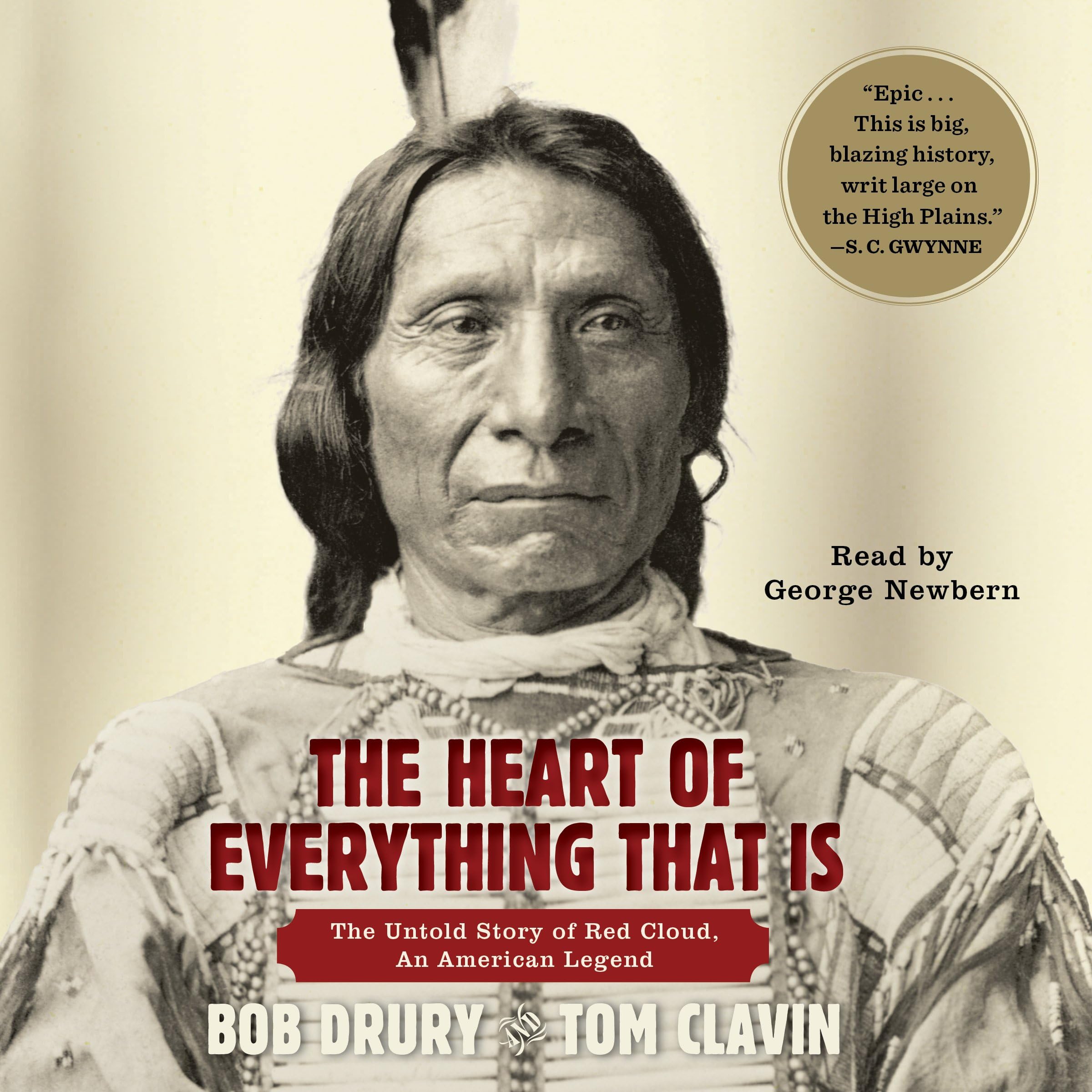
The Heart of Everything That Is: The Untold Story of Red Cloud, An American Legend
Description
This acclaimed New York Times bestselling biography of the legendary Sioux warrior Red Cloud, is “ a page-turner with remarkable immediacy…and the narrative sweep of a great Western” ( The Boston Globe ). Red Cloud was the only American Indian in history to defeat the United States Army in a war, forcing the government to sue for peace on his terms. At the peak of Red Cloud’s powers the Sioux could claim control of one-fifth of the contiguous United States and the loyalty of thousands of fierce fighters. But the fog of history has left Red Cloud strangely obscured. Now, thanks to the rediscovery of a lost autobiography, and painstaking research by two award-winning authors, the story of the nineteenth century’s most powerful and successful Indian warrior can finally be told. In this astonishing untold story of the American West, Bob Drury and Tom Clavin restore Red Cloud to his rightful place in American history in a sweeping and dramatic narrative based on years of primary research. As they trace the events leading to Red Cloud’s War, they provide intimate portraits of the many lives Red Cloud touched—mountain men such as Jim Bridger; US generals like William Tecumseh Sherman, who were charged with annihilating the Sioux; fearless explorers, such as the dashing John Bozeman; and the memorable warriors whom Red Cloud groomed, like the legendary Crazy Horse. And at the center of the story is Red Cloud, fighting for the very existence of the Indian way of life. “Unabashed, unbiased, and disturbingly honest, leaving no razor-sharp arrowhead unturned, no rifle trigger unpulled....a compelling and fiery narrative” ( USA TODAY ), this is the definitive chronicle of the conflict between an expanding white civilization and the Plains Indians who stood in its way.
Reviews
User
Well-balanced Narrative
I became interested in this book after reading "Bury My Heart at Wounded Knee" and I'm glad I read this one to further expand my perspective. First, the narrative of this book is nice to follow, gently laying out more and more of the story of Red Cloud as it unfolds, only deviating momentarily to introduce new characters, or give deeper context to something that is about to unfold.Also, the level of detail given about every character and event is definitely satisfying. It doesn't reach the same depth as DW Donald's "Lincoln", but it is more akin to Hillebrand's "Unbroken". At least for me, the are no big questions that are left unanswered with a decent amount of evidence. For further info on this, the reader can skip to the end and read "Notes and Bibliography" which discusses some of the imperfect sources, such as the Red Cloud autobiography, and how they came to light.Lastly, and probably most important, I found this book to be a very balanced take. It doesn't gloss over details on either side, but doesn't put conclusions in your face about how bad or good or heroic some person or thing was. The book leaves to you to decide those things, which I greatly appreciate. For example, none of the details of what the Sioux did to their prisoners or even their own women are left out, but they are presented in a fair light; and at the same time the book gives very clear picture of how idiotic and brutal the US Military was without simply saying "Sand Creek was an example of how depraved the US Military had become". Speaking of Sand Creek, I learned more essential information about that massacre in this book than I did from "Bury My Heart", although the latter provides more of the heart wrenching details. It was interesting to see how Sand Creek fit in with the bigger picture of Red Cloud's War.Overall I came away from this book realizing that neither side of the conflict was free from the stains of innocent blood, as contrasted to "Bury My Heart" which really focuses largely on the atrocities of the US Military and doesn't leave you feeling anything besides anger towards that party (obviously different book, not saying it takes the wrong stance, I highly recommend that one as well). But fair warning, this is not a G-rated book, there are very gruesome descriptions (such as what happened on Lodge Trail Ridge, or what certain US soldiers did to women's corpses, and so on). I wouldn't want my 11 year old son reading some of this stuff.
User
Good Biography on a Little Known Subject
As a student of history, I have found that biographies, many times, are the best way to assess historical events. I am in the midst of reading a string of biographies, some of which are too scholarly for my taste while others read a little too simple. This book on the life of Sioux warrior Red Cloud probably suffers from having followed Rebel Yell, a biography on the life of Thomas “Stonewall” Jackson, which I found to be outstanding. While this book did not measure up to that biography, it was nevertheless a well written and educational piece of work.I must confess that my knowledge of the mid-late 19th century Indian Wars on the American Plains was, and is extremely limited. In fact, while I am passingly familiar with Sitting Bull and Crazy Horse, the Battle of the Little Bighorn is about the extent of my knowledge. In fact, until reading this work, I had never heard of Red Cloud, who the author proclaims was the greatest Native American warrior of the 19th century. According to the author, his relative obscurity is explained by the fact that much of his prowess was achieved at the expense of other tribes in the area of the Black Hills.This book outlines the early life of Red Cloud and his ascendance to the pinnacle of Sioux leadership, despite a number of handicaps. It follows him through the Civil War years and those immediately following, in which Red Cloud was successful in uniting the various Plains tribes (his most impressive feat) to wage war on the encroaching American settlers and United States army troops along the Bozeman trail. It culminates in the Fetterman massacre, in which Red Cloud virtually wiped out an Army regiment at Fort Phil Kearney in present day Wyoming.The battle itself was not impressive in itself, as Red Cloud outnumbered the American soldiers fifty to one, but the leadership required to unite the competing tribes and the strategy employed led to a success that rocked the Army establishment and led to a temporary withdrawal from the area. Red Cloud knew that the long term prospects of his people were poor and soon thereafter ceded leadership of the Sioux warrior class to his understudy Crazy Horse.As I said, this biography does not rise to the level of some I have read, but it served its purpose well, giving me a better understanding of how the Sioux nation was organized and describing well some of the initial clashes between the Sioux and the immediate post-Civil War American Army.
User
Good Book
Arrived on time was exactly as described.
User
Actual history as exciting as watching every Western ever filmed
I paid less than $3 for this terrific book!? Amazing. Okay, it's history, American history, but written by a couple of pros, ex-NYT writers and both with a number of other books under their belts. Reading this is as exciting as watching every Western ever filmed ... because it's the actual history on which (most) Westerns are based. "Lonesome Dove"? It's there, the drovers, their photos and how the guy who got his 4,000 steers from Texas to Bozeman, Montana before anyone else. Indian wars? You bet: Red Cloud was a brilliant strategist, the only American Indian who fought the United States government and won. Granted, the U.S. welched on the treaties they struck with him, but he shocked the military establishment by attacking more than one fort at a time, something the establishment thought was beyond the skill of an Indian "general" - the more fools they.I just had to think of our current military, which has obviously assumed things about Iraqi and Afghani military forces and their civilian counterparts that just aren't true. That's obviously an old failing on the part of the U.S. military; they've been doing that for a long time. The Indian general, Red Cloud, the authors say, would have whipped both Union and Confederate armies with sheer brilliance in logistics and planning. The U.S. had just won the Civil War and I was surprised that many "U.S." soldiers sent to the West to put down Indian "uprisings' were former Confederate prisoners of war who had been forcibly conscripted into the U.S. Army. By "uprisings" I mean to say 'American Indians angry that the U.S. government expected them to keep the terms of treaties while the U.S. regularly broke and ignored the terms.This is a terrific book and one I'm glad I stumbled across. Get it. Read it. You'll be glad you did.
User
A well written definitive narrative of the Sioux Indian wars
I have read many books about the development of the West and the complicated if not tragic interactions with native American populations. This book is by far the best information you will find about the background of the ongoing conflicts between the different Plains Indian tribes and the U.S. Government. The book is one of a kind because it uses the recently found Red Cloud's autobiography as a primary reference and also includes a mountain of well researched information about all the players involved during the 19th Century Western Indian wars. Very well written and a fascinating read.
User
Interesting book about a less well known Indian
This was a very good book recounting the life of Red Cloud , the only Indian chief to ever successfully wage a war against the US government. The book covers his entire life from the death of his alcoholic father and the subsequent childhood raised by the Ogalala branch of the Sioux tribe that his mother hailed from.His success was due to his ability to have the different branches of the Sioux tribe and other tribes (Cheyenne and Arapaho) work together to keep the white people out of one the last remaining hunting grounds of the Sioux people (Powder River Basin) As civilization began to encroach on their traditional homelands, the tribe was forced into smaller and smaller areas farther west . Things came to a head when the Bozeman trail was built in Wyoming to allow easier and quicker access to the Montana gold strikes. This road was going to bring an end to the Indian's way of life and Red Cloud was able to launch a successful guerilla war campaign against the travellers on the trail and the calvary troops assigned to protect it. The high point was the so called "Fetterman Massacre" known to the Sioux as the "battle of the hundred slain " in which the entire command (81 men) under Capt Fetterman were lured away from protecting a wood cutter detail and killed in a quick 30 minute battle.After the Fetterman incident the campaign continued for another year but the government soon realized that it needed to make peace with Red Cloud and ended up closing the Bozeman trail and withdrawing from 3 forts built to protect it.The book gives a good deal of attention to Red Cloud's army nemesis - Col Carrington, a civil war veteran who hadn't seen any action and his civil war battle hardened underling - Capt Fetterman. Additionally the book gives a great deal of insight into the history of the Sioux tribe from the 1600s. How the tribe was organized - 7 branches and the western Sioux had 7 sub tribes which we are familiar with as they formed the core of resistance to white civilization on the high plains. There are a couple of excellent chapters of what daily life was like as a member of the Sioux tribe , the rituals, the diet, the hunting techniques, the division of labor etc. All of it was very interesting. The final thing I liked about the book was that the author let you know geographic locations by their present day states. IE "the Lakota tribe emigrated west from Minnesota and spent many decades on the Missouri in present day South Dakota. For people that haven't travelled a lot in the US west it makes the story easier to understand . Also the maps provided , even in kindle for very friendly and easy to understand.
User
The book's title should also include, not for the faint hearted...
The book's title should also include, not for the faint hearted. Bob Drury and Tom Clavin don't mince words when describing the horrors of the battlefield, or maybe the mutilation field is a better term. I'm aware of the habits of the Sioux Indians, Sitting Bull, and Crazy Horse, because I read the Dan Simmons novel,' Black Hills' . As a matter of fact, his main character was Paha Sapa, which means Black Hills. But for the life of me, I can't remember reading about Red Cloud, so this non-fiction work was a real eye opener for me. With all the violence around him and in him, it's hard to believe that he died a peaceful death at the age of 87 in 1909. The book's about Red Cloud's War, but focuses on the Battle of the Hundred-in-the-Hands on 12/21/1866 in the Great Plains. Somehow Red Cloud was able to unite the Lakota (all seven Sioux tribes), Cheyenne, Arapaho, and others in an attempt to eradicate the White man from the Great Plains once and for all.A lot of things contributed to the all out war against the U.S. Army. The dribble of white settlers heading west became a flood of wagons after gold was discovered in California. Also the wholesale killing of the buffalos and the spreading of diseases that Indians had no immunity for didn't set well with the Great Plains tribes. During the mid 1860s, the white man would reduce the buffalo population from 30 million to 1,000 in the next forty years. The buffalo meat was important to the Indians, but worthless to the white man. Broken treaties and conniving Indian Agents added fuel to the fire. In 1856 all the tribes of Lakota met to form united front to stop the white threat. It is said that 10,000 Indians attended that meeting. The Lakota Indians are not farmers, nor do they stay in one place long. They are raiders of other Indian tribes, horse stealers, and buffalo hunters. They only tolerated the Cheyenne. The Lakota believe they are warriors and want to stay that way. They take pride in Counting Coup (touching an enemy with a coup stick during battle and leaving unharmed). They heavily attacked white wagons heading west with one wagon out of eleven never making it passed the Rockies. Things got worse for the pioneers in the west when the U.S. Army left the Great Plains to fight the Civil War in 1861.After the Civil War, many soldiers were released from duty, leaving very few to defend Fort Reno, Fort Phil Kearny, and Fort C.F. Smith, which were there to protect the migration of the Easterners, who were following the Bozeman Trail to Virginia City, Montana and then to the Oregon Trail . The U.S. Army was heavily outnumbered and were slaughtered and mutilated on many occasions. Red Cloud's battle with Captain Fetterman's 2nd Battalion of the 18th Infantry Regiment is epic. I thought the savagery of the book was a bit too much, but I guess the authors wanted to tell it like it was. The sidebar characters were strong. I enjoyed the Mountain man, Jim `Old Gabe' Bridger, a friend of the famous, Jedediah Smith. I admired the tactics Crazy Horse used to lure the U.S. Army into ambushes. Most of Red Cloud's thoughts were conveyed to a French Canadian fur trader named Sam Deon, who did the great chief's autobiography. Sam Deon was probably the only white man who was befriended and protected by Red Cloud. Some of the incidents in this book inspired other novels; such as, Nelson Gile, who drove a herd of 3,000 longhorns and a wagon train from Texas to Montana, while fighting thousands of hostile Indians. This episode became Larry McMurtry's famous novel, 'Lonesome Dove' .Finally, I thought the authors slightly favored the Lakota (whose favorite meal was boiled dog and buffalo tongue), but in retrospect, I guess the book was fair. The White man might of won the West, but he paid dearly for it in human life. This was a non-fiction history book, but Drury and Clavin put so much excitement in the chapters that I thought I was reading fiction. And that is exactly how I like to read history. This book is a must for the Wild West fans and history buffs. I highly recommend this enlightening narrative.
User
The Story Of A Native American Military Victory
As hard as the Native Americans fought to retain their land against white settlers, they did not win many military victories against white settlers. Most of us have at least vaguely heard of Custer's Last Stand, but before that, a battle in Wyoming called Fetterman's Fight led to the deaths of 81 soldiers of the US Army and the (temporary) withdrawal of troops from Indian territory. Bob Drury and Tom Clavin's The Heart of Everything That Is takes a deep dive the battle, from its roots in the inter-tribal warfare among the Plains Indians to the rise of Red Cloud as a leader among the Lakota to his (ultimately short-lived) martial triumph. It has significant biographical detail about Red Cloud, but it's not trying to be a comprehensive look at him in particular. Rather, it uses Fetterman's Fight as a microcosm of the greater struggle of the Plains and Western tribes against the changes to their lifestyles wrought by white Americans driving further and further west.Drury and Clavin strive to present a straightforward, unvarnished look at their subjects and push back against the idea that before protracted contact with whites, Native Americans lived as idyllic pacifists. Tribes had allies and enemies and some of them were very comfortable inflicting violence against the latter. Red Cloud was brought up among his mother's people, the Oglala Lakota, one of the more aggressive branches of the greater Lakota nation, and was groomed for leadership by his mother's uncle. As he grew up, his people were pushed farther and farther from their traditional territory and he fought against enemy tribes in his youth, gaining renown, before turning his attention to the threats posed by the continually promise-breaking whites.After a series of skirmishes, things came to a head at Fort Phil Kearney. It was a perfect storm: angry at yet another incursion into their land, the Lakota were able to ally with other tribes. The leadership at the fort was both arrogant and foolhardy. Red Cloud was a smarter tactician than his opponents. And the United States was forced to retreat, to abandon its forts. But it lasted less than a decade. The book covers the immediate aftermath of the battle, but only touches on the long run: Red Cloud, taking a trip to Washington, DC, realized the scale of the threat to his people and the ultimate hopelessness of continuing the fight, and led those that would follow him onto the reservation.Pretty much any book about Native American history is inevitably compared to Dee Brown's Bury My Heart At Wounded Knee simply because of that book's prominence. And I'd say this book is an excellent companion. It doesn't have, and honestly doesn't try for, the scope of Bury of My Heart, which covers more tribes over a longer time period. Instead, it takes a little known episode (I'd never heard of the Fetterman Fight) and explains it, placing its people and events into a larger context. And the book succeeds at this task, developing not only Red Cloud and to a lesser extent, his young protege Crazy Horse, as compelling and sympathetic characters, but also presenting the life of the Army fort, populated not just with soldiers but with families. No one is a cardboard cutout villain.That being said, this book does occasionally get a little dry. I know some people are fascinated with military history and can happily read about tactics and battles for hours, but I am not one of those people. I find it deeply boring to read about attack techniques, and so I did experience waning interest when I think I was supposed to be the most engaged, during the climactic battle itself. I also found myself wanting more of the aftermath, more of Red Cloud's long life after this particular point. Overall, though, it's an interesting look at a part of history that's not well-understood by most potential readers, and I'd definitely recommend it as a way of broadening one's knowledge base about the formation of the United States as we know it today.
User
Super
My friend's husband who has a real affinity for American Indian culture absolutely loved this book. Will be looking for more of this sort.
User
Ok
Ok
User
One of the best, and one of the most instructive
One of the best, and one of the most instructive, books that I have read on the tragedy that was the story of the demise of the North American Indian tribes. They, and their culture, were not understood by the European migrants and in many quarters there was no intention to try. The lands that were their homes were taken from them under every ruse and shady deal imaginable and their story gives no credit to those that stole from them.
User
Historia realista del único Jefe Sioux, que derrotó militarmente a USA
ES UN LIBRO INTERESANTÍSIMO PARA PERSONAS INTERESADAS EN OTRA VERSIÓN HISTÓRICA NO HOLLYWOODENSE.
User
Well written, easy to read, different perspective
I grew up in Indiana and Colorado. What I learned in school about the history of American expansion was seriously at variance with the content of this book. I have a feeling that the content of this book and that of Blood and Thunder by Hampton Sides present a far more accurate picture. Aside from that, both books are seriously good reads.
Common Questions
Trustpilot