🌌 Unlock the cosmos—your gateway to breathtaking night skies!
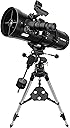
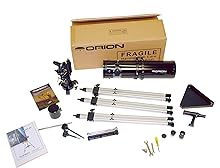
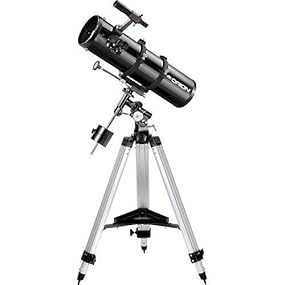
The Orion SpaceProbe 130ST EQ is a 5.1" aperture Newtonian reflector telescope featuring a fast f/5 parabolic mirror for bright, wide-field views of planets, star clusters, and deep-sky objects. Its sturdy equatorial mount with slow-motion tracking enables precise celestial navigation, while the lightweight 28 lb design and adjustable tripod ensure portability. The package includes two 1.25" Plossl eyepieces, star and moon maps, a collimation cap, and a smartphone adapter for astrophotography, making it an ideal, versatile telescope for serious adult beginners eager to explore the night sky.


| ASIN | B00D05BKOW |
| Additional Features | Large Aperture and Equatorial Mount for Versatile Stargazing |
| Best Sellers Rank | #3,908 in Camera & Photo Products ( See Top 100 in Camera & Photo Products ) #66 in Telescope Reflectors |
| Brand | Orion |
| Coating | Lens coating |
| Compatible Devices | Smartphone |
| Customer Reviews | 4.6 out of 5 stars 1,374 Reviews |
| Exit Pupil Diameter | 0.2 Millimeters |
| Eye Piece Lens Description | Plossl |
| Field Of View | 0.31 Degrees |
| Finderscope | Reflex |
| Focal Length Description | 650 millimeters |
| Focus Type | Manual Focus |
| Global Trade Identification Number | 00759270090074 |
| Item Dimensions D x W x H | 24"D x 24"W x 51"H |
| Item Weight | 24.2 Pounds |
| Manufacturer | Optronic Technologies, Inc |
| Manufacturer Part Number | 9007 |
| Model Number | 9007 |
| Mount | Equatorial Mount |
| Objective Lens Diameter | 130 Millimeters |
| Optical Tube Length | 24 Inches |
| Optical-Tube Length | 24 Inches |
| Product Dimensions | 24"D x 24"W x 51"H |
| Telescope Mount Description | Equatorial Mount |
| UPC | 759270090074 |
| Unit Count | 1.0 Count |
| Warranty Description | Limited Warranty against defects in materials or workmanship for one year from date of purchase. |
| Zoom Ratio | 24 |
M**C
great scope for beginners
This is my first telescope. I've read a lot of reviews before buying. My choices were the orion 4.5, 6 dobsonian and the celestron astromaster 130 eq. I was on a budget of 500 USD and with that budget includes shipping here in the Philippines via sea freight. With that budget the dobsonians are out, I've really like the 6 inch built a telescope from orion but the shipping cost was really over the budget. Now the celestron astromaster 130 and this telescope. Well I've read from the users that the celestron astromaster 130; Cons 1. the tripod of the celestron can easily break 2. the dot finder was a challenge to use 3. plus there is no included collimation cap (you can easily make one) 4. Mirror has no center guide (though you can mark it yourself) 5. the included 20 mm plossl is not of good quality Pros 1. Optics is really good with the astromaster 130 2. Parabolic mirror 3. Cost about 187 USD (sometimes it changes to 210 USD) With this I chose the orion spaceprobe 130ST since I don't want to deal with the cons of the Celestron Astromaster 130. After waiting about 50 days the telescope finally arrived. Packaging: It is well packed and it is double boxed to protect the items inside and there's a lot of small empty boxes to prevent the items from moving. The OTA is separated by a divider and tightly packed. All items are complete, The finder scope, 2 eyepiece, dvd's and tools are in a separate box and the EQ mount is already pre-assembled. Assembling the telescope is easy and it took me about 45 minutes (watch the video in youtube on how to assemble the scope, it will really help) Equatorial mount: As for an equatorial mount you'll get the hang of it after several use and is actually convenient to use when tracking objects (its just a turn of a knob.) You can also use the scope like a dobsonian and an alt-azimuth (release the Dec and RA lock and you're free to move it around) Advantaged of an EQ mount is that I tracks objects by a single turn of a knob and it can also be used for astro-photography when you want that on a later time. Performance: Overall the performance of the telescope is great. It is properly collimated, mount is stable and durable. The 2 eyepiece included is of good quality. Focuser is smooth and the finder scope is easy to use (opening your other eye will help you target objects while using the finder.) 260x is the rated useful magnification of this scope but I've tried 325x with the moon and jupiter (using a 6mm plossl and a 3x barlow) The view is not as crisp sharp for jupiter and but I can still see the major bands. I'll purchase the celestron 2.3mm soon and see how it goes. Cons for the Orion spaceprobe 130ST 1. At high magnification the scope will become shaky when focusing. (I guess this is to be expected on the EQ2 mount. Let it settle for a few seconds and the view will steady) 2. My 25 mm siruis plossl has a big lint between the lens (Orion replaced it) 3. Some scratches on the tripod 4. Some dirt on the mirror 5. EQ mount is for latitude 16 and above only. Although you can remedy this by turning the scope so the front leg of the tripod is facing south and the counterweight will not hit the tripod leg. 11/3/2012 On a clear night just recently I spend the whole night looking at jupiter. I got a glimpse of the great spot! (And occasional eye floaters!! Damn) Things I saw on our backyard with limited view Pleiades - easy to spot and magnificent with the 25 mm Plossl Orion nebula - by far easiest nebula to spot Andromeda galaxy - Its just like a gray blur cloud in the sky Jupiter - see above Moon - great as always (don't expect to see the american flag) Sun - Try to view at sunrise and sunset and use a baader filer or mylar I'll update this review when I can.
S**N
Amazing instrument, but be warned if you are a "beginner"!
Wanted to get a telescope for my daughter on her 10th birthday. Was guided by the reviews here which generally stated that this was a solid instrument for beginners. Some notes on the telescope itself and then some comments on what you're in for if you are like me, the true clueless beginner: SpaceProbe 130ST Pros: Nice looking telescope, seems very professionally made. We have seen some amazing sights in the first few nights. The waxing moon looks amazing and all kinds of incredible details can been seen. At 60x and 120x magnification (a 2x barlow lens is needed for 120x mag, not included with this scope) we could see the cloud bands on Jupiter and it's moons. We could even see the shadow of a transiting moon on the surface of Jupiter. We found Saturn, surrounded by one brilliant fat ring. We could make out some cloud rings on the surface as well. Venus looked like a nice bright crescent. The equatorial mount and dials are pretty cool. We got ourselves an education in the coordinates of the night sky: declination, right ascension, etc. However for viewing planets all that went out the window and we did the old point-and-shoot. Space Probe 130ST cons: The mount looks sturdy at assembly, but in use the weaknesses become apparent. At 60x and 120x magnification, focusing on objects is a challenge. Using the focuser will cause enough vibration that we had to 'guess' if we were focused. Adjust the focus, wait for the vibrations to stop, adjust again, repeat. After some practice this really isn't a problem. The assembly instructions were pretty bad. I would almost say that a beginner would have no chance of putting this thing together using the included manual only. Thankfully Orion has an online video which will walk you through the process. The video was very good. The instructions for aligning the mirrors (collimating) are also useless if you are a true beginner. Even the Orion online video is not that helpful. Aligning the mirrors properly is incredibly important for good performance of the telescope. We had to use several online tutorials from other sources to figure this step out. NOTES FOR THE BEGINNER: As a complete uninitiated beginner, I found the assembly to be a challenge. Particularly the aligning, or collimating, of the mirrors, was quite difficult for this beginner and required a fair amount of manual dexterity. Definitely way beyond the capabilities of my 10-year-old, so keep that in mind. I discovered that the only reliable way to get perfect alignment was to purchase a laser collimator ($50 to $100) to assist the process. When using a laser, I could see that what seemed to be perfect alignment with the Orion-included collimation cap was not perfect at all. If you want to get the full performance potential out of this scope, I believe you're going to have to invest in the laser. Also a good investment is the moon filter for lunar viewing, and a Barlow 2x magnification lens, neither of which are included with this telescope.
J**N
Unveiling the Universe - A Fantastic Telescope for Stargazing Enthusiasts!
Unveiling the Universe - A Fantastic Telescope for Stargazing Enthusiasts! The Orion 09007 SpaceProbe 130ST Equatorial Reflector Telescope has taken my stargazing experience to new heights, quite literally! This telescope has truly exceeded my expectations, offering incredible performance and exceptional value for both beginners and seasoned astronomers. From the moment I set up the telescope, I was impressed by its sturdy construction and thoughtful design. The equatorial mount provides smooth and precise tracking, allowing me to easily follow celestial objects as they move across the night sky. The compact and portable design makes it convenient to transport to various observation sites. The 130mm aperture of the telescope's primary mirror is a real gem, capturing a remarkable amount of light and delivering crisp, detailed views of planets, galaxies, and nebulae. The images produced are breathtaking, revealing details that were once hidden from plain sight. The included two eyepieces offer versatile magnification options, catering to a wide range of celestial objects and observation preferences. Assembly and setup were straightforward, even for someone new to telescopes. The included accessories and finder scope were valuable additions that enhanced my overall experience. I appreciate the comprehensive user manual that came with the telescope, providing clear instructions and tips for getting the most out of each observing session. The SpaceProbe 130ST has quickly become my go-to telescope for both terrestrial and celestial observation. Its versatility and high-quality optics make it a fantastic investment for those eager to explore the wonders of the universe. Whether you're a curious beginner or an avid astronomer, this telescope will undoubtedly exceed your expectations. In summary, the Orion 09007 SpaceProbe 130ST Equatorial Reflector Telescope is a stellar choice for anyone passionate about stargazing. Its exceptional performance, user-friendly design, and stunning image quality make it a must-have for those seeking to unveil the mysteries of the cosmos. Prepare to be captivated by the universe's wonders with this outstanding telescope!
R**T
Great scope for beginners
After a bit of research and reading reviews I decided on this scope. It was a bit on e high side for my budget but I am glad I spent a little extra to get a more feature rich kit. It arrived in 2 days, way ahead of schedule. This was fortunate because I got a chance to use it before the skies clouded up for almost a week straight. I had never used an equatorial mount before, but a little reading online before the scope arrived gave me an idea of what to expect. I also purchased a collimating eyepiece that proved useful in fixing the collimation error from rough shipping. Assembly was straightforward and took about 45 minutes while keeping an eye on my curious toddler. Tools needed for assembly were supplied with the scope. The instructions were good, but the mount has a few screws and knobs that aren't covered in the manual. In use, when doing a polar alignment, tightening the elevation axis lock screw causes a slight declination axis (or azimuth axis) shift. This isn't a serious problem because the mount works just fine for its intended purpose, observing. But I expect my hopes of doing astrophotography will have to wait until I can afford a mount made with more precision. The scope itself is great. I got it roughly polar aligned and then turned to look at the brightest object I could see. I focused as best as I could, but this is a bit of a trick that requires you to move the focus, then wait for the vibrations to damp, then adjust and wait again until you get clear focus. It took about 3 seconds for the vibrations to damp. After installing the 10mm eyepiece, I was greeted with a suprising sight, Saturn! The unmistakable shape of the ringed planet came into focus and I couldn't have been more pleased with my first ever view of the planet through my first telescope. The reason I deducted one star was the lack of including the little Allen wrenches for collimation, the lack of complete explanation of all the parts on the mount, and the elevation locking screws tendency to affect the alignment. It should only lock it in place, not cause movement. Also the right ascension axis lock slips a bit. When it is fully tightened you can still move the scope by hand without much resistance. Probably there is too much grease inside the mount. So overall it is a fun scope and will be great for imaging the moon but anything requiring a long exposure is going to need a seriously overbuilt mount with a motor drive that can be precisely polar aligned and is beefy enough to damp quickly.
S**E
Very Nice Telescope!
O.K. so I have had this scope for about 3 weeks now and all I have to say is WOW. First, with the pros: 1. It has a rock-solid mount (however the scope is a little heavy with the counterweight) 2. The generous 130 mm mirror really takes observation to a new level 3. It has a setting circle (however, I haven't really gotten around to using it yet) 4. I received this scope within a week (sweet indeed!) 5. The 2 eyepieces supplied are of good quality The Cons (and they are not a big deal at all) 1. It takes awhile to get used to an equatorial mount (at least for me it does) 2. I was confused with the manual on orienting the telescope correctly (not really an issue because I usually do not polar align the scope, see note below) 3. The right ascension (R. A.) fine control cable I received was too short (I took it off and now use the side metal gear) Some of the things I have seen so far include the Pleiades, the Double Cluster, Jupiter (at 130X and great seeing conditions, Jupiter's cloud belts look amazing), Venus, and the Moon. The crown jewel,though, was looking at Orion's Nebula. I could make out fine detail in it's nebulosity; so awesome! I would definitely suggest getting at least a 2X Barlow lens (although the one I got had some dust on the lens, I cleaned it off very carefully and it works like a charm.) Included with the scope is a 25 mm and 10 mm eyepiece, which with the Barlow lens will give you magnifications of 52 and 130 respectively. 130X does not seem much but it's plenty for me (although a little higher magnification would be nice for planet viewing.) I also got a 13% light transmission moon filter which works nice for details on the surface of the moon. I believe this scope can have a tracking motor (for R. A.) attached to it for following objects in the sky. This would be very handy for anyone dabbling in astrophotography. The first telescope I owned was a cheap plastic refractor for ~100 bucks. It did not perform very well but luckily I didn't get discouraged and just worked with what I had. The second scope I acquired was very nice but it used the GoTo motors that just drained batteries! Also, in my opinion, half the fun was lost due to automatic slewing to whatever was up that night. This scope is great however. I believe it to be the perfect portable size (as opposed to a large scope that has to be dismantled or a permanently mounted scope.) With this scope I am usually viewing within minutes. :) Note: I personally like having the eyepiece at eye level when I am viewing; it's the most comfortable to me. However, when slewing the scope in all 4 cardinal directions the eyepiece changes its location inconveniently. I just rotate the tube to accommodate my viewing height. I have to be careful though to keep the tube balanced with the counterweight. I was wondering if they have something to lock the tube into and then turn it somehow on its axis without it sliding. All in all I think this is a great scope for a great price. Overall I am very pleased with the craftsmanship and I plan on doing business with these folks again.
T**S
Great first telescope!
I haven't taken an astronomy class since college, so I had to start over when I became re-interested in astronomy. Actually, my fascination came from downloading an astronomy app for my iPhone. I had a budget in mind of about $300, but knew nothing about selecting a telescope. I pretty much typed telescope on amazon and looked at what you could get for my budget. I was soon very confused and became obsessed with learning more. I'm ashamed to admit that despite logic and practicality, I tend to buy what ever looks the coolest or should I saw "bad @ss"! Well after spending a month on research and watching every tutorial on the Orion website, much to my wife's annoyance, I narrowed it down to either a reflector or refractor. I live in a small city and there isn't much light pollution, so I choose a reflector. The telescope came in perfect condition, took about an hour to set up and there it sat in the man cave, looking cool, and giving me that false sense that I am wizened. After about a week or so, I took it for a test drive and quickly started losing intelligence points as I tried to man-handle the equatorial mount and polar align it. I'm an auto mechanic by trade, so I'm not usually dumbfounded by technical procedures, but I am not above admitting, I fumbled my way through it. After first looking at mars, which I here is quite difficult, I wasn't impressed. I switched from the 25mm eyepiece to the 10mm, and was still left wanting. I switched gears and looked at Saturn. Now we're talking! My enthusiasm went from 0-60 in seconds. You can clearly see the rings and what appears to be moons. I need a higher powered eyepiece and a Barlow, but I took a gander at the moon before I packed up. I was completely blown away! I actually tried holding my iPhone camera up to the lense and fired away. I got photos that look like you would see in a book. I sent them to my friends and they couldn't believe it. Enough of my yacking! If you want the best beginner scope and don't want to lug a dobsonian around, buy this scope! Trust me! It's $300 bucks, buy the mount for your eye phone, the premium accessory kit and your set. You'll be $500 in the hole, but you won't need anything else. Of course, if I stay interested I'll buy a bigger one. I have to find a way to justify it to my wife first! It's for me and our son honey!
K**S
Wonderful scope with options to grow into for beginner
After much debate on purchasing this scope ( a Newtonian Reflector on a Equatorial Mount with 130mm aperture ) or a Orion SkyQuest XT8 Classic Dobsonian Telescope , I went with this scope for a couple of reasons. 1. This scope is supposedly ( more on this later ) more portable then the 8" tube and base that I would have received. I have small two door car and would not have been able to fit the tub in the trunk and only in the passenger seat. 2. This scope is on a Equatorial Mount which would be needed if you wished to take long exposure AstroPhotography or wanted to have a the telescope track objects in the sky without having to continually adjust. 3. It provided a very bright telescope ( f/5 ) with a wide field of view which was recommend to me to be better for a beginner. 4. The mount could later be upgraded to attach a motor to automatically track objects. Again a plus for taking photos or if you have people over and would like it to stay centered on the object. I was amazed at how quickly objects will move out of view, even a few minutes and your object will disappear. 5. This scope does a little bit of everything well enough and can let me grow or dabble into different areas without having to purchase another scope or added features. At most, you would need two accessories. A Orion Shorty 1.25" 2x Barlow Lens to help with magnification ( The long tube version of this scope Orion SpaceProbe 130 EQ Reflector has a longer focal point as well as the Dobsonian reflectors which gets your more magnification for the same eyepeice) and a camera mount/accessories for taking photos. This is my very first telescope and I will give you my opinion in each area of the product as well as issues I ran into as a beginner. PACKAGING: The scope arrived very well packed with many empty boxes inside the package to serve as cushion for the telescope and parts. It is a single box that is about four feet long and about 50 lbs. Unpacking may take a bit to carefully set up the parts for assembly. INCLUDED ITEMS: It comes with a manual, Orion's starry night software which I found helpful as beginner ( also notifies you of any upcoming events that you may want to watch) , tools for assembly of the telescope ( no hex wrench for collimation i.e. adjusting the mirrors ), collmination cap, and two eye pieces. A 10mm for 65x and a 25mm for 26x magnification. ASSEMBLY: The instructions list that this should take 30 minutes. I agree if I had to do this a second time and I could probably do it in 15 by the second or third time. However, as a beginner with no prior experience, expect an hour to 1 1/2 hour to assemble. The instructions are good but a bit hazy and unclear during certain steps for a beginner. This is due to the large area of controls, gears, and levers on the mount itself that can seem a bit over bearing at first before you are familiarized with the controls. It would be helpful to have smaller diagrams between steps showing exact controls or parts to move. You may have to re-read the steps a few time and continue to consult the single diagram for reference. Order of Assembly: 1. Mount tripods to Mount ( Mount is heavy! ) 2. Add and assembly accessory tray 3. Thread and add counterweight to mount ( Be very careful ) 4. Add ring mounts ( will hold the telescope tube or OTA ) to mount. Remember to add the correct one to the correct side 5. Carefully set tube in ring mounts and tighten. 6. Adjust balance of telescope in both axis 7. Add slow control knobs to worm gears Notes about assembly: I ran into issues at first after installing the counter weight. I was under the impression that the locking bolts to secure the mount at a particular angle would hold the mount in place with the counterweight. No matter how tight you press the weight will force the mount down. I assumed something was broken but luckily I figured out that the latitude adjustment bolt needed to be set first. This bolt limits how low the mount will go. In my case, with the bolt not set the counterweight would flop down and hit the tripod legs. Setting this bolt to 30-40 degrees stops it from BENDING lower and the counterweight stays still now. Second issue I had was mounting the tube rings on the wrong side. There is one right with a small metal wheel on top to be used for taking photos with a camera. That ring should be toward the FRONT of the telescope WHICH IS where the SLOW MOTION CONTROL for Declination is! This means the control knob ALSO points towards the front of the telescope. COLLIMATION: I used the included cap ( place over the focuser or eyepiece tube on the telescope ) to check if the mirrors were aligned. I looked through and it looked pretty close to me at first and I wanted to get out and test it. You should check it after receiving it as some of it may be off. Mine was as I realized later however it was close enough to still see brilliant images the first night. I corrected it today and after over an hour of the learning process I have mine aligned well and it did seem that the moon was sharper then the day before. This is a maintenance process that you have to do on these types of scopes. The first time, it's tough. If I had to do it again now I could do it in about 5-10 minutes or less. Here are some of the mistakes a beginner like me made that caused confusion: When you use the collimation cap, you are supposed to see all these "rings" and reflections of the mirrors. There are only two things you are going to adjust, the secondary mirror and the primary mirror ( the big one at the back of the tube). The secondary mirror is the tricky one. Basically, you look down the focuser and with the telescope parallel to the horizon ( in case you drop a screw or tool and don't' want it falling onto the mirror and breaking it! ) you look through and see if the dark black ring around the center is , well centered. If not you start by using a Philips screw to adjust on the front of the scope. There is a cross at the front and only one Phillips head screw in the center to modify. This Moves the mirror toward the back of the tube or toward the front. This just aligns it so that when you look through you are seeing the whole image of the secondary mirror through the focuser. You may rotate it if it's at an angle but only touch the stub, not the mirror itself. Then, you can use a 2mm Allen wrench to adjust the three screws to adjust the tilt to make that dark black ring in the center. There will be a ring shaped mark that you will see. don't worry about getting that centered yet, only the dark ring around it. Once that is done, you unscrew three screws at the back to take off a cover and then find 6 screws to adjust the back mirror. This is trial and error as well but you just have to move either of the screws a little bit and it will cause the ring mark to move and center with the dark dot directly in the center. This "dot" is the hole that you are looking through that you will see in the mirror reflection. USING THE TELESCOPE Finally, actually using the telescope is not so bad but you will have to get used to moving it around a equatorial mount. It does not move left to right and up and down. It moves in "arcs" that match the movement of the Earth. For the first night, I just moved the telescope around and moved it into position of the moon without polar aligning the mount. Since this was a quick test, I didn't care about that just yet. All the controls moved well and smoothly. I did have to tighten the RA and Dec knobs well to make sure no movement happened, though if you give it a hard nudge or rested your hand on the tube you could accidentally move it slightly. The scope is a bit sensitive to movement. The tripod base was sturdy but once you got to the tube you could tap it and it would bounce slightly and then stabilize. I feel this is normal for any mount in this price range of this type as I tested from tripod off tapping everywhere to see where I could make adjustments to make it more sturdy. All the pieces are heavy and solid, and I think once it gets to the tube itself there is some play in movement just because the telescope is a rolled metal tube. Adding and taking off eyepieces is fairly easy. Simply loosen two screws pop into place. The focuser worked well. Some people complain that it is plastic, but it does not make it work poorly because of it. It was very smooth focusing and also held my DSLR camera with the Orion 1.25" Universal Camera Adapter in place fine. IMAGE QUALITY Fantastic. I had my neighbors over and we were all very impressed with shots of the moon. Pictures would not do it justice to how sharp and clear the images were. I also later that night pointed the telescope at Jupiter and with the 2x barlow lens and 10mm eyepiece could see Jupiter and all four moons. I was very impressed. The image was tiny in the eyepiece but you could see them clearly. I have purchased a 5mm eyepiece for higher magnification ( 130x base and 260x with a 2x barlow ). OVERALL QUALITY Everything is packaged well, seems of decent heft and weight, and is relatively good quality. I only found maybe a few parts that felt "cheap" but really, everything worked well and didn't degrade it from performing properly. I think for the price that this sells for I got good product. SUMMARY This telescope is wonderful and is versatile. It is a bright scope with a wide field of view. It is on a equatorial mount which if you plan on growing into the hobby will want to learn how to use. If you want to try AstroPhotography you have everything basically ready to start other than a mount for your camera. You can adjust the magnification to get very high power with a simple eyepiece upgrade to match other longer focal length scopes. It IS portable, if you take the tube and tripod/mount/counterweight apart before traveling. For me I will be able to fit each piece into my tight spaces and still have someone in the passenger seat. For those with larger vehicles, the Dobsonian telescopes might be more portable. Overall this is a well made scope with options to grow into and can give you some flexibility. My number one reason for buying this over a Orion xt8 is that I could learn and work with a little bit of everything in this new hobby.
P**L
Here's why I bought this telescope
I really didn't look around too much since I had owned and used telescopes. I knew the price point I wanted (but went above and beyond in my buying because of accessories: the Orion 1.25" Premium Telescope Accessory Kit and a case). It was a draw between this and the StarBlast 4.5. I can understand why the one person suggested the Dobsonian, but I didn't want a large telescope (although this is the larger of the two I was choosing between). Telescopes are light catchers that amplify the light from distant celestial objects: so the more a telescope amplifies the light--the more objects you will see. Some of this are big, but just not very bright in the sky. I'm going to reiterate what other reviewers said and say that the Orion Website is really helpful. And what info isn't on the website can be answered by Orion's customer support. I talked with Damien and he said that this scope was the best choice for me. While on the subject of Orion's product information--I strongly suggest watching their video on how to assemble your telescope before even picking up the instruction book. While they say it takes 30 minutes to put the telescope together, it doesn't if you are trying to figure out the assembly instructions. Watching the videos about how to put it together made the process so much easier and less frustrating The next step up would be the SkyProdigy 130 Computerized Reflector Telescope which will aims the scope. But, the real fun of having a scope is discovering this stuff for yourself. I feel that I made the right choice by choosing Orion and this telescope in particular. The optics quality is super and it's not that hard to set up (if you watch their videos). I would also say that you should pick up a copy of NightWatch: A Practical Guide to Viewing the Universe , or a The Miller Planisphere for your latitude as another accessory for this telescope if you are a complete novice at astronomy. Even if you aren't a novice, Nightwatch is a useful guide, although I would suggest that the book Turn Left at Orion: A Hundred Night Sky Objects to See in a Small Telescope - and How to Find Them is a better choice than Nightwatch if you already have a telescope. The Planispheres are excellent star maps and will last a long time. The Orion 1.25 Inch Premium Telescope Accessory Kit is a good purchase for starter accessories, even though it doesn't come with a manual (that info is on Orion's website though). You should be good to go with a good star map and set of accessories to enjoy stargazing!
D**T
Excellent Starter Telescope
My son got this telescope for his birthday. The first pleasant surprise is the build quality and sturdiness. The tripod has a nice weight while still being easy to move around. Once all of the pieces were put together we waited for night and were fortunate to get a clear sky. We skipped reading the manual and therefore struggle trying to position and point at the moon. Once we managed to point it we were all blown away by the amount of detail we could see of our lunar friend. Next my son pointed the scope to a bright star and when he looked got excited by what he saw. When I looked I was confused as to why there was one large star and 3 other pin point stars in a line. Then it hit me... this was Jupiter. We were looking at a planet. We are all hooked. Best advice I can give you if you purchase this is to spend a bit of time reading the manual to get it set up properly first and then go looking at the stars.
R**B
Extrem gutes Teleskop
Ich bin absoluter Anfänger in der Teleskopie. Ich wollte unbedingt ein Teleskop, was für alles ganz gut ist (Planeten, Deep Sky und schöne Mondbetrachtung) und habe mich für dieses entschieden. Das Auspacken und zusammenbasteln hat innerhalb von 30minuten gut geklappt. Die Anleitung ist auf englisch. Im Internet gibt es die aber auch auf deutsch. Man hat 2 Okulare und ein Sucherfernrohr. Wichtig ist, dass man das Sucherfernrohr mit den 2 Schrauben, so einstellt, dass man das gleiche, wie auf dem kleinsten Okular sieht, von der Richtung her. Das wusste ich natürlich erst später und dachte, dass es nicht richtig hergestellt wäre. Aber seitdem ich alles genau so, wie in der Anleitung beschrieben eingestellt habe, ist alles mega gut. Die 2 feineinsteller sind gut durchdacht. Doch der Feineinsteller, der von oben nach unten die Sicht verändert, hatte bei einer Mutterschraube keinen guten Kleber. Irgendwann hatte ich den feineinsteller ohne Teleskop in der Hand, weil ich zu fest das Rädchen nach links gedreht hatte. Mit gutem Sekundkleber ins Gewinde, hält alles wieder Bombenfest. Trotz der kleinen Eskapade bin ich vollends begeistert von diesem Teleskop und kann es jedem empfehlen. Einzige Sache, die ich mir schwierig vorstelle, ist der Transport, da die Stativbeine mit einem Dreieck in der Mitte verschraubt werden, was ziemlich aufwändig ist. Besonders, wenn man bei Nacht draußen irgendwo aufstellen will. Da darf man die kleinen Schrauben mit den Muttern nicht im Gras verlieren! Ich hab mir noch ein 6, 3mm Okular Plössl gekauft und eine 5x Barlow Linse, sowie einen Mondfilter. Seitdem, kann ich auch den Saturn sehen mit seinem Ring. Und den Jupiter, mit seinen feinen horizontalen Rillen, welcher sich direkt neben dem Mond befindet und extrem hell leuchtet. Mit einer Barlow linse verliert man aber deutlich an Schärfe, wenn man kleine Okulare verwendet. Besser man greift tiefer in die Tasche beim Zubehör. Noch eine wichtige Sache, die ich für erwähnenswert halte, man sollte wirklich darauf achten, dass man das Teleskop in allen Achsen im Gleichgewicht einstellt. Seitdem ich das gemacht habe, dreht es sich einfacher und es scheint auch weniger Seitdem zu wackeln.
C**N
buen producto
buena calidad del producto, y buena relacion precio costo, el precio fue 30% mas barato que en tiendas, si se requiere un poco de conocimientos basicos para ajustar el telescopio sin embargo hay mucha informacion en internet
C**N
Telescopio para ver el mar y el cielo
Es bueno, envuelto pesaba bastante, una vez montado ya no tanto. Ha sido para un regalo.
A**R
Ready the entire booklet and watch all videos, so helpful.
This telescope is better than expected. Easy to assemble and the videos available helped greatly. My husband was thrilled with this Christmas present! Need a little time to get used to using it to the full potential but look forward to many years of stargazing.
Trustpilot
1 day ago
3 weeks ago