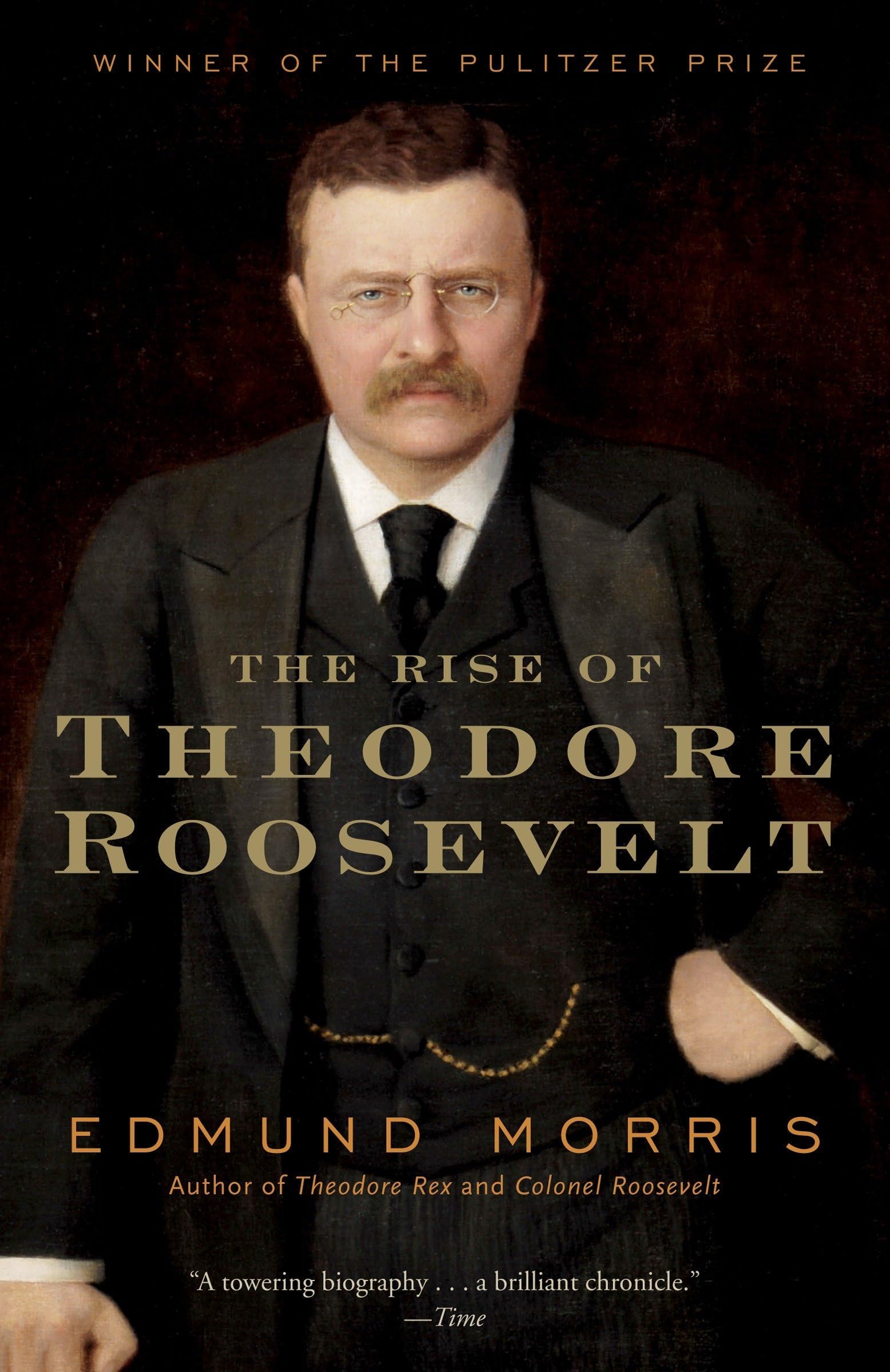
The Rise of Theodore Roosevelt (Modern Library (Paperback))
Product ID: 1609967
Buy anything from 5,000+ international stores. One checkout price. No surprise fees. Join 2M+ shoppers on Desertcart.
Desertcart purchases this item on your behalf and handles shipping, customs, and support to Macau.
WINNER OF THE PULITZER PRIZE AND THE NATIONAL BOOK AWARD • The acclaimed author of Theodore Rex presents “a towering biography [and] brilliant chronicle” ( Time ) of Theodore Roosevelt, the twenty-sixth president of the United States. One of Modern Library’s 100 best nonfiction books of all time • One of Esquire ’s 50 best biographies of all time “Magnificent . . . one of those rare works that is both definitive for the period it covers and fascinating to read for sheer entertainment.”— The New York Times Book Review During the years 1858–1901, Theodore Roosevelt transformed himself from a frail, asthmatic boy into a full-blooded man. Fresh out of Harvard, he simultaneously published a distinguished work of naval history and became the fist-swinging leader of a Republican insurgency in the New York State Assembly. He chased thieves across the Badlands of North Dakota with a copy of Anna Karenina in one hand and a Winchester rifle in the other. Married to his childhood sweetheart in 1886, he became the country squire of Sagamore Hill on Long Island, a flamboyant civil service reformer in Washington, D.C., and a night-stalking police commissioner in New York City. As assistant secretary of the navy, he almost single-handedly brought about the Spanish-American War. After leading “Roosevelt’s Rough Riders” in the famous charge up San Juan Hill, Cuba, he returned home a military hero, and was rewarded with the governorship of New York. In what he called his “spare hours” he fathered six children and wrote fourteen books. By 1901, the man Senator Mark Hanna called “that damned cowboy” was vice president. Seven months later, an assassin’s bullet gave Roosevelt the national leadership he had always craved. This classic biography is the story of seven men—a naturalist, a writer, a lover, a hunter, a ranchman, a soldier, and a politician—who merged at age forty-two to become the youngest President in history. Review: "When the wolf rises in the heart..." - Theodore Roosevelt... Harvard graduate, historian, New York state assemblyman; rancher, Civil Service Commissioner, New York City Police Commissioner, Assistant Secretary of the Navy; Commanding officer of the "Rough Riders;" war hero; Governor of New York; Vice President, and then President of the United States. All of these accomplishments by the time this extraordinary man reached 42 years of age. Theodore Roosevelt's historical achievements are indeed most impressive! In his Pulitzer Prize-winning biography "The Rise of Theodore Roosevelt," biographer Edmund Morris masterfully chronicles the life of this mercurial, complex, and paradoxical man who became the 26th President of the United States. Morris's brilliant narrative depicts Theodore Roosevelt as a man who towered over his world. Yet who would have guessed at future greatness for this, the oldest son of one of New York's wealthiest and most respected families? A sickly child, afflicted with constant bouts of asthma and chronic diarrhea, he is seen by his parents as a child "with the mind, but not the body..." for high achievement. But the young Roosevelt senses his own potential for greatness and resolves to strive mightily to achieve it... Throughout his life, TR is a man of many paradoxes. Largely self-educated, he eventually attends Harvard University, from which he graduates magna cum laude in 1880 with a Phi Beta Kappa key in one hand and a membership in Porcellain, Harvard's most prestigious social club, in the other. The son of a wealthy philanthropist, he eschews the traditional, genteel, upper-class lifestyle in favor of the rough-and-tumble of New York politics. A member of the Republican party, he champions progressive reform. By age 26, he has served two terms in the New York state assembly; has earned the begrudging respect of his colleagues; and has authored several significant pieces of reform legislation. After the death of his first wife, Alice Lee Hathaway Roosevelt, and his mother, Mittie (both women die on the same day, in the same house) TR flees New York, heading to the harsh, uncompromising Dakota Badlands to earn his living as a cattle rancher and writer of history books. Here, in this barren country, a startling transformation takes place. The thin, sickly youth of sallow skin and frail constitution becomes the muscular, tanned, robustly healthy man known to history. "The Rise of Theodore Roosevelt" vividly demonstrates how this intensely energetic politician used his forceful personality in the cause of badly needed reform at all levels of American government. As Morris points out, Roosevelt puts his personal stamp on nearly everything he undertakes. As Civil Service Commissioner during the Harrison administration, he publicly - some say bumptiously - investigates claims of graft and corruption within the Civil Service. He alienates many colleagues, but achieves lasting results. During his tenure, the Civil Service expands dramatically, despite fierce political opposition. The same holds true for TR's tenures as president of the New York City Police Commission (1895-97) and Assistant Secretary of the Navy (1897-98.) In 1898 a series of unexpected events propels TR to national prominence. When war breaks out between the United States and Spain, TR asks for and receives commission in the New York National Guard. Soon he has assembled a tough group of cavalrymen called the "Rough Riders" - friends from his days at Harvard and in the old west. On July 1, 1898, TR and his grizzled band of soldiers will enter the pantheon of American heroes at a place in Cuba called San Juan Hill... After the Spanish-American War, TR returns to New York and runs for Governor. After a tough, closely fought campaign that features former "Rough Riders" endorsing their candidate, TR is elected by a razor-thin margin of 18,000 votes out of nearly 1.1. million votes cast. TR will only spend a year in the governor's mansion, though. By 1900, New York's "old pols" have had enough of Roosevelt's attempts to force progressive reforms through a recalcitrant, conservative New York legislature. Considering TR "too dangerous" to keep on as governor, they make an arrangement to get Roosevelt on the national ticket. McKinley agrees, and an Roosevelt enthusiastically becomes McKinley's running mate. In November 1900, McKinley easily wins re-election and Theodore Roosevelt becomes Vice President of the United States. Ten months later, on September 6, 1901, at the Pan-American Exposition in Buffalo, New York, President William McKinley is gunned down by a young anarchist... Not since I read William Manchester's two-volume "The Last Lion" biography of Winston Churchill have I read a book that's as good as "The Rise of Theodore Roosevelt." Make no mistake: this book is as good as biography gets! Here is the powerfully eloquent story of one of the most gifted and controversial men of the twentieth century, and perhaps even of all time. "The Rise of Theodore Roosevelt" reads almost like a novel. I haven't found a single part of this book that I would classify as "dry" or boring. In fact I found it pretty hard to put down once I started reading it. Part of the reason for that, I suppose, is because TR's life was so darned fascinating to begin with; but give Edmund Morris his due. He has told the story of Theodore Roosevelt with tremendous style and panache. "The Rise of Theodore Roosevelt" is a fair and balanced biography, although Edmund Morris displays an obvious affection for his subject. Morris combines an intellectually stimulating and literate historical narrative with brilliantly insightful historical analysis. Roosevelt's less attractive qualities - his impulsiveness, his emotionalism, and his attempts at self glorification among others - all receive full coverage in this masterful book. Edmund Morris has written an extremely readable, highly entertaining, and factually sound biography. In "The Rise of Theodore Roosevelt," he completely captures the essence of this towering early twentieth century figure, making him totally relevant to today's readers. "The Rise of Theodore Roosevelt" is a biography that's indeed very well worth reading! Review: Roosevelt the Inspirational Man and Leader - There's a lot to like here...this is a very well-written book. 770+ pages is not quick to read, but the reading is easy. The author doesn't challenge the reader with many ponderous questions and perhaps the subject doesn't either. Roosevelt is a straightforward dude (he's even called a 'dude' in some places, leading me to be surprised they used such language in the 1800's). What I liked most about this book is the inspirational character himself. Roosevelt was a stand-up guy who almost always did (or tried to do) the right thing. The fact that he was often successful just highlights his moral qualities. His failures too - and there were many - make him simultaneously more human and relatable. As a 38 year old writing this review I found myself thinking: I don't think we've ever had a truly GREAT president in my life time. Without getting political, I know Reagan and Clinton and Obama have their admirers...but were any of them truly inspirational characters? Personally I haven't felt it. Roosevelt makes you FEEL the inspirational quality. Not just his moral character, which was very strong, but his numerous actions, and the way he lived his life, and the things he did, whether you agree with them or not (such as killing for sport), was very inspirational. I found myself wondering about other past presidents I know little about and how I'd like to learn more about their lives too, especially George Washington who is such a revered (and yet unknown) president. You do learn a bit about some past presidents in this book as well including Grover Cleveland and William McKinley and Benjamin Harrison. Harrison was the worst of the three, although Cleveland wasn't much better (although he seems to have been very clever). McKinley was probably the best president of the three, but certainly not a stellar figure. The book doesn't talk at all about Roosevelt as president (hence, 'the rise of'), so we don't get to learn about what he actually did as the boss man in this massive tome. So that was a bit of a disappointment, but certainly not a reflection on the quality of the book itself. The book is VERY detailed and sometimes I found myself getting a bit bored with some of the details of passing legislation as Roosevelt the assemblyman, and those kinds of things, but you can skim the book in parts and still get a very vivid idea of the man. Honestly I didn't skim as much of the book as I could have just because it was mostly so interesting to me, but it would certainly be possible if you wanted to save time. I recommend this book if you want to learn about one of the truly great Americans that ever lived. If you want to be inspired to live your life to the fullest and to maximize your potential, well this book is a detailed examination of how to make that happen - more so than any self-help guide on the matter in my opinion.
| Best Sellers Rank | #11,241 in Books ( See Top 100 in Books ) #30 in US Presidents #87 in Military Leader Biographies #87 in Military History (Books) |
| Customer Reviews | 4.7 out of 5 stars 3,456 Reviews |
M**S
"When the wolf rises in the heart..."
Theodore Roosevelt... Harvard graduate, historian, New York state assemblyman; rancher, Civil Service Commissioner, New York City Police Commissioner, Assistant Secretary of the Navy; Commanding officer of the "Rough Riders;" war hero; Governor of New York; Vice President, and then President of the United States. All of these accomplishments by the time this extraordinary man reached 42 years of age. Theodore Roosevelt's historical achievements are indeed most impressive! In his Pulitzer Prize-winning biography "The Rise of Theodore Roosevelt," biographer Edmund Morris masterfully chronicles the life of this mercurial, complex, and paradoxical man who became the 26th President of the United States. Morris's brilliant narrative depicts Theodore Roosevelt as a man who towered over his world. Yet who would have guessed at future greatness for this, the oldest son of one of New York's wealthiest and most respected families? A sickly child, afflicted with constant bouts of asthma and chronic diarrhea, he is seen by his parents as a child "with the mind, but not the body..." for high achievement. But the young Roosevelt senses his own potential for greatness and resolves to strive mightily to achieve it... Throughout his life, TR is a man of many paradoxes. Largely self-educated, he eventually attends Harvard University, from which he graduates magna cum laude in 1880 with a Phi Beta Kappa key in one hand and a membership in Porcellain, Harvard's most prestigious social club, in the other. The son of a wealthy philanthropist, he eschews the traditional, genteel, upper-class lifestyle in favor of the rough-and-tumble of New York politics. A member of the Republican party, he champions progressive reform. By age 26, he has served two terms in the New York state assembly; has earned the begrudging respect of his colleagues; and has authored several significant pieces of reform legislation. After the death of his first wife, Alice Lee Hathaway Roosevelt, and his mother, Mittie (both women die on the same day, in the same house) TR flees New York, heading to the harsh, uncompromising Dakota Badlands to earn his living as a cattle rancher and writer of history books. Here, in this barren country, a startling transformation takes place. The thin, sickly youth of sallow skin and frail constitution becomes the muscular, tanned, robustly healthy man known to history. "The Rise of Theodore Roosevelt" vividly demonstrates how this intensely energetic politician used his forceful personality in the cause of badly needed reform at all levels of American government. As Morris points out, Roosevelt puts his personal stamp on nearly everything he undertakes. As Civil Service Commissioner during the Harrison administration, he publicly - some say bumptiously - investigates claims of graft and corruption within the Civil Service. He alienates many colleagues, but achieves lasting results. During his tenure, the Civil Service expands dramatically, despite fierce political opposition. The same holds true for TR's tenures as president of the New York City Police Commission (1895-97) and Assistant Secretary of the Navy (1897-98.) In 1898 a series of unexpected events propels TR to national prominence. When war breaks out between the United States and Spain, TR asks for and receives commission in the New York National Guard. Soon he has assembled a tough group of cavalrymen called the "Rough Riders" - friends from his days at Harvard and in the old west. On July 1, 1898, TR and his grizzled band of soldiers will enter the pantheon of American heroes at a place in Cuba called San Juan Hill... After the Spanish-American War, TR returns to New York and runs for Governor. After a tough, closely fought campaign that features former "Rough Riders" endorsing their candidate, TR is elected by a razor-thin margin of 18,000 votes out of nearly 1.1. million votes cast. TR will only spend a year in the governor's mansion, though. By 1900, New York's "old pols" have had enough of Roosevelt's attempts to force progressive reforms through a recalcitrant, conservative New York legislature. Considering TR "too dangerous" to keep on as governor, they make an arrangement to get Roosevelt on the national ticket. McKinley agrees, and an Roosevelt enthusiastically becomes McKinley's running mate. In November 1900, McKinley easily wins re-election and Theodore Roosevelt becomes Vice President of the United States. Ten months later, on September 6, 1901, at the Pan-American Exposition in Buffalo, New York, President William McKinley is gunned down by a young anarchist... Not since I read William Manchester's two-volume "The Last Lion" biography of Winston Churchill have I read a book that's as good as "The Rise of Theodore Roosevelt." Make no mistake: this book is as good as biography gets! Here is the powerfully eloquent story of one of the most gifted and controversial men of the twentieth century, and perhaps even of all time. "The Rise of Theodore Roosevelt" reads almost like a novel. I haven't found a single part of this book that I would classify as "dry" or boring. In fact I found it pretty hard to put down once I started reading it. Part of the reason for that, I suppose, is because TR's life was so darned fascinating to begin with; but give Edmund Morris his due. He has told the story of Theodore Roosevelt with tremendous style and panache. "The Rise of Theodore Roosevelt" is a fair and balanced biography, although Edmund Morris displays an obvious affection for his subject. Morris combines an intellectually stimulating and literate historical narrative with brilliantly insightful historical analysis. Roosevelt's less attractive qualities - his impulsiveness, his emotionalism, and his attempts at self glorification among others - all receive full coverage in this masterful book. Edmund Morris has written an extremely readable, highly entertaining, and factually sound biography. In "The Rise of Theodore Roosevelt," he completely captures the essence of this towering early twentieth century figure, making him totally relevant to today's readers. "The Rise of Theodore Roosevelt" is a biography that's indeed very well worth reading!
S**.
Roosevelt the Inspirational Man and Leader
There's a lot to like here...this is a very well-written book. 770+ pages is not quick to read, but the reading is easy. The author doesn't challenge the reader with many ponderous questions and perhaps the subject doesn't either. Roosevelt is a straightforward dude (he's even called a 'dude' in some places, leading me to be surprised they used such language in the 1800's). What I liked most about this book is the inspirational character himself. Roosevelt was a stand-up guy who almost always did (or tried to do) the right thing. The fact that he was often successful just highlights his moral qualities. His failures too - and there were many - make him simultaneously more human and relatable. As a 38 year old writing this review I found myself thinking: I don't think we've ever had a truly GREAT president in my life time. Without getting political, I know Reagan and Clinton and Obama have their admirers...but were any of them truly inspirational characters? Personally I haven't felt it. Roosevelt makes you FEEL the inspirational quality. Not just his moral character, which was very strong, but his numerous actions, and the way he lived his life, and the things he did, whether you agree with them or not (such as killing for sport), was very inspirational. I found myself wondering about other past presidents I know little about and how I'd like to learn more about their lives too, especially George Washington who is such a revered (and yet unknown) president. You do learn a bit about some past presidents in this book as well including Grover Cleveland and William McKinley and Benjamin Harrison. Harrison was the worst of the three, although Cleveland wasn't much better (although he seems to have been very clever). McKinley was probably the best president of the three, but certainly not a stellar figure. The book doesn't talk at all about Roosevelt as president (hence, 'the rise of'), so we don't get to learn about what he actually did as the boss man in this massive tome. So that was a bit of a disappointment, but certainly not a reflection on the quality of the book itself. The book is VERY detailed and sometimes I found myself getting a bit bored with some of the details of passing legislation as Roosevelt the assemblyman, and those kinds of things, but you can skim the book in parts and still get a very vivid idea of the man. Honestly I didn't skim as much of the book as I could have just because it was mostly so interesting to me, but it would certainly be possible if you wanted to save time. I recommend this book if you want to learn about one of the truly great Americans that ever lived. If you want to be inspired to live your life to the fullest and to maximize your potential, well this book is a detailed examination of how to make that happen - more so than any self-help guide on the matter in my opinion.
M**S
Wow, do I love reading about Teddy
Wow, do I love reading about Teddy Roosevelt. He is such an inspirational and interesting character. This is a very good book, and I’m very happy to be reading this series. But allow me to warn you, it is quite an investment. This book is about 1,000 pages, and it’s only volume 1 of 3! I do wish that we had delved deeper into TR’s Governorship and I guess there’s really very little to say about his Vice Presidency, but I am looking forward to starting volume 2 in a week or two!
I**N
Fantastic. Would Make for a Great History Course
I never truly understood what a great man Roosevelt was or why until I read this book. While the early going is a little slow (i.e. his childhood years) and redundant in spots, once he reaches young adulthood the story takes off and all I can say is, if you're not taken in by this man's Character and what I'd call his "constructive aggressiveness" then maybe historical books aren't for you. : ) It's not difficult at all to understand (especially when taken in combination with later accomplishments described in the 2nd volume) how Roosavelt ended up on Mt. Rushmore, even though he came along so much later than the other three. He did a tremendous amount of good for this country and struck a balance arguably never before achieved and never achieved since, acting both as a someone who helped businesses and the country to grow and expand, and who helped protect workers, consumers, and so many of our natural resources. A hunter who understood the value of preserving wild resources, a fighter who always let fighting be his last resort (self-education and finding means of cooperation were his main weapons)... ...I would say the best thing that could happen to America today, would be a man or woman in the mold of TR, refusing to go along with all the nonsense narratives about "pro business is anti-social and pro social is anti-business", who is religious but not interested in using the office as a religious platform, and lead through strength, wisdom and compromise. This type of person would have wide appeal to both Democrats and Republicans (and let's acknowledge that whatever Trump is, he's not a Republican and whatever Bernie Sanders and AOC and their type are, they're not Democrats). In fact I believe such a person would not even claim a party, seeing what those parties have become, inflexible and toxic. For sure he was not perfect; like all of us he was a product of the age in which he lived. This meant while he did not believe in social Darwinism and was not a racist by any reasonable definition, he did have some flaws that today we'd categorize as an acquired bias (from his parents and society) towards non-whites. But he nevertheless openly stated the obvious fact that a person's childhood environment and opportunities makes all the difference, that there were men and women of color who if they had been given the same chances he had as a boy, could be just as successful and worthy of everyone's respect. Put another way, he believed in competition and rewarding those who excel, but understood clearly it only meant something if everyone who's being "evaluated" by society started from the same place. And he openly acknowledged that was not happening for some groups. At any rate a great man, a very interesting man and life story, and extremely well researched and written. Highly recommended.
M**E
Multi-faceted Journey of Theodore Roosevelt
In The Rise of Theodore Roosevelt, Edmund Morris presents a compelling and comprehensive biography of one of America’s most dynamic and complex leaders. This classic work chronicles the transformation of Roosevelt from a frail, asthmatic boy into a powerful figure who would become the youngest President in U.S. history. Morris captures TR’s many identities—a naturalist, soldier, writer, ranchman, and politician—allowing readers to see the various influences that shaped his character and ambitions. Beginning at the height of Roosevelt’s international prestige in 1907, following his receipt of the Nobel Peace Prize, the narrative traces his life from 1858 to 1901. Morris details Roosevelt's passionate pursuits, whether he was leading a Republican insurgency in the New York State Assembly, chasing criminals in North Dakota, or commanding the Rough Riders during the Spanish-American War. The biography highlights his relentless energy and drive as he balanced remarkable achievements in public service with his personal life as a devoted husband and father. Morris provides deep insights into how Roosevelt’s diverse experiences and multifaceted personality culminated in his inevitable ascension to the presidency. The Rise of Theodore Roosevelt is not only a portrait of a man who shaped American history but also a testament to the complexities of leadership. This biography is a must-read for those interested in understanding the remarkable life of a leader who embraced every facet of his multifaceted identity in his quest to serve the nation.
B**M
Dynamic Portrait Of Human Colossus
It's hard to imagine a figure like the Theodore Roosevelt as presented by Edmund Morris popping up in a work of fiction. "Too farfetched," some editor would say, and with reason. Here you have wrapped in one skin a bona fide war hero, a writer of popular histories, a legislator, a cowboy, a police commissioner, a governor, and a navy assistant secretary who goes on to become the nation's youngest president. TR, as he is called (never "Teddy" to his face unless you were related), straddled the centuries, characterizing both the refined ideal of the 19th century and the galvanic purpose of the 20th without being dated by too close an identification to either. Morris marks his man at the outset, in a colorful preface set during his presidency (a period which Morris doesn't include in this, his first of three projected volumes on TR) where we see Roosevelt mostly through the eyes of those around him, throwing out his characteristic phrase "dee-lighted" as he breaks the all-time record for most handshakes at a single event without sign of strain. Notes one witness: "You go to the White House, you shake hands with Roosevelt and hear him talk - and then you go home to wring the personality out of your clothes." I felt the same way putting down this book, which by the way is hard to do. Morris writes extraordinarily well, not only about Roosevelt but the times that created him and the people who surrounded him. Even the footnotes are enjoyably readable. You get a lot of Roosevelt's boisterousness, expressing his philosophy that "Life is strife" and that a nation must be willing "to stake everything on the supreme arbitrament of war, and to pour out its blood, its treasure, and its tears like water, rather than submit to the loss of honor and renown." At the same time, there's a warmth and sensitivity to Morris' portrait. Roosevelt was a man who allowed for no doubts, but some surprising nuances. He was able to laugh along with those who poked fun at his spectacles, for example, because he understood the ungainly glasses were a way of sticking out that set him further apart from the crowd. He valued his manly bearing but could pray and cry with surprising abandon. Morris establishes himself as a writer with the skills and persistence to attach himself, remora-like, to this human cyclone, not to mention the eloquence for capturing his many twists and turns. (One gets the feeling he was absolutely the wrong choice to biography Ronald Reagan, as he did in the misbegotten "Dutch", because Reagan was nearly as passive a figure as Roosevelt was active.) While some carp Morris is too positive in his presentation here, I beg to differ. Morris captures Roosevelt's double-dealings with two political parties en route to the New York governorship, and his shunting aside of Navy ambassador John Long, for a time Roosevelt's immediate superior. It's just that Morris writes with agreeable sympathy, and duly notes Roosevelt's many achievements large and small, such as championing reform in the era of the bosses and ensuring the first-time election of a black delegate to head a political convention. Roosevelt was the grandest figure in the Republic between the Civil War and World War I, not faultless but capable of incredible feats. "I have only a second-rate brain, but I think I have a capacity for action," Roosevelt once said of himself. In fact, Roosevelt was that rare blend of smarts and guts. With this bio, you feel like you have gained an exclusive audience with this extraordinary man.
J**G
A BULLY FINE BOOK ABOUT THEODORE ROOSEVELT
When "The Rise of Theodore Roosevelt" was published in 1980, it won the Pulitzer Prize and the National Book Award. The Modern Library thence named it one of the top one hundred non-fiction books. It is the first of three volumes about Roosevelt by Edmund Morris. The work deserves its accolades. It is exquisitely written and, no doubt, the definitive Rooseveltian biography. I shall recognize Teddy Roosevelt the very second I see him in Heaven: "His ample mustache does not entirely conceal a large, pouting underlip, on the rare occasion when that lip is still. Mostly, however, the mustache gyrates about Roosevelt's most celebrated feature––his dazzling teeth. Virtually every published description of the President, including those of provincial reporters who can catch only a quick glimpse of him through the window of a campaign train, celebrates his dental display. Cartoonists across the land have sketched them into American folk-consciousness, so much so that envelopes ornamented only with teeth and spectacles are routinely delivered to the White House." Although the book begins with a description of Roosevelt during his presidency, The Rise of Theodore Roosevelt is appropriately titled. We learn about his poor health as a child; his worshipful love for his father; his Southern mother's loyalty to the Confederacy; his early love for hunting and taxidermy; his marriage to Alice Lee, whose death devastated him; his escape from grief as a cowboy in the wilds of the Dakotas; his writing career; and his early forays into political life. Theodore Roosevelt was a man who––most of the time––felt absolutely certain of his decisions, yet he struggled with himself. He did not believe that a man should remarry. No matter that Alice Lee Roosevelt was deceased. She was his wife forever. He argues with himself, castigates himself, before he gives in to his desire to marry his second wife, Edith. T. R. held himself to a higher moral standard than most men. The book is meticulously researched and presents the necessary bibliography and a plethora of notes. I enjoyed learning the minute details of the President's early life. He was quite an unusual figure. During his presidency, he would wade naked into the stream in Rock Creek Park, followed by his cabinet, no matter how cold the weather. Now that I would like to see. My son read this book before I did. He feels quite enthusiastic about "The Rise of Theodore Roosevelt," which earns The Janie Junebug Seal of Highest Approval.
A**K
Fascinating!
I was fascinated by the level of detail, the way it was written between fact and interpretation and how it kept me wanting to read continuously. I felt I was part of that era following someone on the cusp of greatness. I recommend this book to anyone wanting to learn about the history of one of the many great men that changed America. I also elevated my vocabulary; there are words I had never even heard. (Thank you kindle dictionary and wikipedia!) There was only one very tiny part that made me question his research or cultural abilities and it was related to the passage regarding the war in Cuba against the Spanish. He mention the Spanish taking a siesta and eating tortillas. This is highly unlikely as tortillas were and are not part of the Spaniard cuisine. it is Mexican and Not even close to Cuban cuisine. Not a big deal for others maybe but I was so fascinated with the story that it bugged me for not having that right. I would read it again and know that I would learn something new a second time. Can't wait to read the following one.
R**A
Excellent
There's a recent trend - perhaps a wave - of books on stoicism. With the help of social media, some authors have made a career only of divulging the matter. Ryan Reynolds and James Clear, to name just two writers, come to mind. The only problem is that 90% of the content of said authors has already been written, and their books are a melange of what the stoics originally wrote, only edited (often poorly), revisited and repeated. And then Mr Reynolds and Mr Clear books sell by the million, but when a superb edition of the complete works of Epictetus (a key Stoic who hugely inspired Marcus Aurelius and Seneca) was issued quite recently - 2022 -, it received almost no attention and sold poorly. The point I'm making is that to really know the Stoics it is better to read and study them directly. Or to read books like this one, "The Rise of Theodore Roosevelt". At almost 1,000 pages it makes for a harder read than those "Wisdom of the Stoics" platitudes I mentioned before, but it is far more rewarding, and worthy. It is, in the end, a true lesson of life. It is the life of a true Stoic. And then the book is superbly well written, with superb prose that at the same time watches every detail and paints the larger pictures. And it's set perfectly to the era: one can almost feel the USA at the end of the XIX century, right after the failed reconstruction, wiped away in large parts by cold storms, with the West still to explore and be won, and with the first magnates (Morgan, Rockefeller) defining and at the same time enlarging capitalism. To finish, I'll come back to my initial point: to learn how to lead a happy life, to gain control of yourself, etc., etc., read the Stoics first hand; or "The Rise of Theodore Roosevelt".
D**R
Excelente obra biografica
Edward Norris não poupou esforços para compilar a ascensão de "Teddy" - como ele não gostava de ser chamado por outros que não seu circulo mais intimo - em uma narrativa fluída e generosa em detalhes, todavia não cansativa. Ao final do livro ficamos na expectativa de continuar lendo e lendo e lendo.. Recomendo ao máximo.
J**S
Favourite biography ever
This three-part biography is my favourite non-fiction book ever. It blew my mind and I was riveted the whole time. I've recommended it even to people who don't typically read biographies and they've loved it (evident by their completion of all three volumes!). He was a super interesting man who had a super interesting life. He was a powerhouse of both mind and body, which is exceedingly rare. I can only boast of being a powerhouse of neither.
J**U
Makes you waking to live like he did, strong man.
Excellent, life changing
J**L
Good book
Long but good book
Trustpilot
4 days ago
3 weeks ago