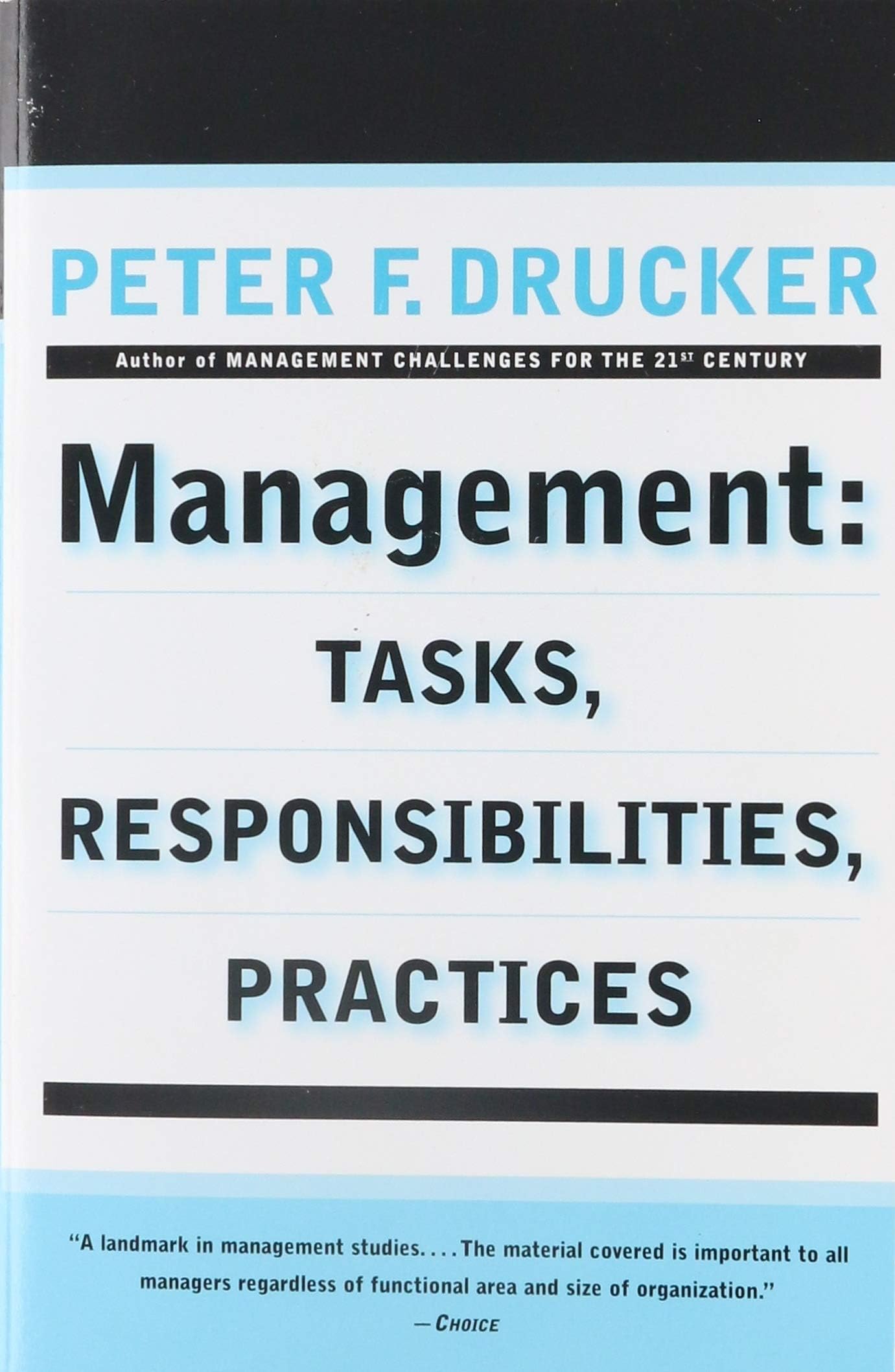


Management: Tasks, Responsibilities, Practices
Product ID: 18112194
Buy anything from 5,000+ international stores. One checkout price. No surprise fees. Join 2M+ shoppers on Desertcart.
Desertcart purchases this item on your behalf and handles shipping, customs, and support to Macau.
desertcart.com: Management: Tasks, Responsibilities, Practices: 9780887306150: Drucker, Peter F.: Books Review: The True Spirit of Management - A very practical book! I came across this in my first professional job after college in the Wall Street area in 1974. The officers in the Consulting Company, where I worked, used this pretty much as their Bible on running their business. We used to meet regularly as a staff and discuss Peter Drucker's ideas. Management wanted us to be versed in this stuff. I personally latched onto his thinking. It made sense! It worked! I carried it with me to other companies on Wall Street as I grew into management positions, and later in the Management area of several computer manufacturer's Software Engineering Research and Design departments. Drucker was famous for the whole concept of Management by Objectives (MBO). Besides being the "latest craze," it met with great success. It was a logical tool for businesses to plan their growth, future, operations and the management of their day-to-day business, departments, etc. This grew into what we know today as Strategic Planning. This book still has tremendous value today. I have replaced my original hardcover copy twice. It has stood the test of time. I find that the most valuable chapter in this good-sized book has been Chapter 36, "The Spirit of Performance." That was a chapter which emphasized: ------------------------------------------------------------ To Make Common Men & Women Do Uncommon Things--The Test Is Performance, Not Good Feelings--Focus on Strength--Practices, Not Preachments--The Danger of Safe Mediocrity--What "Performance" Means--What to Do with the Non-performer--"Conscience" Decisions--Focus on Opportunity--"People" Decisions--The Control of an Organization--Integrity, the Touchstone. ----------------------------------------------------- It basically encompassed the most essential things a manager had to know about managing, motivating and dealing with people. It spoke of things like responsibilities, accountability and fairness. It was extremely uplifting. For instance, it taught: ----------------------------------------------------- The spirit of performance requires that there be full scope for individual excellence. The focus must be on the strengths of a man--on what he(/she) can do rather than on what he(/she) cannot do. "Morale" in an organization does not mean that "people get along together"; the test is performance, not conformance. Human relations that are not grounded in the satisfaction of good performance in work are actually poor human relations and result in a mean spirit. And there is no greater indictment of an organization than that the strength and ability of the outstanding man(/woman) become a threat to the group and his performance a source of difficulty, frustration, and discouragement for the others. Spirit of performance in a human organization means that its energy output is larger than the sum of the efforts put in. It means the creation of energy. This cannot be accomplished by mechanical means. A mechanical contrivance can, at its theoretical best, conserve energy, but it cannot create it. To get out more than is being put in is possible only in the moral sphere. Morality does not mean preachments. Morality, to have any meaning at all, must be a principle of action. It must not be exhortation, sermon, or good intentions. It must be practices. ----------------------------------------------------- Thirty-six years later, I still go back to this. I have had reason twice to go back to this just in the last few months. This and an essay, "A Man Subject to Authority." from a spiritual book, "Unprofitable Servants: Conferences on Humility," by Nivard Kinsella, O.S.C.O., were resources I kept close at hand and referred to frequently. Coming from two completely different sources they seemed to compliment each other very well. The essay began it with, "Humility is the most necessary of all the virtues. It is so at all times and for everyone. If it can be said to be more necessary for one than for another, that one is the person who is in authority." In a sense, it could have fit right into Drucker's chapter on "The Spirit of Performance." I think both were bordering on sort of a universal truth concerning dealings with people. I think, even after retirement, I'll have a copy of both of these books, which open first to the above sections, in close proximity--never too far away! In fact, only a few months ago, I bought an audio copy of the book on CDs. I hope to listen to the whole thing sometime in the near future. Why? It always seems to spur me on. In writing this, I once again took a look at the end of Ch. 36. It does me good. We need more of this in our country. I'll share it with you here: ----------------------------------------------------- This chapter has talked of "practices." It has not talked of "leadership." This was intentional. There is no substitute for leadership. But management cannot create leaders. It can only create the conditions under which potential leadership qualities become effective; or it can stifle potential leadership. The supply of leadership is much too uncertain to be depended upon for the creation of the spirit the enterprise needs to be productive and to hold together. But practices, though seemingly humdrum, can always be practiced whatever a man's aptitudes, personality, or attitudes. They require no genius--only application. They are things to do rather than to talk about. And the right practices should go a long way toward bringing out, recognizing, and using whatever potential for leadership there is in the management group. They should also lay the foundation for the right kind of leadership. For leadership is not magnetic personality--that can just as well be demagoguery. It is not "making friends and influencing people" that is flattery. Leadership is the lifting of a man's vision to higher sights, the raising of a man's performance to a higher standard, the building of a man's personality beyond its normal limitations. Nothing better prepares the ground for such leadership than a spirit of management that confirms in the day-to-day practices of the organization strict principles of conduct and responsibility, high standards of performance, and respect for the individual and his work. ----------------------------------------------------- That's what makes this book great! Review: Essential Base for Improving My (and maybe your) Management practices - As I study and apply my way through this wonderful book, I'm becoming a better and better manager of my business. I strongly recommend Drucker's book and his approach to anyone who desires to be a better manager or business owner. None of the management practices Drucker recommends is outdated. A very few points he makes have been overtaken by events. But they won't do any harm, because they are easily recognized. On the other hand, some of his predictions, made so many years ago, have turned out to be right on the button. This carries great weight with me because it indicates that he knows what he is saying. Other reviewers were correct about getting this early edition. I got the more recent edition at the library. A lot of it did not seem to be Drucker's style. So I bought the original. Presuming that I successfully master and apply all of this edition, Then I'll buy the most recent edition. In my best reviews, I cite examples from the book. It's hard to do that here, because Drucker covers so much ground and provides countless examples. So I'll share the one point that hit me the hardest: when an action should be done, do it; don't avoid the painful solutions, because delay only allows the problems to grow worse.
| ASIN | 0887306152 |
| Best Sellers Rank | #1,120,639 in Books ( See Top 100 in Books ) #3,327 in Entrepreneurship (Books) #4,859 in Leadership & Motivation #5,447 in Business Management (Books) |
| Customer Reviews | 4.7 4.7 out of 5 stars (163) |
| Dimensions | 5.31 x 1.95 x 8 inches |
| Edition | Reprint |
| ISBN-10 | 9780887306150 |
| ISBN-13 | 978-0887306150 |
| Item Weight | 1.4 pounds |
| Language | English |
| Print length | 864 pages |
| Publication date | April 14, 1993 |
| Publisher | Harper Business |
B**N
The True Spirit of Management
A very practical book! I came across this in my first professional job after college in the Wall Street area in 1974. The officers in the Consulting Company, where I worked, used this pretty much as their Bible on running their business. We used to meet regularly as a staff and discuss Peter Drucker's ideas. Management wanted us to be versed in this stuff. I personally latched onto his thinking. It made sense! It worked! I carried it with me to other companies on Wall Street as I grew into management positions, and later in the Management area of several computer manufacturer's Software Engineering Research and Design departments. Drucker was famous for the whole concept of Management by Objectives (MBO). Besides being the "latest craze," it met with great success. It was a logical tool for businesses to plan their growth, future, operations and the management of their day-to-day business, departments, etc. This grew into what we know today as Strategic Planning. This book still has tremendous value today. I have replaced my original hardcover copy twice. It has stood the test of time. I find that the most valuable chapter in this good-sized book has been Chapter 36, "The Spirit of Performance." That was a chapter which emphasized: ------------------------------------------------------------ To Make Common Men & Women Do Uncommon Things--The Test Is Performance, Not Good Feelings--Focus on Strength--Practices, Not Preachments--The Danger of Safe Mediocrity--What "Performance" Means--What to Do with the Non-performer--"Conscience" Decisions--Focus on Opportunity--"People" Decisions--The Control of an Organization--Integrity, the Touchstone. ----------------------------------------------------- It basically encompassed the most essential things a manager had to know about managing, motivating and dealing with people. It spoke of things like responsibilities, accountability and fairness. It was extremely uplifting. For instance, it taught: ----------------------------------------------------- The spirit of performance requires that there be full scope for individual excellence. The focus must be on the strengths of a man--on what he(/she) can do rather than on what he(/she) cannot do. "Morale" in an organization does not mean that "people get along together"; the test is performance, not conformance. Human relations that are not grounded in the satisfaction of good performance in work are actually poor human relations and result in a mean spirit. And there is no greater indictment of an organization than that the strength and ability of the outstanding man(/woman) become a threat to the group and his performance a source of difficulty, frustration, and discouragement for the others. Spirit of performance in a human organization means that its energy output is larger than the sum of the efforts put in. It means the creation of energy. This cannot be accomplished by mechanical means. A mechanical contrivance can, at its theoretical best, conserve energy, but it cannot create it. To get out more than is being put in is possible only in the moral sphere. Morality does not mean preachments. Morality, to have any meaning at all, must be a principle of action. It must not be exhortation, sermon, or good intentions. It must be practices. ----------------------------------------------------- Thirty-six years later, I still go back to this. I have had reason twice to go back to this just in the last few months. This and an essay, "A Man Subject to Authority." from a spiritual book, "Unprofitable Servants: Conferences on Humility," by Nivard Kinsella, O.S.C.O., were resources I kept close at hand and referred to frequently. Coming from two completely different sources they seemed to compliment each other very well. The essay began it with, "Humility is the most necessary of all the virtues. It is so at all times and for everyone. If it can be said to be more necessary for one than for another, that one is the person who is in authority." In a sense, it could have fit right into Drucker's chapter on "The Spirit of Performance." I think both were bordering on sort of a universal truth concerning dealings with people. I think, even after retirement, I'll have a copy of both of these books, which open first to the above sections, in close proximity--never too far away! In fact, only a few months ago, I bought an audio copy of the book on CDs. I hope to listen to the whole thing sometime in the near future. Why? It always seems to spur me on. In writing this, I once again took a look at the end of Ch. 36. It does me good. We need more of this in our country. I'll share it with you here: ----------------------------------------------------- This chapter has talked of "practices." It has not talked of "leadership." This was intentional. There is no substitute for leadership. But management cannot create leaders. It can only create the conditions under which potential leadership qualities become effective; or it can stifle potential leadership. The supply of leadership is much too uncertain to be depended upon for the creation of the spirit the enterprise needs to be productive and to hold together. But practices, though seemingly humdrum, can always be practiced whatever a man's aptitudes, personality, or attitudes. They require no genius--only application. They are things to do rather than to talk about. And the right practices should go a long way toward bringing out, recognizing, and using whatever potential for leadership there is in the management group. They should also lay the foundation for the right kind of leadership. For leadership is not magnetic personality--that can just as well be demagoguery. It is not "making friends and influencing people" that is flattery. Leadership is the lifting of a man's vision to higher sights, the raising of a man's performance to a higher standard, the building of a man's personality beyond its normal limitations. Nothing better prepares the ground for such leadership than a spirit of management that confirms in the day-to-day practices of the organization strict principles of conduct and responsibility, high standards of performance, and respect for the individual and his work. ----------------------------------------------------- That's what makes this book great!
T**K
Essential Base for Improving My (and maybe your) Management practices
As I study and apply my way through this wonderful book, I'm becoming a better and better manager of my business. I strongly recommend Drucker's book and his approach to anyone who desires to be a better manager or business owner. None of the management practices Drucker recommends is outdated. A very few points he makes have been overtaken by events. But they won't do any harm, because they are easily recognized. On the other hand, some of his predictions, made so many years ago, have turned out to be right on the button. This carries great weight with me because it indicates that he knows what he is saying. Other reviewers were correct about getting this early edition. I got the more recent edition at the library. A lot of it did not seem to be Drucker's style. So I bought the original. Presuming that I successfully master and apply all of this edition, Then I'll buy the most recent edition. In my best reviews, I cite examples from the book. It's hard to do that here, because Drucker covers so much ground and provides countless examples. So I'll share the one point that hit me the hardest: when an action should be done, do it; don't avoid the painful solutions, because delay only allows the problems to grow worse.
L**N
A great read.
A great read...though very lengthy! Only buy this if you are serious about becoming a great manager and only if you are willing to read it a minimum of 3 times -- it will take that many reads to begin to absorb the more significant material. There is no management training better than Drucker!
Y**H
Management classic
Management classic. Lead your team effectively
W**U
Classic Drucker
I have read several of Mr. Drucker's books and found them all insightful. I am a big proponent of management as a profession and this book provides the essential tools and techniques needed to be a great manager. It should be mandatory reading for all managers!
R**L
Great Book,
Every page is full of wisdom, I doubt it will ever be obsolete. Although it is intended for managers, I believe it has great insights for all people.
B**N
What can be said, Drucker always the best--needed refresh.
I had this book in school and it was my favorite, but I could not find it, so I bought it again, as a digital edition. Timeless classic. Drucker is still the best, and the most cogent.
W**E
Required reading for business.
Classic, I used it during my MBA. Best single business text I ever had. I gave it to my wife who was starting a business. Required reading if you want to do your job well in business.
A**L
Great book, author and insight and some of which is very relevant today - Must read!
J**A
Un excelente libro para comprender el Management y sus diferentes contextos, porqué grandes empresas crecieron y fueron exitosas y porqué otras no... de mis mejores compras de libros, aprendí bastante!
F**I
É un libro denso di messaggi e spunti di riflessione non banali, da leggere con attenzione. Chiunque si occupi od intenda occuparsi di gestione d'azienda vi troverá innumerevoli insegnamenti e tecniche da mettere in pratica. Ha più di 40 anni, ma non li dimostra affatto.
F**G
Takeaways from reading the book: Who is the customer? - Page 80: Understand who the customer is. Usually, a business has at least two customers. Example: For a business that makes consumer goods, customers are 1) end users and 2) supermarkets. - Page 82: Understand where the customer is. Example: One of the secrets of Sears' success in the 1920s was the discovery that its old customer was now in a different place: The farmer had become mobile and was beginning to buy in town. - Page 83: Understand what the customer buys. Example: Does a premium car user primarily buy transportation or status? - Page 91: Sony asked "What are the unsatisfied wants?" and found that there was an unsatisfied want for portable transistor radios. What is the purpose? - Page 41: A company exists for the sake of the users. - Page 43: No organ can survive the body which it serves. The enterprise is an organ of society and community. - Page 55: Sears stopped defining its business as goods and started defining it as the needs, wants, and satisfactions of the American middle-class family. - Page 61: The purpose of a business must lie in society - outside of the business. - Page 61: There is one valid definition of a business purpose: To create a customer. - Page 61: It is possible that a person had no want for something before a business created it. - Pages 61 and 79: A customer determines what a business is. What the customer sees, thinks, believes and wants must be accepted as objective fact. - Page 61: What the customer thinks he is buying is what matters. It determines what a business is, what it produces, and whether it will prosper. - Page 75: What are the values and beliefs of the business? - Page 89: In light of external changes that are happening, what will the purpose of the business be? - Page 89: To find out what a business will be, a reliable foundation is demographic analysis. - Page 92: The goal of the question "What will our business be?" is to adapt to anticipated changes, i.e. to modify, develop and extend the existing business. Asking this question, IBM realized that data processing would have to mean computers instead of punchcards. - Page 122: The three questions "What is the business?", "What will it be?" and "What should it be?" are separate conceptual approaches. - Page 122: With respect to the question "What should the business be", the first assumption must be that it will be different. - Page 150: There were different ideas about what the purpose of the American university should be when it was built. For example, President of John Hopkins University, Daniel Gilman, saw the university as producer of advanced knowledge, whereas President of Columbia University, Nicholas Murray Butler, saw the function of the university as the systematic application of rational thought and analysis to basic problems of a modern society. What characterizes objectives? - Page 94: GE's planning does not start out with the question, "What new things should we go into?" It starts out with the question, "What existing product lines and businesses should we cut back?" - Page 99: Objectives are the fundamental strategy of a business. - Page 99: Objectives must be operational - capable of being converted into specific assignments. - Page 99: From the start, Marks & Spencer converted objectives into work assignments. It thought through what results and contributions were needed in each objectives area. It assigned responsibility for these results to someone and held the person accountable. And it measured performance and contribution against the objectives. - Page 100: Objectives are needed in marketing, innovation, human organization, financial resources, physical resources, productivity, social responsibility and profit requirements. - Page 101: Objectives are direction and commitments. - Page 108: Retail stores need objectives for the development of stores and utilization of shelf space. - Page 117: In setting objectives, management always has to balance the immediate future against the long range. - Page 122: What new and different businesses, technologies, and markets should the company develop? How is planning of actions done? - Page 126: The first step in planning is to get rid of what is obsolete and no-longer productive. Ask yourself, "If we were not committed to this today, would we go into it? If the answer is no, ask yourself how you can get out - fast. - Page 126: The next step in planning is to ask "What new and different things do we have to do? - Page 126: Think through the time dimension. When will you start work? When do you need to see results? - Page 128: The test of a plan is whether management commits resources to action which will bring results. - Page 128: Decide what you will measure and how you will measure it. Tools and technology - Page 224: The right question for the manager is not whether there is a bigger tool for the job. On the contrary: The manager needs to ask, "What is the simplest, the smallest, the lightest, the easiest tool that will do the job?" - Page 226: If human effort is mis-engineered into the system so that it does machine work, the system works poorly. What kinds of innovation are there in a business? - Page 107: Innovation in products and services. - Page 107: Innovation in marketplace, consumer behavior and values. - Page 107: Management innovation, i.e. innovation in skills and tasks needed to make products and services and to bring them to market. How can we increase productivity? - Page 33: Taylor defined what productivity is with respect to the manual worker - not with respect to the engineer or knowledge worker. - Page 33: An engineer who created drawings for an unsalable product is unproductive. - Page 33: Productivity with respect to the knowledge worker is primarily quality. - Page 33: Knowledge cannot be productive unless the knowledge worker finds out who she or he is, what kind of work she or he is fitted for, and how he works best. - Page 67: Productivity means the balance between all factors of production that will give the greatest output for the smallest effort. - Page 68: Increased productivity in a modern economy is never achieved by muscle effort. It is always achieved of doing away with muscle effort. Examples of substitutes are technology and knowledge. - Page 100: All businesses depend on three factors of production: People, capital and physical resources. They must be employed productively. There must be objectives for the supply, their employment and their development. - Page 111: The task of a business is to make resources productive. - Page 111: Productivity includes all the efforts the enterprise contributes. It excludes everything it does not control. - Page 176: The knowledge worker is not productive when she or he feels fear. - Page 176: Only self-motivation and self-direction can make the knowledge worker productive. - Page 176: For most knowledge work we cannot define or measure productivity. - Page 199: To make work productive, 4 initiatives are required: 1. Analyzing to find out what needs to be done. 2. Defining a process. 3. Control of quality and quantity. 4. Appropriate tools. What work are humans good at? - Page 183: Coordination. - Page 183: Relating perception to action. - Page 183: A human being works best when mind, senses and muscles are engaged. - Page 184: A person works best if he or she can personally control speed, rhythm and attention. - Page 184: A person works better with a high degree of diversity than doing a single operation. - Page 184: Work is one of the ways in which a person measures his or her worth. - Page 185: The Benedictine monks preached that all work was serving and contribution and equally deserving of respect. - Page 187: Aristotle said that people are social animals. We need work to satisfy our needs for belonging to a group. What does a manager do? - Pages 17 and 39: Think through and define the purpose. - Pages 49 and 73: Based on the purpose, set goals in key areas. - Page 17: Direct resources toward greatest results and contributions. - Pages 17 and 41: Organize work for productivity. Lead people toward productivity and achievement. - Page 17: Communicate with people within the organization. - Page 17: Make decisions under conditions of uncertainty. - Page 17: Strategic planning. - Page 31: Become an entrepreneur. Learn to continuously build and manage an innovative organization. - Page 35: Generate and direct human energy. - Page 35: Express basic beliefs and values. - Page 45: Find out what products, orders, customers, markets or people produce 80% of the results or have the potential to do so. - Page 46: Find out what is holding back the business. - Page 46: Find out what small changes would strongly increase results. - Page 54: Organize work. Example: As Sears moved from mail order selling to retail operations, organization structure decentralized - increasing local autonomy. - Page 73: Managing a business must be a creative rather than an adaptive task. - Page 111: The continuous improvement of productivity is one of management's most important jobs. It is also one of the most difficult. What values and beliefs characterize management? - Page 6: The essence of a manager is responsibility. - Page 13: Wherever rapid and social development took place after World War 2, it occurred as a result of systematic and purposeful work on developing managers and management. - Page 35: Economic and social development is the result of management. - Page 19: For the communist reformers in Hungary, the former Yugoslavia, and the former Czechoslovakia, management embodied Western values: The value of individual responsibility, the value of autonomy, and respect for the individual. - Page 24: The goal of Frederick Taylor was to make it possible to give workers decent livelihoods by increasing the productivity of work. - Page 43: Management has to serve the present and the short run as well as the future and the long run. - Page 111: It is no longer adequate, as many managers still seem to think, to say, "This is what we need; what do we have to pay for it?" One also has to say, "This is what is available; what do we have to be, how do we have to behave, to get the fullest benefits?" Who helped people understand what management is? - Page 3: In 1900, institutions were small. Social tasks were handled in the family. Individual professionals such as farmers, store owners and craftsmen were working by themselves. - Pages 14 and 25: Before World War 2, only Harvard taught management. Harvard Business School started in the 1930s to teach courses in management - though still mainly in production management. - Page 14: By the late 1960s, hundreds of business schools were teaching management all over the world. - Page 22: The Compte de Saint Simon (1760-1825) discovered management. He saw the emergence of organization. He saw the task of making resources productive. What needs to happen when a company has success? - Page 65: It is not necessary for a business to grow bigger. But it is necessary that it constantly grow better. - Page 87: The most important time to ask "What is our business?" is when a company has been successful. - Page 87: It is never popular to argue with success. - Page 159: Success breeds its own hubris. It creates emotional attachment, habits of mind and action and false self-confidence. What should governments do and not do? - Page 4: Government in Switzerland has grown far less than in any other country in the world. - Page 13: The Marshall plan set out after World War 2 to mobilize management for economic and social reconstruction. The success of the Marshall Plan made management a bestseller. - Page 133: Manage government organizations more for contribution and performance than for the convenience of employees. - Page 106: A new market tends to expand more rapidly when there are several suppliers rather than only one. - Page 154: The market approach can be capitalist as well as socialist. Whether ownership is in capitalist hands or not is no longer primary. What matters is managerial autonomy and accountability. What matters is whether resources are being allocated to produce results and on the basis of results. - Page 160: Customers of a government owned monopoly have no redress against inefficiently, poor service, high rates, and general disregard of customer needs. Should people, who work for a company, own it? - Page 52: Every person, who worked for Sears, received an ownership stake in the company. - Page 190: Worker ownership works only in highly profitable businesses. When profits drop, worker ownership no longer solves the conflict. Other research from the book - Page 117: To produce more sales almost always means to sacrifice immediate profit. - Page 124: Forecasting is not a respectable human activity and not worthwhile beyond the shortest of periods. - Page 146: Human beings will behave as they are being rewarded. - Page 168: The purpose of play lies in the player. The purpose of work lies with the user of the end product. - Page 169: At the end of the 19th century, work centered around the home. - Page 170: All pressures of society, family and neighbours, community and school, push young people toward more schooling. - Page 182: Knowledge work by definition does not result in a product. It results in a contribution of knowledge to somebody else. - Page 196: As employees compare themselves with each other, the size of salaries becomes more about social aspects as economic aspects. - Page 208: Without mass production methods, neither Gothic cathedrals and churches nor Japanese temples could have been built. They were built by semiskilled and unskilled workers. - Page 235: The spread of education gives people a wider horizon. To be updated.
A**R
日本語訳を読んだだけではわからない、微妙な英語の言い回し、意味を理解できます。 全部読まなくても、部分部分、要所要所の英語表現を確認し、理解を深めるだけでも効果あると思います。
Trustpilot
1 week ago
1 month ago