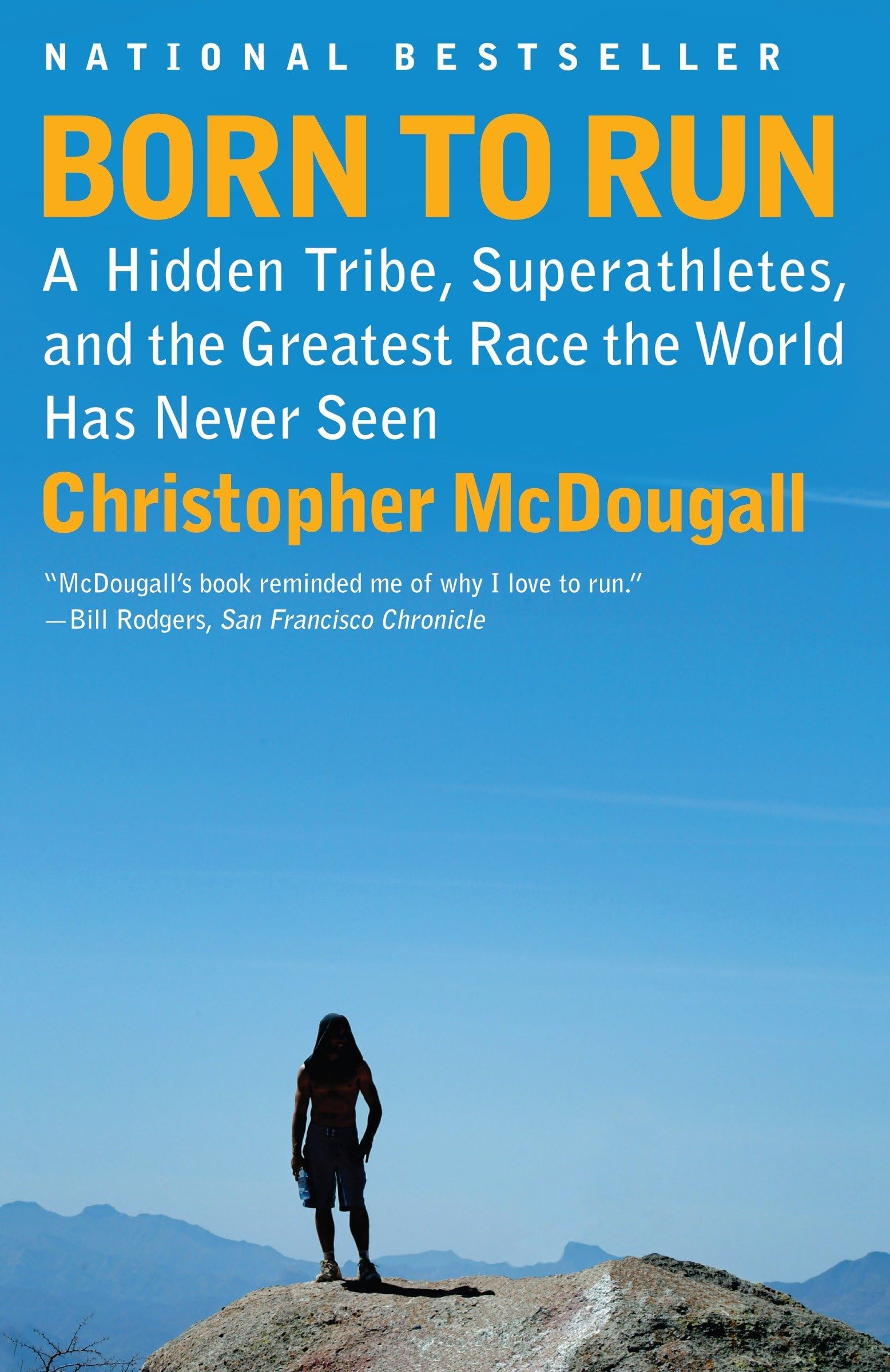
Born to Run: A Hidden Tribe, Superathletes, and the Greatest Race the World Has Never Seen
Product ID: 199731
🌄Copper Canyon setting
📚Scientific & evolutionary insights
🏃♂️Epic ultra-running saga
Buy anything from 5,000+ international stores. One checkout price. No surprise fees. Join 2M+ shoppers on Desertcart.
Desertcart purchases this item on your behalf and handles shipping, customs, and support to Macau.
🏃♀️ Unlock your inner ultra-runner — because we were all born to run!
Born to Run is a bestselling, genre-defining book that blends thrilling storytelling with scientific research to reveal how the Tarahumara Indians of Mexico’s Copper Canyon run ultra-distances effortlessly. Journalist Christopher McDougall explores evolutionary biology, critiques modern running shoes, and chronicles a legendary race that challenges the limits of human endurance, inspiring readers to rethink running and their own potential.


| Best Sellers Rank | #8,577 in Books ( See Top 100 in Books ) #2 in Track & Field Sports #3 in Extreme Sports (Books) #13 in Running & Jogging (Books) |
| Customer Reviews | 4.7 out of 5 stars 26,480 Reviews |
M**A
Anyone can run, anytime, anywhere!!!
I love to get outside and walk, then try my legs at running, but mostly what I do is I trot. I had to read this book, because it is a famous runner's classic by now, and I wanted to learn more about our fabulous human anatomy and how the author, Christopher McDougall assures the reader that we were truly evolved to run. My personal trainer warned me NOT to run, because I am obese. If you were to look at my body, you would not really say I'm obese, but I am overweight or you might say that I am fat. You won't get in trouble for saying that, even though it's sort of mean, because it's the truth and I need to do something about it! So, I need to work out at the gym and I need to run because running burns lots of calories. I happen to love my body, however - and I DO run, because I LOVE the way that it makes my body feel! This book delves into the joy of running, and there is alot of helpful scientific facts that support the notion that all human beings who can walk, can also run. The author assures us that our bodies were designed to run, and in fact, humans have been running to just survive on this planet since the day we appeared on this beautiful earth. Now - I will never be a half-marathoner, and I don't even want to think of being a marathoner; 26 miles is just too much for me to wrap my mind around. But I can do a 5K, and maybe if I try hard and adjust my attitude, I can do a 10K! After reading this book, I know that I can do anything that I set my mind to doing. Running long distances does require some training, dietary support and strategy. McDougall tells a wonderful story about the Tarahumara Indians that run through treacherous trails in the Copper Mountains of Mexico, and the dangers that follow them, which only encourages them to run faster. It is a funny book; full of great scientific insight and suggestions for thought for all of us who dream of running. McDougall's attitude is contagious; the longer I live, the more I realize that it is our attitudes that help us to achieve our goals. Having a positive attitude can push a person to get up and get out and run. Attitude is more important than appearance, than education, than money or circumstances. Attitude can either make you win or lose; it is up to the individual. After reading this book, I realized that life is 10% of what happens to me and 90% on how I react to it. I learned that having the most expensive running shoes is not the best plan...as a matter of fact, McDougall claims that the more expensive the running shoe, the more likely it will cause foot problems or injury!McDougall promotes cheap, beat-up old running shoes or Vibrams; which I always had such a low opinion of because of their extreme ugliness. Nobody wants to see your toes! Feet are somewhat ugly, and Vibrams make them look even uglier; I don't like to show my feet off if I don't have to. But anyhow - - - I loved that McDougall discusses the Mexican diet of pinto beans, tortillas and rice, with some form of protein added to the plate. He gets into Chia, which is a weird plant based grain that I normally never noticed, but now I will go to the health food store and give it a try. You can add it to your cereal, or main dishes or create a drink out of Chia. It's supposed to be a clean and energy packing food. Diet has an enormous impact on one's ability to run and run and run. I can't imagine running for four hours straight, though. I know my limitations. Or are they just self-imposed, imaginary limitations that I should endeavor to smash through like they don't exist? This book has adjusted my attitude about how I view my body. Attitude is what drove this man to overcome his own pain while running, and he achieved a high level of running performance by the end of the book. Get the book, read it - savor it like a hot bowl of delicious soup on a cold, dank and rainy day! There is alot to learn inside of it and I guarantee you will enjoy the process of reading it.
D**R
Excellent Source of Inspiration for Runners and a Fascinating Examination of Modern Running Shoes
Christopher McDougall's "Born to Run" contains an epic tale about a race between some of the greatest modern ultra-runners pitted against the original (and elusive) extreme distance-runners, the Tarahumara Indians of Mexico. I was impressed on multiple levels and look forward to re-reading this book in the future. I chose to read this book at this time because I am in the middle of training for my second half-marathon and thought it would give me an extra boost of inspiration for my training. Not only was the book helpful for my training, it was educational and thrilling at the same time. This book pack quite a punch — certainly more than I bargained for, which was a pleasant surprise. The Tarahumara Indians are a group of native Mexicans that are well-known for their ability to run ultra-marathon distances. They are difficult to locate due to their ability to camouflage their homesteads, and prefer hermet-like isolation to interacting with the outside world. It is difficult to earn their trust, and McDougall explains the process that he went through to locate them and then cultivate a positive relationship with them. I found the story of the Tarahumara fascinating and even jaw-dropping at times, and McDougall does an excellent job describing their background to his readers. There is a character in the book named Caballo Blanco, who is a former-American that lives primarily in the Copper Canyons where the Tarahumara are located. He is capable of running ultra-marathon distances daily, just like the Tarahumara, and he has befriended the Indians over a long period of time. "Born to Run" begins with the search for Caballo, who takes McDougall under his wing and eventually orchestrates an incredibly unique ultra-marathon race between the Tarahumara and a small ragtag group of modern ultra-runners. The book takes a brief detour to discuss the correlation between modern running shoes and injuries. I was very interested in this section and absorbed a lot of helpful information that I plan to gradually incorporate into my running practice. Next there is a section that offers evolutionary evidence that shows that our species may have evolved the ability to run long distances specifically for persistence hunting (running animals to death by exhaustion). Is it really possible that modern-day humans are built for long-distance running because it provided an evolutionary advantage over the Neanderthals? I will have to reserve my judgment for this theory until I read more scientific evidence, but it is certainly an interesting theory. And it inspires me to encourage everyone I know to pick up running, since we may have literally been built for it! The climax of the book centers on the race between the Tarahumara Indians and modern ultra-runners. The race sounds like a once-in-a-lifetime opportunity and McDougall's description of it is enough to make any runner salivate with desire to take part. "Born to Run" is an excellent book that provides a thrilling yarn, a history of an ancient group of ultra-runners, an in-depth look into the possibility that modern running shoes cause running-related injuries, and an evolutionary theory about our ancestors' ability to run long distance for hunting animals. I would advise any runner who is interested to give it a read, and look forward to reading it again in the future.
S**A
Run for fun
First, this book tells a good story. It meanders through colorful characters, rather eccentric most of them, & difficult terrains. Threads emerge & dissolve in this largely straightforward storyline, but for me the two aspects, woven into the larger story, that set this book apart are the science & philosophy of running. First, the philosophy. Essentially, this book projects running as a 'flow' experience. Not grit, not determination, not endless hours of practice in the search of a medal or a record, but running because its something you love to do. Because its fun to run, because its fun to push your body to see how far it will let you push. And the only goal you set is your own. Just like music, you enjoy it when you start & enjoy it as you gain mastery. You gain mastery because you enjoy it, you practice because you love it, & if you do get certain recognition or commercial benefits, well, that is secondary too. The end goal is engagement & enjoyment - & that's the philosophy of running too, just as much it is the philosophy of music or arts. Secondly, the science. I found the anatomical aspects both interesting & convincing, I enjoyed reading about what the anatomy of running means for running shoes. I can't say if the research behind is exacting, McDougall is no scientist, but to me it made sense. It is when McDougall starts talking evolution that I got a little uncomfortable. It is a brilliant piece to read & its a great argument to show how our bodies are made for distance running - in fact, it almost reads like a detective novel as McDougall sets out to find the evolutionary roots of running - & while the theory & reasoning seemed to make sense, I do not know if McDougall presents enough evidence. Yes, he presents the story of a hunter-gatherer tribe which ran its prey to exhaustion to feed on it, but I do not know if this is representative enough as evidence that links running directly to Darwin's evolution. McDougall writes flowing text with a certain amount of humour. Good story & good research - you should pick it up if you are a runner & even if you enjoy popular philosophy & motivational theories. @souvikstweets
A**O
A journey that may become your own
(This review refers to the hardcover edition.) 5-stars -- A page-turner that may change your views on running and of life. This book is a true story. This book is a fun adventure. This book is an education. This book is a journey. This book is a serendipity. This book may change your life. There are four stories in the book. The author searches for a cure to the pain in his foot. Along the way, he meets a number of interesting characters whose life stories are each adventures in themselves. He ultimately gets an education in evidenced-based, experiential, and peer-reviewed research that turns mainstream theories of running bio-mechanics, extreme endurance and the evolution of man on their sides. And finally, as you relive the events of his story, you may write the final story comprised of your own realization and then your own personal quest for the joy of running and the joy of life. One of the top reader reviews of this book highlights four chapters that cover, in the reviewer's opinion, the key information comprising the meat of the book, the "must-read" chapters (chapters, 15, 25, 27, 28). But the reviewer tires of the narrative rambling through the remainder of the 300 pages, and wishes that the author would simply get to the point, further suggesting that busy readers bypass the excess and skip right to these four chapters. May I propose that this reviewer may have missed the whole point of the book. Although enthusiastic about the material he highlights that encouraged him to try running again, the reviewer may not experience all the serendipitous moments of the story since he was not enamored with the journey of the book, a journey necessary in toto to lead the reader to the full joy of running. You do not have to be an extreme endurance practitioner or enthusiast to realize and experience the thesis of the book, that man was born to run. What you learn here can still give you joy in running and in life even if taken in only modest amounts. The only (very minor) critique I have is that no bibliography was provided so as to more easily examine the research and background stories referenced. Fortunately, Wikipedia and Google search make short work of that task as long as you don't reside in the Copper Canyons of Mexico (their internet coverage is not quite as ubiquitous as elsewhere). (This review is only my preliminary draft of first-impressions. I intend to write a more detailed exposition focusing particularly on the research referenced throughout the book, but that will require a second reading, and no doubt a few more runs under my belt.) Run to the nearest library or bookstore to read this book. Then read this book to run for your life.
K**N
Born to (Endurance!) Run...
Although ultramarathoning is still considered a fringe sport by the at large American population, it is rapidly growing -- the fastest-growing outdoor sport in the country in 2002, in fact -- and given the popularity of Christopher McDougall's "Born To Run", I'm not surprised by that claim. What you may be surprised to discover, however, is that homo sapiens evolved because we ran. And we survived -- thrived -- because we ran far. This book is part self-discovery, part history of running lore, and part exploration of running mechanics. McDougall embarks on this journey because of a single, simple question -- "How come my foot hurts?" -- to which few medical professionals proffer anything except, "You just aren't physically built to run". Refusing to accept their hopeless diagnoses, McDougall devours all things running-related, visits medical specialists, and eventually hunts down Caballo Blanco -- the White Horse -- a gringo living amongst an ancient, hidden tribe: the Tarahumara. The eventual meeting of Caballo Blanco marks the beginning of a fundamental shift in McDougall's running form, philosophy, and life disposition. To wit, running well meant living lean and building soul as much strength. And Scott Jurek, the perfect embodiment of American ultrarunning, bridges the gap between the modern ultrarunner and the Tarahumara. Sprinkled throughout the story of how a handful of elite American ultrarunners, Jurek and Luis Escobar included, trekked down to the Copper Mountains of Mexico to race against the legendary Tarahumara, McDougall offers up thoughtful and well-reasoned explanations of barefoot running, the evolution of running, and "persistence-hunting" (hunting via running). There are many (many!) underline and write-in-the-margins excerpts in this book -- some about Jurek, the Tarahumara, Caballo Blanco, and others just about running. The story about Jurek's resolve at his first Badwater 135 race is particularly moving: "There's no way, Scott told himself. You're done. You'd have to do something totally sick to win this thing now. Sick like what? Like starting all over again. Like pretending you just woke up from a great night's sleep and the race hasn't even started yet. You'd have to run the next eighty miles as fast as you've ever run eighty miles in your life. No chance, Jerker. Yeah, I know. For ten minutes, Scott lay like a corpse. Then he got up and did it, shattering the Badwater record with a time of 24:36." Barefoot Ted is also extensively quoted -- running barefoot is witnessing a tremendous uptake in believers -- due, in no small part, to the popularity of this book. The sage of barefoot running, Barefoot Ken Bob, declared: "Shoes block pain, not impact! Pain teaches us to run comfortably! From the moment you start going barefoot, you will change the way you run." McDougall also interviews and extensively quotes a handful of academics, e.g. Dr. Dennis Bramble of the University of Utah, regarding the history and the role that running played in human evolution. Theories are explained, evidence presented, and examples provided, all culminating to Dr. Bramble's solution to human excess and epidemics: "Just move your legs. Because if you don't think you were born to run, you're not only denying history. You're denying who you are." There is much more to this book -- more than I could conceivably write here -- but suffice to say, I devoured this book in several hours and have been digesting it since. And to hijack a saying of the Tarahumara: "When you run on the earth and run with the earth, you can run forever."
W**A
Running Truths + A Few Stubbed Toes
If this book were a runner, it stubs its toes in two areas: 1) The author unfortunately writes in a Frat Boy prose style; irritating, but the story is gripping enough that the reader can overlook it. Some may not mind, as style is a matter of taste. It is an athletic story, but the editors should have recognized that there's much more here than just a yarn that interests "jocks". Please don't let this stop you from reading the book. It is a ripping yarn. 2) The book reads like a string of articles out of "Men's Health" magazine because that's what the writer does for a living, and it is how the book originated. The author has some awards in this category, so at least he's a "good" article writer. It is a bit choppy. Don't let this dissuade you either. The book flies fleetly in these areas: 1) Bravely dispels running myth and flies in the face of tradition. Every *other* running book/magazine out there lionizes the likes of Bill Bowerman (Nike inventor) -- while this book, in nearly overwhelming fashion, exposes the downside of shoes (not all shoes, just super-cushioning raised-heel shoes, such as most running shoes since 1980). This may as well be flat-out heresy in the running world, in which shoe companies rule. The author is not doing this to be cheeky, but rather stumbled upon what the running community is starting to accept as fact (Ask yourself why Nike is now manufacturing a shoe called the "Free" which mimicks barefoot conditions.) 2) Answers paradoxical questions that anyone has run for awhile has already asked themeslves, such as: If I keep buying more expensive shoes, why am I getting injured *more*? Why is it some people are able to run (even barefoot?) without injury? Why are old men in Mexican villages hiking 30 miles a day in flimsy sandals, while my dad can't get along without orthotics? Why don't the people I know who wear orthotics ever "get better"? 3) Excellent collection of the odd--yet very true--feats in running lore. Much of this book ties in to the running community in Colorado, where I live, and where my wife has been an "almost-elite" (yes she's way faster than I am) runner and marathoner for over a decade. The races, runners, and coaches mentioned throughout the book will be well known to anyone well-versed in the sport. The ultra-runners are a fringe breed of folks to be sure, but there are many trail runners and trail-running groups in mountainous states like CO, WA, NV, UT, etc, and the same coaches that study ultra running are the ones coaching the Deena Kastors and Paula Radcliffes, and even Haile GebreSelassie. Look, running 100 miles at 10,000 feet (Leadville 100 race) is more than even most die-hard trail runners want to tackle. I already live at altitude and even *I* think going to Leadville sucks. The fact that Copper Canyon tribe members can go there and run 100 miles of the trails sight-unseen and WIN in flimsy sandals (beating other champion trail runners with their Nikes and energy gels, mind you) *IS* a story, and a downright compelling one. Some people are accusing the author of exaggerating, but as insane as some of the antics are in this book, there is not a lot of hyperbole. Read about other races like the Pike's Peak race, or Badwater (Runner's World Bart Yasso ran it in melting shoes, and wrote about it), and you'll soon realize how insane these activities are. Sure there are slow runners trotting around on ultra-marathon trails, but running a race like that to WIN is totally different story. Even Lance Armstrong (as is explained in the book w/humorous anecdote) can't succeed at marathon running, despite his uber-conditioned body. On a personal note, I have had running-related injuries in my teens (ankles), 20's (runner's knee), and now in my 30's (achilles). I now realize that the bio-mechanics of heel-striking is what's doing me in, and what has kept me from running more than a few miles at a time without injury. This book is only the *latest* piece of literature I have read that is advocating for barefoot training -- the other EXCELLENT work that comes to the same conclusion, just through a more scientific approach -- is BRAIN TRAINING FOR RUNNERS by Fitzgerald. Those of you dissatisfied with this book's science backing should check out Fitzgerald's approach, as he comes to it with a kinesiology background, but also as a runner himself, he mirrors the conclusions drawn in Born to Run.
B**S
Inspiring! Would make Edgar Allen Poe run barefoot!
Once upon a workout dreary, while I trotted, weak and weary, over many quaint and furious heel-strike, feet now throbbing sore, while I stumbled, nearly bumbled, suddenly there came a stabbing, as of someone cruelly stabbing, stabbing at my insole's door. "Tis an odd pebble," I muttered, "stabbing at my insole's door- only this, and nothing more." Ah, distinctly t'was but likely, from the dark pits of my psyche as each separate worn out Nike, wrought its mark on arches sore. Lo, though I felt idiotic; - vainly I implored my new orthotic- mend my arches, end my sorrow- sorrow for my poor foot's core For the rare and radiant arch once named within this biped's core- nameless here for evermore. And with painful step uncertain, pulled aside my mental curtain Thrilled me - filled me with fantastic terrors never felt before; So that now, to still the beating of my heart, I stood repeating, "'Tis some pebble entreating entrance at my poor foot's core- Some odd pebble entreating entrance at my poor foot's core; - This it is, and nothing more." Presently the pain grew stronger; hesitating then no longer, "oww," said I, "You pebble, though small have made running such a chore And as I run my strength sapping, and so quickly you came rapping, And so forcefully you came tapping, tapping at my poor foot's core, That I scarce was sure I felt you"- here I un-shod the poor core, empty there, and nothing more. Deep into that Nike peering, long I stood there wondering, fearing, Doubting, dreaming dreams no runner ever dared to dream before; But the silence was unbroken, and the emptiness gave no token The only word there spoken was to this biped's unshod core This I whispered, and an echo murmured back, "ouch- foot is sore" merely this, and nothing more. Back into the Nike turning, all my joints within me burning, Soon again I felt a tapping somewhat harder than before. "Surely," said I, "surely that is something in my orthotics: Let me see, then what therat is, and this mystery explore - Let my heart be still a moment and this mystery explore; - 'Tis a poor fit and nothing more." Now I stood and flung the shod, though not far, it landed whence I trod, Now stood I, bare and stately, looking on pale feet once sore Not the least pain in my feet; they smiled back as to entreat Now set freed and perched below me was my pale white core Perched in dust and now unshod there was my pale white core Perched and bare, sore no more Then this bony foot beguiling my sad frowning into smiling By the grave and stern decorum of the countenance it wore. "Though thy form art shaped and true, thou," I said, "art sure no shoe, Ghastly grim and ancient foot wandering from the Nike shore - Shouldn't I shod you to protect you and your fallen core Quoth my foot, "Nevermore." Much I marveled this ungainly foot to hear discourse so plainly, Though its answer little meaning- little relevancy bore; For we cannot help agreeing that no living human being Ever yet was blest with seeing naked foot in dust to adore - Foot or toe upon the dirty brown dust now below me, that I now adore, And now to shod "Nevermore." Now my foot, standing lonely in the dirty dust, spoke only That one word, as if its soul in that one word it did outpour. Nothing further then it uttered- no step had it stuttered- Till I scarcely more than muttered, "other shoes I've tried before- On the morrow you will pain me, same as shoes have left me sore." Then my foot said, "Nevermore." Startled at the stillness broken by reply so aptly spoken, "Doubtless," said I, "what foot utters is its only stock and store, Caught from some cruel Nike master whom unmerciful Disaster Followed fast and followed faster till its steps turned arches sore- Till the dirges of its Hope when shoes turned arches sore- Cried' Never - nevermore'." But the bare foot still beguiling all my sad soul into smiling, Hastily found I seat next to my dear feet, looked at arches once held sore; Then upon the dirt road sinking, I betook my feet though stinking Fancy unto fancy, thinking what this fallen arch often sore What this grim, ungainly, ghastly, gaunt and fallen arch often sore Meant in croaking "Nevermore." This I sat engaged in guessing, but no syllable expressing To the foot whose fiery soles now burned into my bosom's core; This and more I sat divining, with my head at ease reclining On the dirt road dusty lining that the bright sunlight gloated o'er But whose dusty dirty lining with the sunlight gloating o'er, shoes shall wear, ah, nevermore! Then me thought my stride grew lighter, like footwork of a prize fighter Stride like Seraphim whose footfalls tinkled on the dusted floor, "Doh!," I cried, "thy God hath lent thee - by these angels he hath sent thee Respite - respite, delight, from thy memories of foot once sore Quaff, oh quaff this kind respite, but won't the foot again become sore?" Quoth my foot, "Nevermore." "Barefoot!" said I, "how very odd! - better still than shoes of devil! - Whether Nike sent, or over-pronation caused thee foot to sore, Desolate yet all undaunted, on this dusty path enchanted - On this sole by horror haunted- tell me truly, I implore - Is there - is there relief by shoe to be had? - tell me - tell me, I implore!" Quoth my foot, "Nevermore." "Barefoot!" said I, "how very odd! - better still than shoes of devil! - Whether Nike sent, or over-pronation caused thee foot to sore, Tell this soul with fit orthotic, makes me run as though robotic, Shall mine foot have pain thought chronic and remain ever sore? Clasp arch fallen and broken, which has been forever sore? Quoth my foot, "Nevermore." "To you oh shoe this word in parting, shoe or fiend," I shrieked, upstarting - "Get thee back into the tempest and the Night's Plutonian shore! Leave no black swoosh as a token of that lie thy soul hath spoken! Leave arches to be unbroken!- quit the pain that makes me sore! Take thy print from out my heart, and take thy form from off my floor!" Quoth my foot, "Nevermore." And the shoe, never fitting, still is sitting, still is sitting In the pallid dust of the trail just where my once shod feet were sore; And the Nikes have all the seeming of a demon that is dreaming, And the moonlight o'er them streaming throws its shadow on the floor; And my sole from out that shadow that lies floating on the floor Shall be lifted - Evermore!
S**M
This book should come with a warning sticker
OK, I may be late to the party, but I feel I have an important point to make about this book. It's very, very dangerous. It's likely that you're already a runner, if you're interested in reading "Born to Run." So, you're probably already enjoying the rewards as well as the pitfalls of the running lifestyle: the crisp early morning runs, the thrill of race day, and the constant niggling (and maybe not so niggling) injuries that we just accept as a price for our passion. You may come to the book with little more knowledge than the blurbs on the cover or a friend's recommendation that it's an awesome book. So you dive in, and McDougall begins to spin his tale. The book reads like a 4-minute miler, and you find yourself engrossed in a story that just gets better and better as each chapter unfolds. Then, with subtlety and cunning, the author begins planting these notions in your head that maybe, just maybe, what you've thought about running, about YOUR running, has been wrong. That maybe those injuries that you have accepted forever might be your own damn fault, or, more specifically, Nike's damn fault. You begin to wonder, really really wonder, if perhaps this tribe of noble people have something to say directly to you about your own way of meeting the world, sole-wise. And before you know it, you've tossed your running shoes, and starting running in bare feet. Though you've been running for years, you start again, at square one, and learn a new way of running. And it's joyous and light, and you find yourself actually smiling when you run, and your legs tingle for hours afterward, and you decide that you'll never wear shoes on your run again. In short, the book changes your damn life. "Born to Run" is that kind of book. Well-written, passionate, intelligent, and thoroughly enjoyable. I read it twice, back to back, and still return to favorite chapters often. The cast of characters is terrific, the story unfolds at a wonderful pace, and the writing is solid. But I should warn you, and I think the publishers should too: this book will make you look at your running life in a very different way. It will make you want to run freely and with joy, to recapture that feeling that you had as a child when running was a spontaneous reaction to your place in the world, instead of something you endured to stay fit. It is a great celebration of running, and a cogent argument that we were built to be runners, that our place is on our feet, moving forward, and doing so with little to nothing on our feet. I loved this book. You will, too. But be warned: it could change your life. If it does, be sure to send Mr. McDougall your letter of thanks.
R**O
Maravilhoso
Uma jornada incrível, vc corre com eles!
J**S
This will make you run
I started to read this and i was bummed everytime I had to put it down, and then I got the audiobook and I could barely stop listening. Christopher unravels the story of the Tarahumara, the running people located somewhere in the Barrancas and feeds you on their ease of lifestyle, and passion of running. As someone who forced themselves to run 45 minutes a day, I now find that running to me is more of an enjoyment and that there is so much more than “just running.” This book was a joy, and subtly compares running an Ultra, to the race of life which I personally feel inclined to liken to my own journey of faith as a Christian. Humans were born to run, because we were made to run. Our own two legs are the best vehicles we were ever given, and after reading this book, I’m sure you’ll be convinced likewise.
A**R
Nice and interesting book
Super recommend for runners at all levels.
"**"
Muy motivador
Me encanta ese libro! Me motiva a salir a correr y he aprendido nuevas técnicas y mucha información. También lo tengo en castellano!
W**N
We are built to run.... especially without high cost trainers
As someone who runs regularly, I couldn't put Born to Run down. McDougall's storytelling is so compelling that I found myself reading late into the night. The book delves into the world of ultrarunning, focusing on the Tarahumara people of Mexico's Copper Canyons, who run incredible distances with ease. Their approach to running—joyful, communal, and without modern gear—reminded me of why I started running in the first place: for the pure pleasure of movement. What stood out to me was how McDougall emphasizes that running isn't just about speed or distance; it's about building yourself up, both physically and mentally. He challenges the notion that running is inherently harmful, suggesting instead that our bodies are designed for endurance. This perspective shifted my mindset, helping me appreciate each run as an opportunity to connect with my body and the world around me. Reading this book heightened my passion for running, reminding me that it's not about chasing records but about embracing the journey. If you're a runner—or even if you're not—I highly recommend Born to Run. It's a testament to the joy and resilience that running can bring into our lives.
Trustpilot
3 days ago
1 day ago