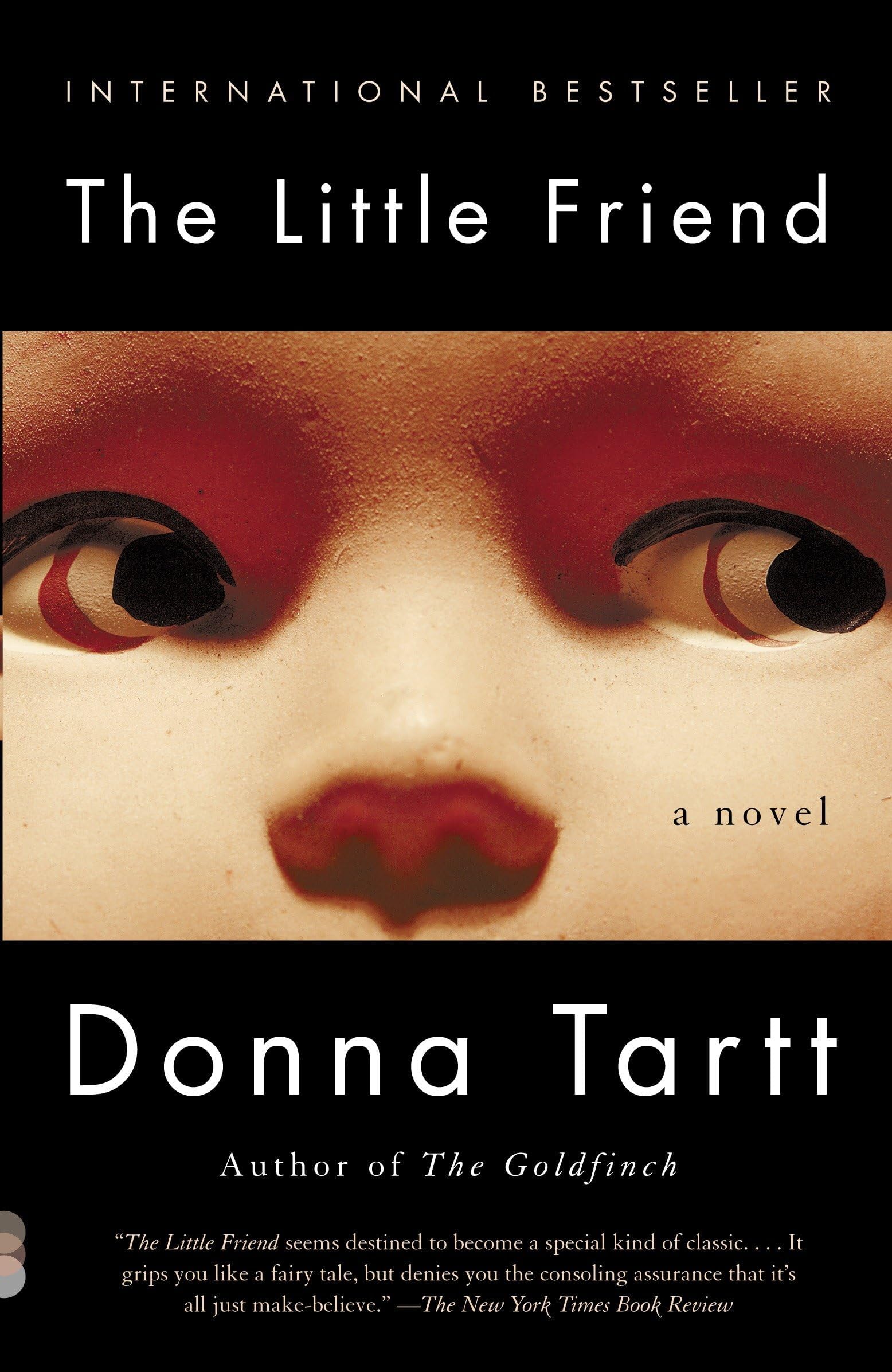
The Little Friend: A Novel (Vintage Contemporaries)
Product ID: 3522982
🌍Richly detailed Southern US setting
🏆#1,126 in Literary Fiction - critically acclaimed
📚624 pages of immersive storytelling
Buy anything from 5,000+ international stores. One checkout price. No surprise fees. Join 2M+ shoppers on Desertcart.
Desertcart purchases this item on your behalf and handles shipping, customs, and support to Macau.
📖 Unlock the Southern mystery that everyone’s whispering about — don’t miss out on this literary rite of passage!
Donna Tartt’s The Little Friend is a 624-page literary novel set in 1960s Mississippi, blending a murder mystery backdrop with a deep exploration of grief, social dynamics, and a fiercely independent young protagonist. Ranked among the top literary fiction titles, it offers richly detailed storytelling that challenges conventional genre expectations and rewards readers who crave complexity and atmospheric depth.


| Best Sellers Rank | #29,724 in Books ( See Top 100 in Books ) #1,098 in Literary Fiction (Books) #2,483 in American Literature (Books) #9,817 in Genre Literature & Fiction |
| Customer Reviews | 3.8 out of 5 stars 7,713 Reviews |
E**S
One of the Best Books I've Ever Read
Had I paid any attention to the reviews at either Goodreads or Amazon, I might have been dissuaded from reading The Little Friend by those who didn't like the book, calling it "boring", "too long", "bad ending". That would have been a sad thing, because I'm putting it in that Difficult-to-Get-Into club of mine called "One of the Best Books I've Ever Read". It's very hard for me to see this as anything less than a 5-star book, so let me try to convince you readers who are contemplating reading it but are on the fence because of the book's detractors. However, let me temper that with a caution to those who want a quick read, a tied-up-in-a-bow ending, or who aren't willing to get deep into a character and the character's milieu---if you are one of those, go with a John Grisham. The paperback edition I read was a hefty 624-pages, and I savored every one of them. The editor's description of The Little Friend (TLF) will lead you to believe that this is a murder mystery, and perhaps that's why some readers are ticked off that it lacks the typical and expected structure of a murder mystery. In fact, that's likely what enticed me to buy it. But while TLF does, indeed, begin with a mystery---the 12-year old, unsolved murder of the brother of the main character, Harriet. The mystery is also the impetus for the quest that is the book's focus. But the mystery is simply the background and jumping off place. This is really a story about Harriet, one of the most compelling characters I've ever encountered; the town where the story takes place (Alexandria, Mississippi); and the recently desegregated and deeply racist social climate in which the action occurs. Harriet was a baby when her brother, Robin, is murdered. When we meet her 12 years later, she's like an urchin from a Dickens' story. If it were not for the inconsistent and eclectic parenting she receives from the family's African-American housekeeper, her stern and cold grandmother, and a gaggle of great-aunts, Harriet would be just a step away from being raised by wolves. Her mother has been in a drug-induced slumber since the day of the murder, and her father lives in Nashville and only visits on holidays. Harriet is an old soul. She's intelligent, indomitable, opinionated, delightfully odd, and very well-read. The tales of Kipling, Stevenson, Doyle, and those of true-life adventurers fuel her imagination. A summer without the structure and diversion of school, and the general lack of parental supervision the children receive, provide a fertile ground in which Harriet and her devoted acolyte, Hely, set out to find Robin's killer. But, again, though it's an important one, this "detecting" is simply the backstory. TLF's prologue is one of the best I've ever read. It begins: "For the rest of her life, Charlotte Cleve would blame herself for her son's death because she had decided to have the Mother's Day dinner at six in the evening instead of noon, which is when the Cleves usually had it." Its 15 pages concisely and brilliantly provide us with everything we need to know to prepare us for the rest of the story. We clearly understand the family dynamics and a bit of its history. We meet many of the characters and, in very few words, we learn a lot about each one of them. We know the horrific event that forever after alters the family and sets in motion its disintegration. But from that point forward, each subsequent chapter is minutely detailed. Many readers found that maddening, but others, like me, loved and appreciated those details. I found myself rereading passages to savor them, and noticing now beautifully crafted and essential all those lovely words were. One of the things that I found the most amazing was how well Tartt captured the time and place: the casual and cruel racism, the decaying town, the cadence and sound of the voices across the spectrum of social classes; and the thinking of the children: their fertile imaginations, their terrible decisions, the pains they must endure at the hands of the careless and unthinking adults who rule their worlds. My early childhood was spent in a small Missouri town in the 1950s, and Tartt's descriptions brought back the sights, sounds, and feelings (both physical and emotional) of that time and place. Other reviewers have compared TLF to To Kill a Mockingbird and The Heart is a Lonely Hunter. I was also making those comparisons. But to be clear, TLF by no means mimics those books---it holds its own and is unique in its voice, but it shares the keen sense of place and the uncanny understanding of the characters' interior lives that those other books have. Many reviewers complained about the book's ending. I'm trying not to spoil it for readers by what I'm going to say next, so if you are even a tad concerned about that, stop reading this review now. The ending is not all tied up in a bow, with the author going over clues we should have picked up on, and detailing for us why the killer did what he/she did. If you are expecting such an ending, this book won't deliver. But I contend that Tartt wrote the perfect ending for this particular book. It's is purposefully and carefully written, and A Little Friend would be a completely different book with anything but the ending Tartt gives us. I believe that the Prologue and ending are a pair of perfectly matched bookends. I loved this book and highly recommend it for people who want beautifully written prose and a whopping good story. I'm in awe of Donna Tartt's talent and insight into the human spirit, and immensely glad I found her. I'm reading Tartt's The Secret History next.
D**R
Reminds one of TO KILL A MOCKINGBIRD
Donna Tartt had to have been thinking of TO KILL A MOCKINGBIRD while she was writing this book. There are too many similarities to ignore. The book is set in Alexandria, Mississippi, just a stone's throw from Maycomb, Alabama. Harriet Cleve Dufresnes, the lead character, could be Scout Finch six years later. The villain of the piece, Farish Ratliff, will remind you of Bob Ewell. Harriet even has a little boyfriend who worships the ground she walks on. Harriet is a great character, feisty and brave, willing to take on a copperhead in order to get even with Danny Ratliff, whom she blames for the murder of her brother who'd been found hanging from a black-tupelo tree when she was a baby. Just as captivating are Harriet's great aunts, Edie, Addie, Libby, and Tat. These are truly original characters; no one has written senior citizens better since LADIES OF THE CLUB. Edie, Harriet's grandmother, is an older version of Harriet. When she looks Harriet in the eye, she sees herself looking back at her. This is a finely textured book, with lots of atmosphere and folklore that Tartt positions between action sequences. Tartt is great at foreshadowing. There's a scene at the beginning where Harriet learns how to hold her breath (like her hero Houdini) that will come in handy later on. There's so much to like about this book I have to give it at least a four, but it's not a seamless novel. There's too much description, the kind that the author had to have put in later to give the book verisimilitude. Much of this is repetitive, lots of light playing off of the sides of buildings. I'm not the type to skip description, but I can understand why some readers might want to skim over some of this. The ending is also disappointing, leaving the reader dangling. Any mystery lover (as I am) is going to want to throw the book up against the wall when he finishes. What happens to Danny Ratliff is also completely unrealistic. You'd think at least one of the forty-some people Tartt thanks in her acknowledgments would have balked at some of this.
A**.
seems like something out of the glitteriest fairytale
From the first read of Tartt's The Goldfinch, I was hooked. The obsession with beauty reflects into every corner of the book, from the plot to the language to the use of time to the setting. A sewer, in that book, seems like something out of the glitteriest fairytale. I liked every person in it, even the bad ones, even the bullies, they felt real. Like people I might meet someday. In spite of the unlikely plot, The Goldfinch is one of the most realistic books I've ever read. The Secret History felt the same. The undercurrent of unlucky stars and Theo's hidalgo personality became a more roiling evil and apathy in it, but even in that awful winter shack there was a sort of glitz, a sparkle. Reading those books is escapism. The Little Friend also has some good things. It has beautiful language, it has eerily perfect temporal description, and the place is very real. I can feel the surroundings in that book around me, just as the racism and flamboyant Christian ideals feel very well-drawn. The impact of Robin's death feels very like what might happen on your doorstep, something Tartt must be a superpower to pull off. However, I didn't like it all that much. The chorus of narrative personalities squeezed into one third-person narration was interesting, but it felt impersonal, and occasionally made the characters seem a bit one-dimensional. The people in the book, which I find very important, are many and varied, but some characters filled with potential, such as Edie, were left a bit undeveloped, and for some reason I found most people in the book very easy to dislike, even Harriet and Hely. The plot has none of the glitz of the previous books, and it could have been so enticing. One of the best made aspects of the book, which is the hard-as-nails portrayal of the ugliness and unpredictability of life, I found soured my reading experience significantly. It takes another kind of person to like this almost pessimistic portrayal of the world, and I like evil and ugliness the way I found it in Tartt's other two books: filled with beauty. Everything can be beautiful, if seen from the correct perspective, which is another problem with the narrative voice, that a single perspective would perhaps have given the book an unseen dimension. The collective character used here is reminiscent of García Márquez' La Mala Hora, which uses an entire town as its main character, but unsuprisingly that is a hugely disliked book. It is very well to attempt a difficult and admirable style, but knowing how to pick your challenges is better, and it is plain to see that a different sort of narration would have benefitted this book plenty. One scene stayed with me, which is the one where Harriet, in a foolhardy attempt to save a blackbird trapped in a tar pool, ends up hastening its already inevitable death. I could feel my arm being pulled out as Harriet tried desperately to save the poor bird. It is simultaneously one of the most beautiful and terrible scenes I've read, and it also is a remarkably good portrayal of Harriet's personality; impulsive, rough. I am alright with the ending. Like most, I would have preferred closure, but Harriet's giving up of the quest is a miraculous thing: she grows up. She lets go of some unnecessary hate, hate that made the book so bitter when it might not have been. This letting go shows us how much of a coming-of-age tale this book really is. Overall, I think I'll enjoy it more the next I read it. I think that those expecting to find Tartt as they have found her in other books will find her, but with a disagreeable veneer. The ugliness of this book, which can be enjoyable or exciting in shorter works, was cumbersome in something so large. Expect to continue finding the awesome vocabulary, but this book is one difficul critter to like.
A**A
Thoroughly Enjoyable.
This book was authored by Donna Tarrt who also wrote The Goldfinch. This too was thoroughly enjoyable.
M**Y
A second novel that compares well with the first
Two things right off the bat: 1) Once again (as with The Secret History) Ms. Tartt kept me reading her novel right to the end, even though 2) I have rarely come across a group of characters who are less sympathetic than those who people these pages. Like The Secret History, The Little Friend begins with a death, though this time it is possible that the death was accidental not a murder. What follows are the parallel histories of two very dysfuntional families: one is the middle-class (with upper-middle pretentions) extended family of the dead child, the other, (whose lives wierdly intersect with the first's) is a lower-class bunch who live in a group of trailers and that includes felons, a grandmother who has been terminally ill for decades, and a would-be preacher who questions his calling because he proves to be inept as a snake-handler. Like The Secret History, there is a complete cast of fully-fleshed walk-ons. Tartt tells The Secret History from one character's viewpoint, thus coloring all events and people with his perceptions of them. She narrates The Little Friend from multiple viewpoints, so that throughout -- and at the end -- the reader knows more about what is happening (and why) than any single character, though, in actuality, the reader is not always sure what he does and doesn't know. That in itself is not a problem; what is a problem is that the characters are not communicating with each other, even when they think they are. That makes for some very uncomfortable reading, in which the reader -- at least this one -- wants to shout at the page: "For God's sake, why aren't you all listening to each other?" And then, if that weren't enough, we have Harriet, that dear, confused, pre-pubescent child who never seems able to say what she wants to say, and often says (or does) what she desn't want. Even allowing for her disfunctional mother (whose reaction to her sons death back on page one was to go to be for the next decade), her domineering Grandmother (whom she resembles in more than looks), her three aunts (really great-aunts, all of whom have more than a little of the post-bellum south about them: Slightly impoverished, but cultivated, none-the-less), her desperately-in-need-of-psychiatric-care sister, and her absentee father...even allowing for all of that, she is a very unlikeable child. Why can't she say what she really thinks to the long-suffering hired woman, Ida Rhew? Why must she be so horribly mean to the poor little LaSharon (one character who, though not particularly likeable, is at least admirable for trying to improve herself, even though she doesn't seem to have a clue how to do it). And, why on earth does she decide that Danny is the murderer, based on nothing by a chance remark? Why? Because she's a mixed up little girl going through a difficult time in any girl's life and desperately in need of guidance and quite a bit of tender attention -- which she is not getting. In short, she is a very real character, as are most of the people who pass through these pages. That is Donna Tartt's gift, she sees life and she records it. She doesn't ask us to like it, she just hands it to us and lets us make of it what we will. An author who can do that must be very trusting of her readership. As I wrote at the on-set, I finished the book, even though several times, I was ready to put it down in sheer frustration with what was happening on the pages, including once when I was 80% finished (page 421, to be exact). However, whether I wanted to see how it all turned out (which, ultimately, I didn't -- once again, Ms. Tartt proves to be a mysterious writer as well as a mystery writer), whether I wanted to see if I liked Harriet any more than I did (which I didn't), or whether I just wanted to finish what I had started (which I did), whatever the reason, I finished and, as with The Secret History, have pondered what I read for a couple of days now. (I also went back and re-read the prologue, which had an entirely different meaning after I had completed the book.) One peculiarity, which other reviewers have noted: I couldn't figure out when this was supposed to be taking place. Edie drives a car from the late '50s which is twenty years old, but the writing on the water tower (Class of 1970) has worn off from years of weather. The TV references seem to be early 70s, but there is also a reference to the non-gay player being chosen for a ball team, which does not seem to be a phrase one would have heard from an elementary school child in small-town Mississippi in the early 70s. Although an editor could have and should have made some sense of those references, they were not sufficient to destroy the authenticity of the sense of (southern) place. Once again, a provocative novel from Ms. Tartt. (But, please, could there be at least one likeable character next time?)
G**.
A lackluster attempt for a second novel...
Those of you reading this review probably know Tartt's background. She has written 3 books, taking a 10 year hiatus between the publishing of each one. This is her 2nd book. This book is set in the 1970s in the town of Alexandria, Mississippi. Her descriptions of the town's architecture, streets, flora & fauna, and people is perfect. This is 2014 and there are literally hundreds of towns scattered throughout the South that still match her setting. Having said that, this book is a stupendous disappointment. I was not impressed with her 1st book (The Secret History). I like this book even less. It is overly long, tedious in spots. There is no continuity to the plot or progress of the characters. This book is written in the third person perspective, a departure from her other 2 books which are both written in 1st person. That is the only thing about this book that I like. Tartt does display a brief bit of wry humor when she describes the misadventures of the drug dealing Ratliff brothers. This is something that is missing from her other 2 books. SPOILER ALERT FOR THE REST OF THIS REVIEW... There is not one likable character in this book. Harriet, the main character, is not really liked by any of the other characters and it is impossible to build any empathy or sympathy for her. Her older brother died when she was very young. Was it suicide or murder? The case went unsoved. When she is 12 years old, she makes it her summer project to solve the case and bring her brother's murderer to justice. Without any background from Tartt, Harriet decides it has to be one of the Ratliff brothers. She settles on Danny. Now the book just falls apart and everything becomes preposterous. Harriet and Hely throw a live cobra snake off of an overpass and it lands in the open passenger compartment of a car they think is being driven by Danny Ratliff, only it's his grandmother driving. She gets bit several times and still lives. Later while having a paranoia attack, Danny shoots his older drug dealing brother point blank in the head while they are sitting in Danny's car. Danny's brother lives. Danny determines that his nemisis all summer has been Harriet. He follows her up an old abandoned water tank where they both fall through the rotten wood into the tank. The tank has about 6 feet of nasty, brackish water in it. Harriet manages to get out, but the water makes her sick and she ends up in the hospital. Danny who can not swim, instead of drowning, manages to bob up and down & tread water for 2 days before the police find him and take him to the hospital. Harriet & Danny are both now in the hospital just a few rooms apart. Harriet wakes up with both of her parents in the room talking about Danny Ratliff, and BOOM!! It is revealed that Danny was her dead brother's best friend when he died. DANNY RATLIFF IS THE LITTLE FRIEND in the title of the book. That's the end of Tartt's book. All of the loose ends in the plot are still loose. Absolutely nothing is resolved.
D**Y
Mystery, Dreams and Youthful Hopes are not only for Our Little Friends
Donna Tartt is a superb author . She writes with great detail and description about her settings and in this novel especially her characters . This is a lovely coming of age story ,in my opinion , as all of the adults seem stuck in time and damaged in different ways by the mysterious death of the oldest , and it would seem favorite child of the whole family . So to gain attention and win favor , it only makes sense that the story takes its readers on a series of flashbacks and dangerous stunts by the youngest child to solve the murder and become the family hero . Donna Tartt loves a complicated plot so there is no way that this story is simple ! There are meth dealers, snake handlers, rumors of crazy relatives, and oh so much more that makes this my favorite of all Tartt's novels . Secret History was good and it had me hooked on her style , but when the not as popular The Little Friend came out it was so unusual and refreshing . The twists and turns in this novel had me turning pages so fast because I became so easily attached emotionally to the main character. Even though I knew the poor child was chasing an empty dream I found myself holding on to a childish miracle . The miracle that youth always holds and never releases until older age sets in with years of disappointing experieces . Although, there are always exceptions to that statement too! There are people who keep that twinkle of youthful adventure inside their eyes and open dreams inside their hearts for life. Maybe Tartt will come out with a novel such as this one day ! A novel about an adult adventurer who has always had that mischievous twinkle in their eyes and their ideas were often touched by the clouds. I believe if any author could, it would be Donna Tartt !
M**W
Who is the little friend ?
Although it has a good ending it was too long and overly detailed. The writing is at times beautifully descriptive, and at others, confusing and boring.
2**0
Ms. Tartt is nothing short of a great story-teller
What a wonderful story. Imaginative, creative, humourous, human. I can highly recommend it. The book gives us great insight into Mississippi life - before the advent of air-conditioners apparently - and the suble nuances in southern society. I loved the child's perspective. Although the children seem to be the most observant witnesses to the adults' stories and dramas, they remain "invisible". They act on what they think is right, but only have snippets of the larger picture. It all comes together in the end in a wonderous and marvelous way. Donna Tartt is nothing short of a great story-teller.
H**O
Muy buen libro, pero…
A mí el libro me ha gustado mucho, la verdad. Es verdad que puede resultar pesado y largo para las personas a las que no le gustan las descripciones porque Donna Tartt hace mucho uso de ellas. Como dicen las críticas, no es The Secret History, pero no por ello es un mal libro.
K**.
A beautiful reflection on grief and the repercussions of a violent act
A beautiful reflection on grief and the repercussions of a violent act on two families that couldn't be more different from one another: The Cleves, a middle class and matriarchal close-knit group, and the dirt-poor meth-making Ratliffs. Usually, I don't like children as main characters, but with Donna Tart as a writer, I was more than willing to make an exception and I'm glad I did because this is a masterpiece. Harriet's quest to avenge her brother is dark and menacing, riddled with guilt and failure and most of all loneliness. There is a stark contrast between her troubled mind and the carefree attitude of her best friend Hely, for whom childhood is as it should be, with caring parents. All the surrounding characters, from both families are very well crafted and multilayered; they all have their qualities, their vices and soft spots but my favorite was without a doubt Edie, capable and pragmatic but also cold and starting to feel her body and mind ageing. The themes are dark and actual, ranging through all societal issues like racism, male chauvinism, unemployment, drug use and of course murder. On this note, don't get wrong footed by other reviews; this book is not about who killed little Robin, it is about all the aftershocks this one act provokes. In that way, it reminder me very often of Reservoir 13 . If you are looking for opulent prose, a young but powerful heroin, with a splendid tapestry of characters on the hot and humid background of 1970's Mississippi, then look no further and dive into the melancholy and wonderful world of little Harriet Cleve Dufresne.
I**N
Kitap hasarlı geldi.
Kitabın hem sayfaları kıvrık hem üstünde hasarlı geldi.
N**P
Four Stars
The whole point of Donna Tartt IS the beautiful but long story. That ending though!
Trustpilot
4 days ago
1 month ago