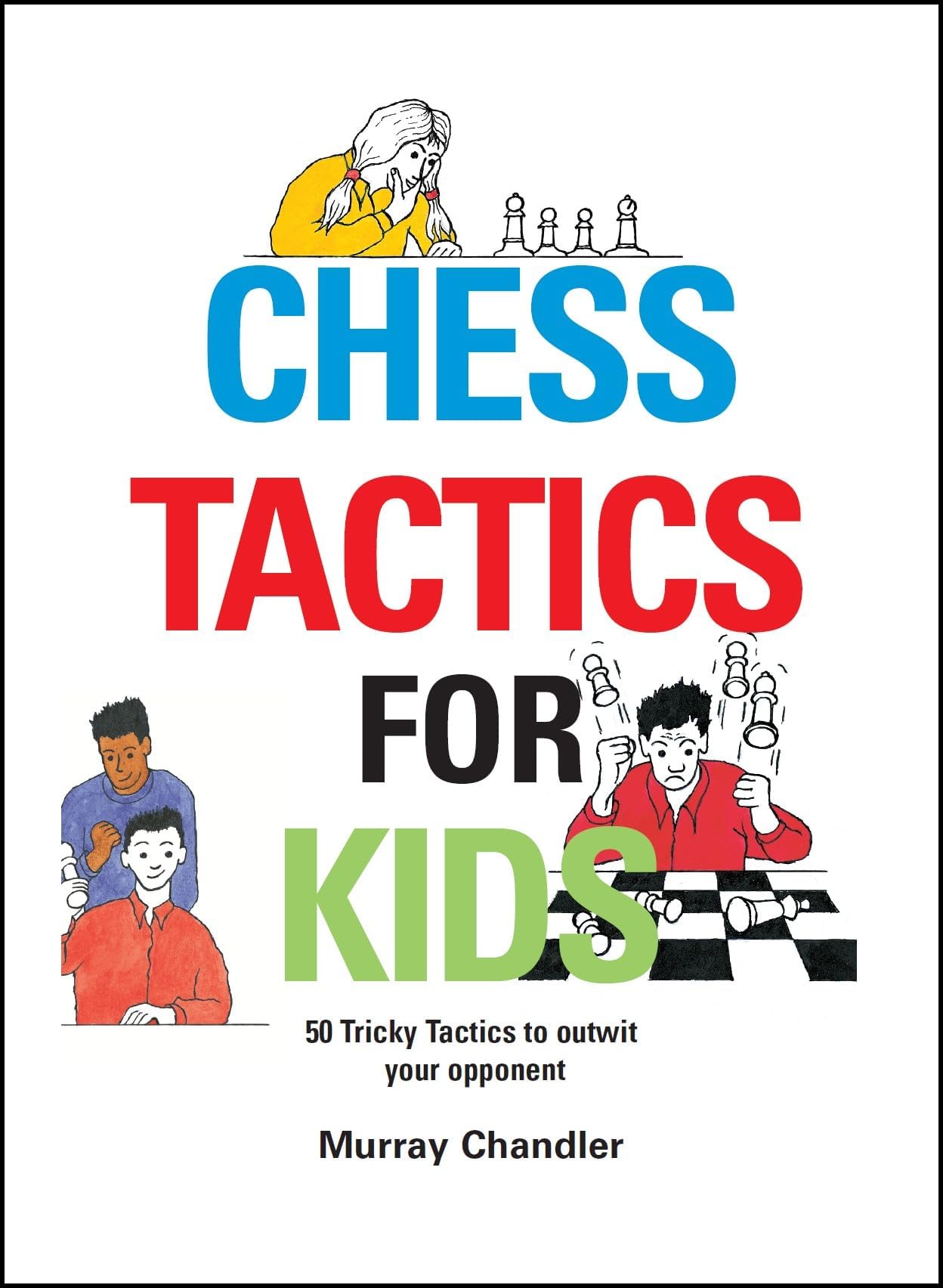
Chess Tactics for Kids
Product ID: 3757839
📚50 tactical motifs decoded
🔄Reusable, bite-sized lessons
♟️Real-game chess positions
Buy anything from 5,000+ international stores. One checkout price. No surprise fees. Join 2M+ shoppers on Desertcart.
Desertcart purchases this item on your behalf and handles shipping, customs, and support to Macau.
♟️ Outsmart your opponents with every move — don’t just play chess, master it!
Chess Tactics for Kids is a highly rated, used book featuring 50 essential chess tactics explained through real-game examples. Designed for all skill levels, it offers concise, two-page lessons that make mastering complex strategies accessible and fun. Authored by grandmaster Murray Chandler, this book is a proven tool to boost your chess confidence and performance, making it a must-have for aspiring players eager to elevate their game.
| Best Sellers Rank | #53,712 in Books ( See Top 100 in Books ) #15 in Children's Board Games Books #42 in Chess (Books) |
| Customer Reviews | 4.5 out of 5 stars 356 Reviews |
R**K
Excellent book to learn some nifty tricks
Murray Chandler again proves his ability to convey great ideas in small bites! Like his other book (the famous 'How to beat your dad...'), this book gives a fifty great ideas, which you could try and remember some while playing. Best part is that how often you can read this - you don't have to read it cover to cover each time, or even sequentially. You just open it wherever it opens, and read that particular tactic! (Of course, I recommend you try and read it front-to-back, sequentially, at least once - and mark the pages that really resonate with you). I have three Gambit books now, and I think they have made this their style : each concept is given only two pages, the left and the right. First it is introduced with some text and two diagrams, and then the implementation is shown on the right page - in exactly four diagrams that could be from four different games or less. Once you get used to it, it's a great format! And like their other books, I have the same complaint here too : it would have been great if of the game referenced had been named exactly (date and players). Some of these positions seem so obvious or simplistic that you start wondering how great masters and grandmasters ended up in that situation! But still - get the book. It's better than playing with your smartphone to pass the time!
A**R
Excellent book worth going through again and again
An absolutely fantastic and thorough book. The content is well thought out and the examples are superb. Even the production quality of the book (the print, the binding) is excellent. The themes and patterns shown here are something that are applicable to almost every chess game - right from those played by beginners to the super GMs. Some reviewers have said that the kids' pictures on the cover is misleading i.e. the material is quite advanced. But then, these days the kids are soooo good ... I suspect that if the pictures were of adults instead, the kids - the target audience - might get discouraged by the wrong impression that the book is too elementary ;-) I must point out that the author takes the games played by kids pretty seriously! On the back cover it says, "Murray Chandler finished .... ahead of Kasparov and beat him in World Cadet Championships in 1976 ... one of the few players with 100% score against Kasparov" ... Yes, indeed. The author was 16 years old and Kasparov was 13.
B**N
Suitable for all ages
I bought this book because of two precocious children who wanted to learn chess. Strangely, it is the 6 year old who is benefitting most, but his reading skills are more akin to a 9 year old. That seems to be an appropriate age for an interested child to approach this book; eight or nine. For those who are mildly interested in chess only, this book will be absolutely useless. Choose a book for children that focuses on basics of simple moves, basic strategies. "Chess for Children" also by Murray Chandler would be ideal. Once over the basics, this book is perfect. Staged scenarios, step-by-step explanation, clear demonstration of advantages and disadvantages - all of this can be absorbed in small bites. If you set the pace for the child, and let him explore, you will soon find yourself at a disadvantage when you set the board up for a game. As others no doubt would agree, this is not a book for everyone. It is not easy, it is not a book to be read in one sitting. The child interested in chess will be, however, part of a self-selecting group that is well able to use this book under guidance.
M**H
Excellent For Beginners, A Complete Tactics Primer
While I prefer Susan Polgar's "Chess Tactics For Champions" for a first book on tactics, this book, in the long run, is superior to hers. Fifty tactical motifs, all very well explained by Murray Chandler. I'm around 1600 USCF and while I ended up with a 52-of-54 score on the final test (two small errors prevented elusive perfection), I wouldn't exactly call this book easy. But the bottom line is your kid -- or any beginner -- can't go wrong with this. Keep checking it out now and again after you've read it and your tactics will be solid. Some tactics are fairly deep, but overall it's a good prep course for John Nunn's "Learn Chess Tactics" and then Fred Reinfeld's awesome "1001 Winning Chess Sacrifices and Combinations," (although Reinfeld's books are in descriptive notation, they are excellent to build one's pattern recognition and horizon). Three good checkmate books (in recommended reading order) are: Chandler's misnamed "How to Beat Your Dad at Chess," "The Art of Checkmate," by Georges Renaud, and Reinfeld's "1001 Brilliant Ways to Checkmate." Don't hesitate to buy this book!
P**R
Excellent for anyone up to club level - also, a question for experts
It's not for complete beginners, but kids can learn very fast, and this book is excellent for introducing players to the basics of good tactics. Now, a question regarding puzzle # 22 ob page 120, for any experts out there. I think white can sacrifice its knight and win by queening a pawn: 1. Qf5+ QxQ 2. NxQ, KxN 3. a5 (black moves) 4. b6 and if a7 x b6 then 5. a6... I don't see anything black can do to prevent white from getting a queen on a8 or perhaps b8. But perhaps somebody here can figure out a better outcome for black. The best I can see for black is and end game of black Knight with 4 pawns versus white king and queen, with white winning easily. This seems better than the answer provided, which wins two pawns (and also wins, of course).
K**T
Another good one from Murray Chandler
This book contains 50 standard tactical situations that are explained in a clear manner. I agree with many of the reviewers that it is somewhat above beginner level. But most kids will be there soon enough. It is also an excellent review for stronger players. I highly recommend it. Regarding Public Defender's comments about the answer to puzzle #22 on page 120 I think he must be referring to a different book. There is a puzzle #22 on page 120 in this book, however in the starting position of the puzzle the white Queen is on d1, so the first move of Qf5 that he suggests is impossible.
A**R
MAYBE FOR EXPERIENCED CHESS PLAYING KIDS
Wow, maybe for EXPERIENCED CHESS PLAYING KIDS. But, for a newbie like me, I was lost after the first couple of pages. It took me awhile to figure out in the FIRST EXAMPLE, with only five pieces on the board, how the rook sacrifice let the knight put the King in checkmate. It would be obvious to any player with a few months of experience but that ain't me, yet. Then, the terminology that the author thinks we are all familiar with. "Of course, you can see several tactical motifs hidden below the surface - including deflection and discovered attack..." REALLY??? I SURE MISSED IT. I'll bet that after I become more familiar with chess then this book will be super helpful.
M**3
HARDBACK IS BEST FOR THIS BOOK SINCE IT IS A BOOK WORTH SAVING TO READ OVER AND OVER AGAIN
HARDBACK IS BEST FOR THIS BOOK SINCE IT IS A BOOK WORTH SAVING TO READ OVER AND OVER AGAIN
S**R
Brilliant for beginners and experienced players
I bought this book for my 7 year old son, who's beginning to play chess at school. He loves it, and so do I. I'm a pretty decent club standard player with an extensive chess library, but I still find this entertaining to dip into every now and again. All of the examples are taken from real games, some at the very highest level. They are clearly diagrammed, the typeface is clear and easy to read (important with books for children), and new ideas are introduced with a diagram every move or two. Highly recommended.
J**N
Five Stars
Good book indeed. Need to spend more time reading, learning from it :-)
B**.
Schach
Sehr gut für Kinder
A**R
Chess Teaching
Good reference book to learn chess tactics
M**G
Really useful even for grown-ups learning chess
Really useful even for grown-ups learning chess. Great insightful book with great strategies.
Trustpilot
1 month ago
1 month ago