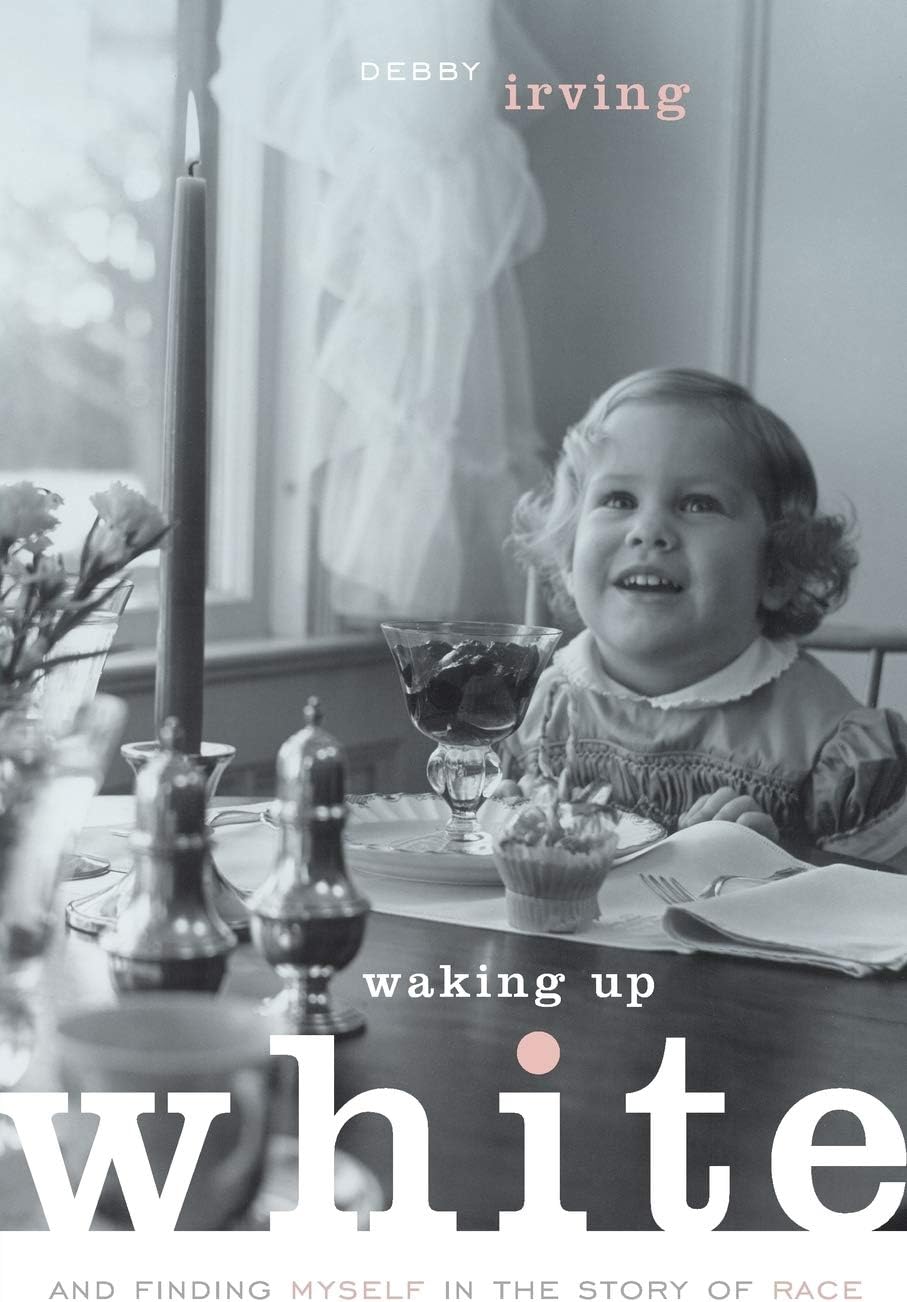
Waking Up White, and Finding Myself in the Story of Race
Product ID: 5131804
Buy anything from 5,000+ international stores. One checkout price. No surprise fees. Join 2M+ shoppers on Desertcart.
Desertcart purchases this item on your behalf and handles shipping, customs, and support to Macau.
For twenty-five years, Debby Irving sensed inexplicable racial tensions in her personal and professional relationships. As a colleague and neighbor, she worried about offending people she dearly wanted to befriend. As an arts administrator, she didn't understand why her diversity efforts lacked traction. As a teacher, she found her best efforts to reach out to students and families of color left her wondering what she was missing. Then, in 2009, one "aha!" moment launched an adventure of discovery and insight that drastically shifted her worldview and upended her life plan. In Waking Up White, Irving tells her often cringe-worthy story with such openness that readers will turn every page rooting for her-and ultimately for all of us. Review: A good idea to read twice - This is a first rate book for those of us who grew up in the "white bubble" because we don't know what we don't know. Debby Irving actually lived in a place and had the advantage that she could take courses and seminars to learn where we are in the bubble and why we are there. I did learn some things from the book despite not having started out with quite as much naivete as the author. Discussing race is hard for most of us because we have been taught not to "make personal remarks" about how someone looks. A four-year-old might ask someone why he has one arm, and his mother is immediately embarrassed, basically because we don't want to hurt someone's feelings. Discussion of race falls immediately into the "personal comments" category. But we, in our bubbles, don't realize that people of color are under stress every day because of their color and often talk about it. We might be so careful to try not to offend that we actually can never be real friends because there is a whole forbidden area. So, even in our non-bigotry, we have set up barriers. The author actually attended seminars about how to get past these problems. The book is very useful and is a good read for us all. The author defines culture well. She says culture is to a group what personality is to a person. And, she points out there is actually a white culture that we who grew up inside it don't always recognize. Ms. Irving is quick to point out her own obliviousness, one that many of us have. There are enough interesting insights in this book that it is worth reading twice. And for elementary school teachers the lesson near the end to get a skin color recipe is worth the price of the book. Review: Effective and engaging. - Just finished this last night, great book for a new understanding of something that can be hard to discuss. I just finished a communication degree (BS) and there were many discussions of equity, culture, intersectionality, identity, race etc. My last course was intercultural communication. Anyway, I'm relatively up to speed for a middle aged white man, and I thought this book terrific. My children's school encouraged parents to read this as part of a new book club, so we'll be discussing it next week. While I personally wasn't exposed to a lot of new-to-me information in this book, it IS quite consistent with what I've learned thus far-and I think goes pretty far to match my understanding after a good bit of attention to the subject in college. With the caveat that the author's upper-class upbringing may be off-putting to some (push past that - totally worth it) it is very approachable and easy to read. Most chapters are about 15-20 minutes to read and the writing is detailed without seeming academic. I think this book is a great tool, a doorway to knowingness for those of the dominant class in the US to see things that are often invisible, and you can't change behavior you don't recognize. BTW, there's a show "Dear White People" that attempts to tackle this subject that I enjoyed.
| Best Sellers Rank | #125,496 in Books ( See Top 100 in Books ) #2,727 in Community & Culture Biographies #3,952 in Memoirs (Books) #5,226 in Education & Teaching (Books) |
| Customer Reviews | 4.4 out of 5 stars 3,609 Reviews |
S**R
A good idea to read twice
This is a first rate book for those of us who grew up in the "white bubble" because we don't know what we don't know. Debby Irving actually lived in a place and had the advantage that she could take courses and seminars to learn where we are in the bubble and why we are there. I did learn some things from the book despite not having started out with quite as much naivete as the author. Discussing race is hard for most of us because we have been taught not to "make personal remarks" about how someone looks. A four-year-old might ask someone why he has one arm, and his mother is immediately embarrassed, basically because we don't want to hurt someone's feelings. Discussion of race falls immediately into the "personal comments" category. But we, in our bubbles, don't realize that people of color are under stress every day because of their color and often talk about it. We might be so careful to try not to offend that we actually can never be real friends because there is a whole forbidden area. So, even in our non-bigotry, we have set up barriers. The author actually attended seminars about how to get past these problems. The book is very useful and is a good read for us all. The author defines culture well. She says culture is to a group what personality is to a person. And, she points out there is actually a white culture that we who grew up inside it don't always recognize. Ms. Irving is quick to point out her own obliviousness, one that many of us have. There are enough interesting insights in this book that it is worth reading twice. And for elementary school teachers the lesson near the end to get a skin color recipe is worth the price of the book.
X**N
Effective and engaging.
Just finished this last night, great book for a new understanding of something that can be hard to discuss. I just finished a communication degree (BS) and there were many discussions of equity, culture, intersectionality, identity, race etc. My last course was intercultural communication. Anyway, I'm relatively up to speed for a middle aged white man, and I thought this book terrific. My children's school encouraged parents to read this as part of a new book club, so we'll be discussing it next week. While I personally wasn't exposed to a lot of new-to-me information in this book, it IS quite consistent with what I've learned thus far-and I think goes pretty far to match my understanding after a good bit of attention to the subject in college. With the caveat that the author's upper-class upbringing may be off-putting to some (push past that - totally worth it) it is very approachable and easy to read. Most chapters are about 15-20 minutes to read and the writing is detailed without seeming academic. I think this book is a great tool, a doorway to knowingness for those of the dominant class in the US to see things that are often invisible, and you can't change behavior you don't recognize. BTW, there's a show "Dear White People" that attempts to tackle this subject that I enjoyed.
#**R
Becoming Aware of ways being white privileged out development.
The author shares her insight from her own (sometimes awkward) attempts to understand race in America; what white privilege is and how it affects everyone's lives. How whites benefit from it and how African Americans suffer underneath it. How we take our jobs, schools, homes, friendships for granted. How the lives of those without such privilege are affected. One of the points made that I had never thought about is the impact of the benefits we reap due to generation after generation of white privilege. My father went to college on the GI Bill. A benefit largely denied to African American veterans. My parents bought their first home with a VA Home Loan, a loan largely denied to minority veterans. I had no idea about either of these privileges but I can certainly see how I am continuing to reap the benefits of something (many things) that happened for my family 79+ years ago and continue to benefit me and my children today. The author offers plenty of questions as food for thought to help the reader think through this important and sensitive issue. ⭐️⭐️⭐️⭐️
A**D
Covers Emotional Journey of Becoming Racially Aware
What this book adds is the emotional journey of discovering one's own internal racism and awareness that White is indeed a culture. For many people in power and coming from privilege, this notion is a shock. Several reviewers have wondered if people could actually be as unaware as Ms. Irving is. I say heartily, "YES!" Most people in power and with academic and economic privilege rarely discuss race or see it playing into their decisions. Yet, because of their positions of power those choices affect hundreds of people. We don't see white culture or even that there is a majority culture, there just is the way things are. Aren't they that way for everyone? If you're protected from race, you never think about it because you don't have to. That's the way it is for many White Americans, and its why we don't get anywhere with racism. People keep denying that they have it rather than asking, "How am I racist and not know it?" That's a more interesting question. We need books that deal with the personal journey of discovery of one's own racism, as well as treatises on Black/African American's experiences, systemic racism, and how racism is enacted (often unknowingly) in health care practice and policy. This book effectively fills the niche for white people, especially women, on the emotional repercussions of waking up white, and how to deal with all the feelings that brings up. No other book I've read on racism or white culture (20 so far on my reading list) has done that with compassion and understanding.
D**T
Excellent book, very thought provoking
Excellent book, very thought provoking. It was recommended as a good book to read at a workshop I attended on white privilege and overcoming racism. The author writes of her own experience, somewhat different from mine, as a WASP from New England with a long list of ancestors stretching back into the past. She thought she was not racist, that anyone could achieve whatever they wanted. Then, one day, she realized that white is a race too, that it is not just culture or economic class that relates to how well people do. She saw systematic racism in our society and began to dialogue with others of all races to see what one person could do. She points out that for whites like me and others, with more recent immigrant ancestors that we still have the advantage white race gives us..There are relatively short chapters with questions at the end of each to think about. She recommends writing down responses to help the thinking process. The most striking thing I learned was the inequity of the GI bill after World War II which helped so many servicemen get a house and a college education. When Black veterans tried to use it, there were problems with getting a house, and finding a college that would accept them. It wasn't so equal as I had always thought. Finally she now works and encourages all of us to work at ending racial disparities..
L**N
How did she miss the Civil Rights Movements?
I am astounded that Ms. Irving seems to have "missed" the entire Civil Rights Movement from the late fifties and the sixties. I grew up in Michigan — Detroit (1952-1955) and Lansing (1955 on). I certainly noticed the segregation in Detroit which my patents explained by saying that the area was where they made Negroes live. "That area" looked like photos of Europe right after WW II. My parents may have been a bit more enlightened than some, but not extraordinarily so. They did take me to see Dr. Martin Luther King, Jr. when he spoken at the Lansing Civic Center. I would say her book is very "guilty liberal" which is not really helpful. I note that she gives anti-racism workshops. I cannot Believe I would attend. The book has some good material and some good insights.
O**R
Help me see racism with new eyes and my role in it.
I read this book in December 2018 on the recommendation of a person from my church. I am finally getting around to writing a review because of the murder February 23, 2020 of Ahmaud Arbery by two white men who shot him while he was jogging. The men were not arrested until May 7. 2020 – 10 and a half weeks later. I’ve seen a number of posting that basically say “Those two bigots are evil and deserve to be thrown into jail. Why can’t the bigots be like me and care for everyone.” That would have been my reaction before I read this book. I have always thought of myself as one of the good guy, fighting for the rights of Black Americans. This is how Debby Irving thought of herself. The book is about her journey of discovery that brought to the understanding that some of the things she was doing to “help” black America were actually having the opposite affect. Debbie grew up in a predominately white upper middle class community, like I did. In her mission to help Blacks she set up activities to help Blacks become more like her and was frustrated that it didn’t work. This led her to deeply examine her history and the history of racism in American. My eyes were opened to how the GI bill after WW II was basically for whites only. It allowed whites to get educated, purchase homes and move into the middle class. It enabled whites to start building generational wealth. The million blacks who served in WW II were – for all intents and purposes – excluded from using the benefits of the GI Bill. On top of this was discovering how loan funding after WWII was limited for redlined areas – which were defined as areas with high concentrations of Blacks – which resulted in the decay of black neighborhoods. In her journey she comes to realized that as a white person she doesn’t have to think about how being white will affect society’s reaction to her. For Blacks everyday they have to think about being Black will be perceived. She didn’t have to think about race because as a white person it didn’t matter. She is a part of the majority White America. Even things that we think of as conversation starters – such as “What do you for a living” are viewed negatively by Black as they are loaded with a meaning that I did not see. The book made me aware of the responsibility that I have to stand up to racism in a way that empowers minority communities. And more importantly how I am responsible to avoid actions which perpetuate the continuing racism in America.
I**Y
Great For Adjusting Perspective
Although I have a masters degree in social work and each of our courses addressed issues of class and race, this book still helped me recognize times when I misstepped and let me anxiety about race interfere with a real connection. I think it is a helpful book for the many who may not have had a close relationship with people of color and who may need help seeing the many ways we misunderstand and disrespect them. I read this in conjunction with a study group, and the discussion was very helpful. It reads quickly and the discussion questions are useful for the group or individual contemplation.
R**B
Life... It is different for all..... All Lives Matter
We all have to look below the layers of life we have lived to come close to understanding how others live
L**Y
Educational book on how to better understand the topic of race as a white woman
In the midst of the BLM movement I wanted a book that would shed light on the white experience in relation to race. Micro-aggression and how to be a better anti-racist ally. White privilege narrows our view of experience in so many ways. This book is educational and gets you thinking about how to can unlearn age old social patterns regarding race. I particularly liked the chapter breakdown with is sectioned under various topics. This makes the book easy to digest as well as the thought provoking questions in each section that encourage you to make notes and think about relevant examples in your own life. Definitely one of the books I've not heard about as much. Would highly recommend.
S**S
Amazing book...
This is a must read for anyone willing to learn and interested in equality and/or social cohesion. As Peggy McIntosh says in her review.. it will hopefully take some of us from 'white oblivion to white awareness'. I'd particularly encourage those working in Human Resources/Organisations to read it. Thank you Debbie.
M**E
Understanding racism
This book is definitely worth reading. It really explains how racism started and how we got to where we are today. Also, what we can do about it.
A**R
it is particularly useful in posing appropriate questions and exercises at the end ...
I haven't finished reading this book yet, but so far it's impressive! If you are working in the area of diversity/anti-racism, it is particularly useful in posing appropriate questions and exercises at the end of each chapter. It is also a very useful perspective in discussing race and racism.
Trustpilot
4 days ago
2 weeks ago