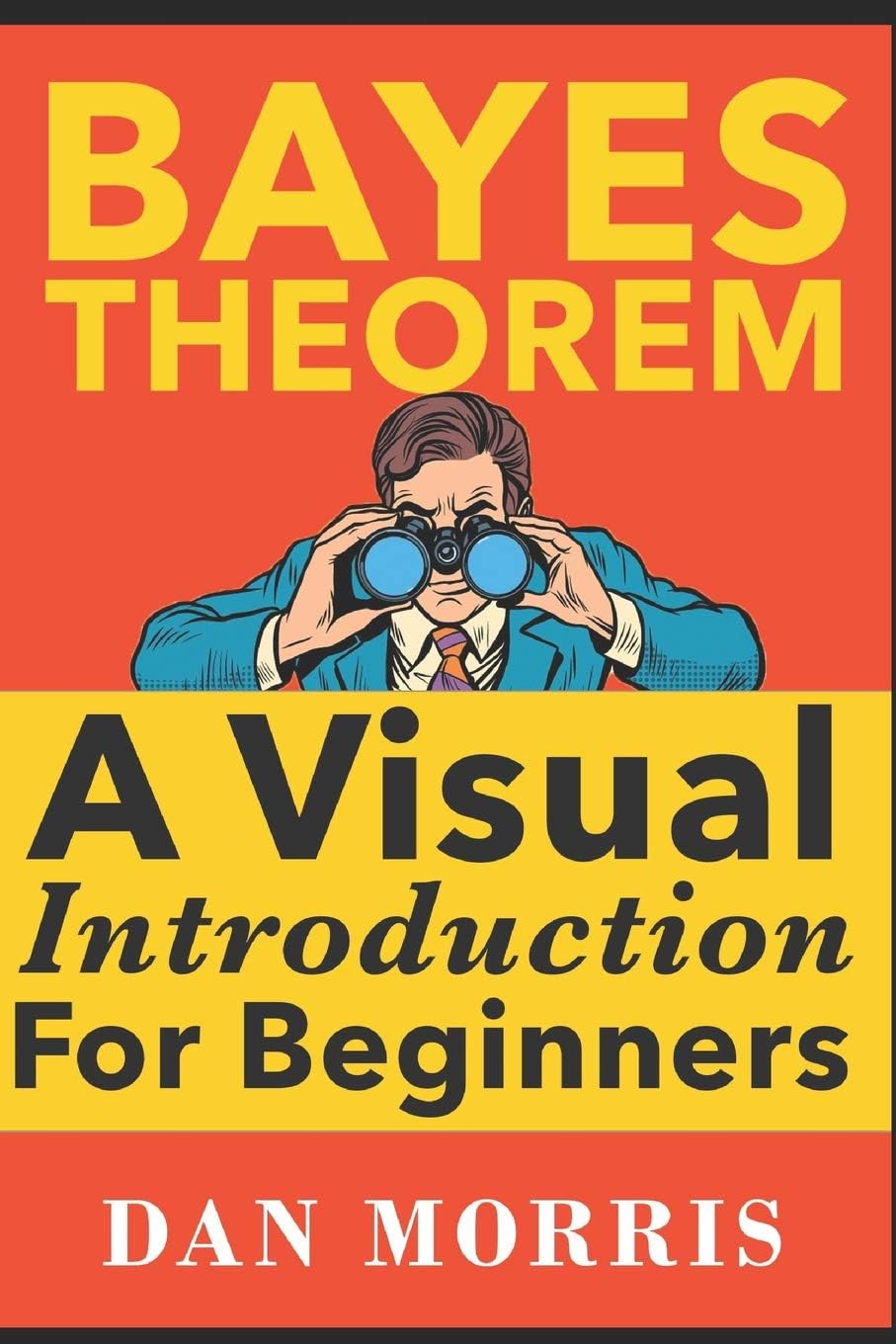
Bayes' Theorem Examples: A Visual Introduction For Beginners
Product ID: 56969932
Buy anything from 5,000+ international stores. One checkout price. No surprise fees. Join 2M+ shoppers on Desertcart.
Desertcart purchases this item on your behalf and handles shipping, customs, and support to Macau.
***** #1 Kindle Store Bestseller in Mathematics (Throughout 2016) ********** #1 Kindle Store Bestseller in Education Theory (Throughout 2017) ***** If you are looking for a short beginners guide packed with visual examples, this book is for you. Bayes' Theorem Examples: A Beginners Visual Approach to Bayesian Data Analysis If you’ve recently used Google search to find something, Bayes' Theorem was used to find your search results. The same is true for those recommendations on Netflix. Hedge funds? Self-driving cars? Search and Rescue? Bayes' Theorem is used in all of the above and more. At its core, Bayes' Theorem is a simple probability and statistics formula that has revolutionized how we understand and deal with uncertainty. If life is seen as black and white, Bayes' Theorem helps us think about the gray areas. When new evidence comes our way, it helps us update our beliefs and create a new belief. Ready to dig in and visually explore Bayes' Theorem? Let’s go! Over 60 hand-drawn visuals are included throughout the book to help you work through each problem as you learn by example. The beautifully hand-drawn visual illustrations are specifically designed and formatted for the kindle.This book also includes sections not found in other books on Bayes' Rule. These include: A short tutorial on how to understand problem scenarios and find P(B), P(A), and P(B|A). - For many people, knowing how to approach scenarios and break them apart can be daunting. In this booklet, we provide a quick step-by-step reference on how to confidently understand scenarios. A few examples of how to think like a Bayesian in everyday life. Bayes' Rule might seem somewhat abstract, but it can be applied to many areas of life and help you make better decisions. Learn how Bayes can help you with critical thinking, problem-solving, and dealing with the gray areas of life. A concise history of Bayes' Rule. - Bayes' Theorem has a fascinating 200+ year history, and we have summed it up for you in this booklet. From its discovery in the 1700’s to its being used to break the German’s Enigma Code during World War 2. Fascinating real-life stories on how Bayes' formula is used everyday. From search and rescue to spam filtering and driverless cars, Bayes is used in many areas of modern day life. An expanded Bayes' Theorem definition, including notations, and proof section. - In this section we define core elementary bayesian statistics terms more concretely. A recommended readings section From The Theory That Would Not Die to Think Bayes: Bayesian Statistics in Python i> and many more, there are a number of fantastic resources we have collected for further reading. If you are a visual learner and like to learn by example, this intuitive Bayes' Theorem 'for dummies' type book is a good fit for you. Praise for Bayes' Theorem Examples "...What Morris has presented is a useful way to provide the reader with a basic understanding of how to apply the theorem. He takes it easy step by easy step and explains matters in a way that almost anyone can understand. Moreover, by using Venn Diagrams and other visuals, he gives the reader multiple ways of understanding exactly what is going on in Bayes' theorem. The way in which he presents this material helps solidify in the reader's mind how to use Bayes' theorem..." - Doug E. - TOP 100 REVIEWER "...For those who are predominately "Visual Learners", as I certainly am, I highly recommend this book...I believe I gained more from this book than I did from college statistics. Or at least, one fantastic refresher after 20 some years after the fact." - Tin F. TOP 50 REVIEWER Review: Got it at last - This book provides an excellent introduction to Bayes' Theorem using four examples that are reworked at increasing levels of complexity. The illustrations are useful, but the text is so clear that after the first few pages I found I could solve the problems before reading the answers - something I never really managed in previous attempts to get a handle on Bayes's Theorem. The book also has useful links to other sources if you want a more complicated explanation. Review: Good explanation - Couple of contradictions but overall very good and well explained Liked the real life examples the most Detail of the complicated formats would have been interesting to finish on
| Best Sellers Rank | 430,488 in Books ( See Top 100 in Books ) 1,282 in Mathematics Teaching Aids 10,341 in School Education & Teaching |
| Customer Reviews | 4.1 out of 5 stars 1,116 Reviews |
D**P
Got it at last
This book provides an excellent introduction to Bayes' Theorem using four examples that are reworked at increasing levels of complexity. The illustrations are useful, but the text is so clear that after the first few pages I found I could solve the problems before reading the answers - something I never really managed in previous attempts to get a handle on Bayes's Theorem. The book also has useful links to other sources if you want a more complicated explanation.
C**S
Good explanation
Couple of contradictions but overall very good and well explained Liked the real life examples the most Detail of the complicated formats would have been interesting to finish on
N**T
Excellent intro to Bayes.
I've bumped into Bayes Theorem a few times, but never really found a structured approach to analysing the usual world problems such as 'a test shows...what's the probability that...'. This book does just that and takes you through a step by step process for classifying and approaching simple problems involving Bayes Rule. There are some excellent resources on the web (e.g. Google: Arbital guide to Bayes Rule with it's interesting waterfall diagram) but they never quite did it for me, mainly because they seemed to skip steps used to break apart such problems. This book, on the other hand, leads you through each step in explicit and detailed fashion. Essentially, it works by teaching you to map a problem onto simple diagrams and then onto the formal expression of the Theorem itself. This worked really well for me. So if you're willing to work through the examples piece by piece, you should pick up this wonderful little theorem in no time at all.
R**O
Theory only
Clearly explained, but no practical examples on how it can be applied in any real betting scenario.
A**R
good explanation for Baye's but not for advanced tuition
good explanation for Baye's but not for advanced tuition. It provides a number of examples that it repeats in different scenarios for greater clarity.
M**N
Very accessible Easy to understand
I particularly liked the logic trees and found this assisted me in understanding and using Bayes theorem.
J**S
A good introduction.
Interesting and challenging. A good introduction.
G**C
A very good exposition of an important theorem in probability
A neat explanation of an important theorem used for answering questions of the form 'what is the probability of A being true given that B is true?'. The text is built around three examples that are analysed three times over in increasing detail. This short work shows why 'common sense' thinking can get you into deep trouble when looking at issues of probability. The maths is basic. Provided that you understand what a percentage (or a normalised value) is, you are likely to be fully equipped to understand this text. An excellent piece of writing that shows how maths does not have to be scary.
A**O
Muy bueno. Super didáctico.
Es un pequeño panfleto maravillosamente escrito que de forma sencillísima da toda la información sobre este teorema y su aplicación y todo lo que hay que considerar a la hora de utilizarlo, cómo enfocar los problemas, cómo utilizar la información existente... todo muy sencillito muy bien explicado una y otra vez a través de diversos ejemplos. Alguna pequeña falta de maquetación en la edición en tapa blanda que aquí algunos critican muy duramente y no tiene mayor importancia, no afectando al meollo de lo expuesto. Lo leí de una tirada, y lo he releído 3 veces más muy gustosamente. Me ha entusiasmado de tal manera que, siendo un magnífico manual introductorio, ahora compraré algo que profundice un poco más, del tipo usar Bayes en programación con Python para resolver con Bayes problemas de probabilidad con la herramienta informática. En realidad la fórmula de Bayes no es más que la fórmula general de la probabilidad que dice que en la ocurrencia de un evento la probabilidad de que ocurra el suceso A es igual al número de casos favorables dividido entre el número de casos posibles. Por ejemplo si tiro una moneda al aire tres veces seguidas la probabilidad, a priori, de que la primera vez que tiro salga cara es (al ser sucesos independientes cada lanzamiento) 0.5. Ahora bien, si hay información adicional sobre el evento, a posteriori, ésta puede cambiar el valor de los casos favorables y posibles considerados. La incorporación de estos cambios en la fórmula general es la fórmula de Bayes, en la cual, en el numerador va el valor modificado de los casos favorables, y en el denominador el valor modificado, incorporando la información, de los casos posibles. Así, si en tres lanzamientos de una moneda al aire tengo a posterior la información de que en dos de ellos salió cara, la probabilidad de que el primer lanzamiento haya sido cara, cambia al incorporar esta información: casos posibles 3 CCX CXC XCC; casos favorables 2 CCX CXC. Probabilidad pedida, con información incorporada: 2/3, que es lo que sale con la fórmula de Bayes.
A**R
This is a great book that does exactly as it promises - clearly ...
This is a great book that does exactly as it promises - clearly introducing Bayes for beginners like me! The visuals are a big help, and the authors writing style is easy to follow. It's also really well formatted for the Kindle.
E**T
A fair attempt at explaining Bayes Theorem
If you know nothing about Bayes Theorem this book is not a bad introduction. However I still think the best way of understanding Bayes into remember the formula that the probability of text being correct is %true positives/(%true positives + %false positives). In other words the secret to understanding Bayes is including the percentage of false positives in the denominator. Morris does include this formula in the book but I still feel the non-mathematical will find this book a challenge.
C**C
Livre indispensable au débutant❗️😉
Pour avoir une idée claire de l’apport effectif du théorème de Bayes, i.e. enrichir a posteriori la connaissance a priori des données résultant d’une expérience, ce livre est indispensable : Le débutant est tenu par la main, et sa progression est tellement bien balisée qu’il ne peut pas ne pas comprendre... Je recommande vivement ce livre, qui démystifie totalement une technique de raisonnement probabiliste, non évidente au premier abord.
J**Z
Buen libro
Buen libro, aunque más bien estuvo creado para estar en línea y está es la impresión con sus errores por ello, el contenido es muy bueno.
Trustpilot
1 week ago
3 weeks ago