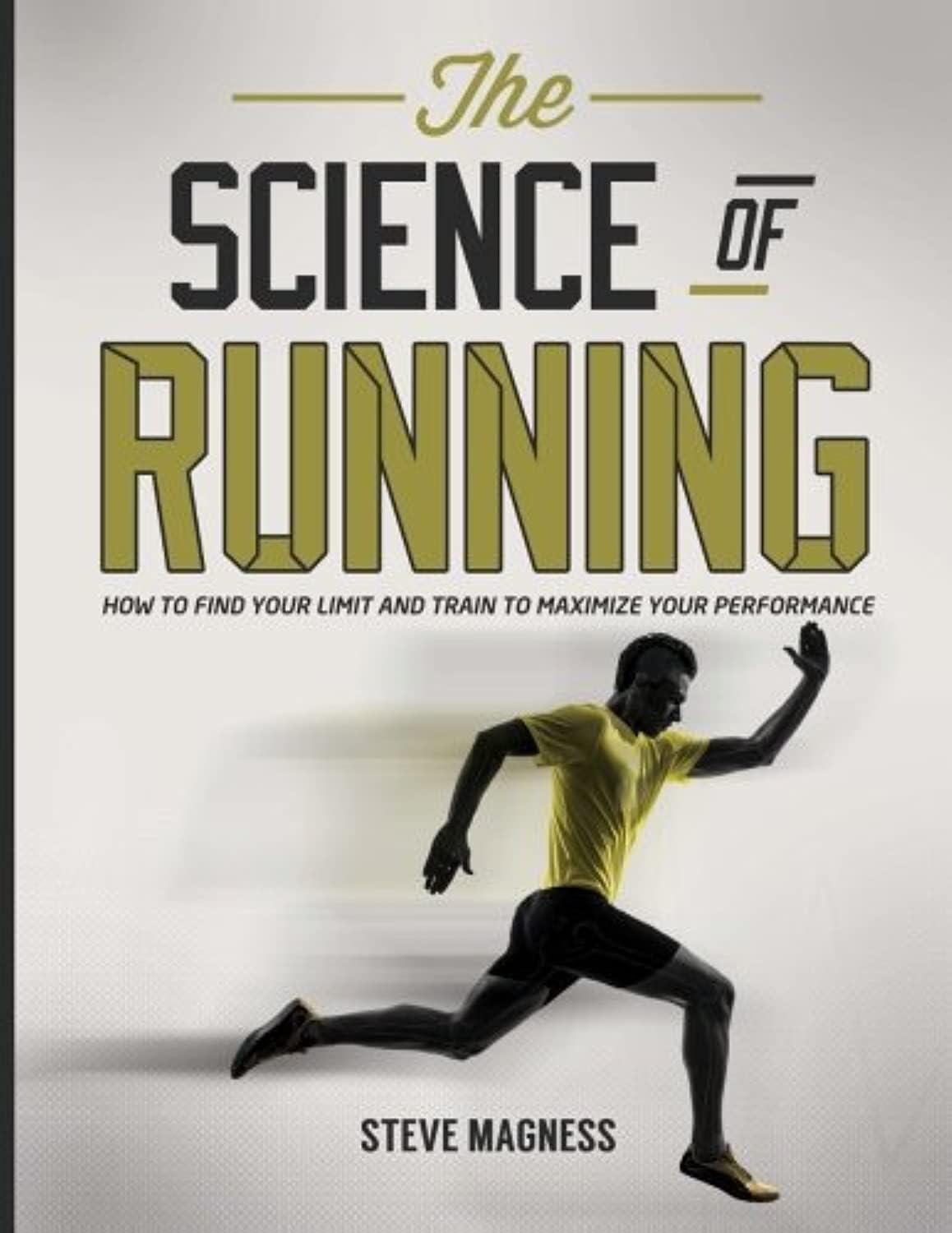
The Science of Running: How to find your limit and train to maximize your performance
Product ID: 620212
Buy anything from 5,000+ international stores. One checkout price. No surprise fees. Join 2M+ shoppers on Desertcart.
Desertcart purchases this item on your behalf and handles shipping, customs, and support to Macau.
Reviews of The Science of Running:"The Science of Running sets the new standard for training theory and physiological data. Every veteran and beginner distance coach needs to have this on their book shelf."-Alan WebbAmerican Record Holder-Mile 3:46.91 "For anyone serious about running, The Science of Running offers the latest information and research for optimizing not only your understanding of training but also your performance. If you want to delve deeper into the world of running and training, this book is for you. You will never look at running the same."-Jackie Areson, 15th at the 2013 World Championships in the 5k. 15:12 5,000m best If you are looking for how to finish your first 5k, this book isn’t for you. The Science of Running is written for those of us looking to maximize our performance, get as close to our limits as possible, and more than anything find out how good we can be, or how good our athletes can be. In The Science of Running, elite coach and exercise physiologist Steve Magness integrates the latest research with the training processes of the world’s best runners, to deliver an in depth look at how to maximize your performance. It is a unique book that conquers both the scientific and practical points of running in two different sections. The first is aimed at identifying what limits running performance from a scientific standpoint. You will take a tour through the inside of the body, learning what causes fatigue, how we produce energy to run, and how the brain functions to hold you back from super-human performance. In section two, we turn to the practical application of this information and focus on the process of training to achieve your goals. You will learn how to develop training plans and to look at training in a completely different way. The Science of Running does not hold back information and is sure to challenge you to become a better athlete, coach, or exercise scientist in covering such topics as:· What is fatigue? The latest research on looking at fatigue from a brain centered view.· Why VO2max is the most overrated and misunderstood concept in both the lab and on the track· Why “zone” training leads to suboptimal performance.· How to properly individualize training for your own unique physiology.· How to look at the training process in a unique way in terms of stimulus and adaptation.· Full sample training programs from 800m to the marathon. Review: the greatest compilation of runners knowledge I've found on the general ... - For sure, the greatest compilation of runners knowledge I've found on the general subject. From the 400m sprinter to the marathon runner, this book digs deep. Fist, it delves headfirst into the scientific concepts of running and basic kinesiology in the sport. Digging deep into the physiological process your body goes through from mile one to mile twenty+ between activating muscle fibers to pulling glycogen from the muscles, the marginal increase of muscle fatigue, etc... A bit of a read for someone uneducated in the subject such as myself, but read at a slower pace, soak in the information and take notes and it becomes less overwhelming. Second section is the training portion. First going into philosophy, theory and application then helping tailor a periodized training routine based on your own individual needs. It helps put perspective and focus on one's end goals and helps create a system in which you can attain those goals. Not simply by stating "Do X on Monday and Y on Wednesday for Z amount of weeks, invariably", no it goes deeper than that into theory and the application thereof to assist in developing a regimen specific to ones own needs. This is a great book and I will soon be utilizing it to create a new training regimen and hopefully be on my way to running a full marathon and even ultra's next year (not coming from a couch potato of course). Review: Good info, needs an editor - This book is packed with information. Steve obviously knows his topic and I found the science and physiological details very interesting, although they may go over the head of people without a background in science. He really does a good job of explaining the science of training and how different stressors create different adaptations and how to use that information to design training. I hadn't seen his breakdown of athletes by muscle fiber type before and this section is very interesting because it explains how to adapt training plans and workouts based on whether a runner has predominately fast twitch or slow twitch muscle fiber for their event. This would help explain why, besides other genetic variations, different athletes respond to the same workouts differently. He definitely is not a fan of cooking cutter training plans and really gets into adapting training for the individual athlete. He's also doesn't seem to be a fan of zone training and advises to through it out of the window. His classification of workout paces makes a lot of sense and has been proven effective by coaches such as Renato Canova. Also his explanation of funnel training was new to me and varies quite a bit compared to Lydiard type training. So the fly in the ointment is the plethora of misspellings and grammatical errors and is the reason for not giving it 5 stars. They book just needs a good editor to go through it and help fix those basic errors and perhaps to refine the organization of the content and make it read better. The book is still quite readable, but it's been a long, long time since I've seen these kind of problems in the age of word processors.
| Best Sellers Rank | #51,253 in Books ( See Top 100 in Books ) #23 in Running & Jogging (Books) |
| Customer Reviews | 4.4 out of 5 stars 745 Reviews |
K**E
the greatest compilation of runners knowledge I've found on the general ...
For sure, the greatest compilation of runners knowledge I've found on the general subject. From the 400m sprinter to the marathon runner, this book digs deep. Fist, it delves headfirst into the scientific concepts of running and basic kinesiology in the sport. Digging deep into the physiological process your body goes through from mile one to mile twenty+ between activating muscle fibers to pulling glycogen from the muscles, the marginal increase of muscle fatigue, etc... A bit of a read for someone uneducated in the subject such as myself, but read at a slower pace, soak in the information and take notes and it becomes less overwhelming. Second section is the training portion. First going into philosophy, theory and application then helping tailor a periodized training routine based on your own individual needs. It helps put perspective and focus on one's end goals and helps create a system in which you can attain those goals. Not simply by stating "Do X on Monday and Y on Wednesday for Z amount of weeks, invariably", no it goes deeper than that into theory and the application thereof to assist in developing a regimen specific to ones own needs. This is a great book and I will soon be utilizing it to create a new training regimen and hopefully be on my way to running a full marathon and even ultra's next year (not coming from a couch potato of course).
A**E
Good info, needs an editor
This book is packed with information. Steve obviously knows his topic and I found the science and physiological details very interesting, although they may go over the head of people without a background in science. He really does a good job of explaining the science of training and how different stressors create different adaptations and how to use that information to design training. I hadn't seen his breakdown of athletes by muscle fiber type before and this section is very interesting because it explains how to adapt training plans and workouts based on whether a runner has predominately fast twitch or slow twitch muscle fiber for their event. This would help explain why, besides other genetic variations, different athletes respond to the same workouts differently. He definitely is not a fan of cooking cutter training plans and really gets into adapting training for the individual athlete. He's also doesn't seem to be a fan of zone training and advises to through it out of the window. His classification of workout paces makes a lot of sense and has been proven effective by coaches such as Renato Canova. Also his explanation of funnel training was new to me and varies quite a bit compared to Lydiard type training. So the fly in the ointment is the plethora of misspellings and grammatical errors and is the reason for not giving it 5 stars. They book just needs a good editor to go through it and help fix those basic errors and perhaps to refine the organization of the content and make it read better. The book is still quite readable, but it's been a long, long time since I've seen these kind of problems in the age of word processors.
K**L
Best running book that I’ve read so far
Steve goes into much more detail from a science-based perspective than all the other Marathon training books. Also his YouTube Channel is worth following.
G**Y
Running With Science
In the past year, there have been a number of excellent books on training distance runners published: Greg McMillan's You (Only Faster), Owen Anderson's Running Science, Jack Daniels third edition of his Running Formula, Pat Tyson's update of Joe Newton's classic Coaching Cross Country Successfully and now the most recent addition to this list is Steve Magness's The Science of Running. For those of us who remember when the only guidance on the subject was Fred Wilt's How They Train and a quarterly publication, Track Technique, we appreciate their efforts. Steve Magness's avowed purpose is to integrate the separate silos of coaching practices and research science. His own qualifications are impressive: high school phenom, disappointing college career followed by a quest to study the best coaches and coaching in the world and then his absorption of the science of running and exercise physiology (much of what appeared on his informative science of running blog). He also spent a stint with the Nike Oregon Project, seeing and supervising first hand the training of world class athletes. All this has been distilled into the Science of Running, a 331 page opus that is divided into two parts: the science and then the coaching. Mercifully, the 144 page science section is not a biology lecture on mitochondria, lactate threshold, and VO2 Max concepts.True to his promise, he attempts to use science to guide training. One learns that there is no rational basis for the current fixation on the emphasis of running at VO2 max. Other insights include that there are numerous signaling pathways activated by different types of training that can accomplish the same adaptation, that sprinting is the best plyometric, the importance of correct biomechanics to optimize the storage of kinetic energy. Before transitioning into the coaching portion of the book, the author concludes that the disconnect between science and coaching can be attributed to science's need to test a single variable in isolation vs. the integrated environment that the coach needs to actually train his athletes in. The coaching section's central premise is that the athlete's training should be oriented on his muscle fiber types with separate training programs created for the two types of athletes. He explains different types of training for both muscle fiber types, starting with the 800 meter runner progressing all the way to the marathon. This approach is also used when discussing supplementary training such as core exercises and strength training. Despite the fact that we are now into the coaching section, science insights are still injected when evaluating training. For example, the reader learns that probably the best core training is to run at various speeds. Steve Magness can be justifiably proud of his contribution to the literature of distance running training. And since this book is probably destined for several more editions, I would encourage him to improve his current edition in two ways. First, there are numerous typographical errors throughout the text, misspellings and missing letters, distracting but easily corrected. Secondly, there is no index, which makes retrieving some of his insights more difficult than necessary. Despite these shortcomings, this is an outstanding guide for any coach or runner, at any level, wishing to become better and / or faster.
J**S
Instant must-read addition to a running/coaching library, with crossover relevance to most sports
A must-read for anyone coaching from high school on up, as well as serious runners of all sorts. Much of this applies in principle to sports ranging from swimming to alpine skiing to wrestling or other currently popular forms of grappling such as BJJ or NHB, so while the title correctly identifies the book's focus, this book would be useful to a much wider audience. The coverage of the partial disconnect between science and coaching is excellent. In this regard, I believe more extensive discussion of both the current enthusiasm for drills alongside running, and of the cultlike fad for H.I.I.T. training, would be helpful additions to future editions of the book. Drills, particularly the idea that drills help prevent injury, may currently be a social phenomenon that could get more empirical support from future scientific research and coaching practice, or not. H.I.I.T. and some heavily branded gyms utilizing H.I.I.T, may well be an example of anti-science and negative coaching, if not implemented as part of a broader training approach. Highly recommended.
T**E
Really like the funnel training approach
This book is better researched and better written than most running books. It does suffer a bit from not being critically proof read and it was obviously spell checked by a computer. Really designed for coaches but, there is a lot here for the amateur to serious runner who desires to improve their race times. You can use the information in this book to easily design a great training plan to meet your next race goal knowing not much more than your goal pace. If you want to be spoon fed a training plan this is not the book for you. Training focused on more on pace specificity than most others makes a lot of sense and I think converging on it from both the speed and endurance tangents is brilliant aka the Funnel Training Plan. Now if there was an app or website....
S**O
A Wealth of Knowledge
Steve does a great job of explaining why training works for some athletes and not for others. A part of me wishes I would have had this information years ago, but at the same time I am not sure if I could have fully grasped the information without these experiences. This book is for the runner who has a vested interest in their running... or has ran competitively in the past and is now coaching other athletes. I think it's important for the reader of this book to have experienced the ups and downs of training themselves. I think it would be hard to deeply understand the information in this book if you have not experienced competitive training yourself. In college I was very lucky to train with Olympians, high school phenoms, and the blue-collar runner who worked their way up the team. I was always fascinated by how a group that contained so much talent, often only had a handful that reached the top. We all did the same training and some even trained harder, but not everyone improved at the same rates. The Science of Running does a great job of explaining this dilemma. Why do some countries dominate in particular events. The East-Africans in the marathon, the Jamaicans in sprinting. At the elite level athletes are all working their tails off, but not everyone is responding the same to training. Those that reach their genetic potential have found what works for them. For these athletes if they were under a different "system" of training they might not be at the level they have reached under their current training system. The Science of Running does a great job of explaining this dilemma. The act of running is so simple. Get a pair of shoes and head out the door. But if it's so simple, why is it so hard to pinpoint what is "successful" training. There are a million ways to approach training and there is no cookie cutter program that is the perfect answer. The Science of Running does a great job of explaining this dilemma. The Science of Running does a great job of explaining many things and combining it with real life experiences will allow you to be able to take your running or those you coach to a new level.
J**H
Excellent resource
This is an excellent book. The background information compliments the training section very well. The training section seems to be very up to date, cutting edge. The training plans are a breath of fresh air compared to some of the more traditional running books which may be starting to look a bit dated at this stage. I think people who follow these plans or tailor them to their own needs (which should be manageable thanks to the detail in the book) will have good results. I have many, many running books, but this one has been a real breath of fresh air, I am delighted with it. The only gripe I would have is it should have been edited to remove typos and improve readability.
K**R
This book is people interested in High performance sports and Sciences.
This book is very good. As anyone would suggest it is for High performance and Science freak. Not for normal "to-do" guidelines. It is having extremely intense content. And yes very outstanding practically helpful book vast out look to training.
P**P
Great
Love this informative book
B**N
Excellent livre
Excellent livre sur le sujet de la préparation athlétique qui couvre tous les aspects importants d'une bonne préparation à l'exercice physique en général même si un emphase particulière est mise dans le livre sur la course à pied. Notes importantes : - Il s'agit d'un ouvrage EXTRÊMEMENT technique qui nécessite des connaissances relativement avancées en biologie et physiologie pour pouvoir en tirer le meilleur. L'approche est extrêmement scientifique et appuyée par une masse de diagrammes, tableaux, courbes et chiffres. - Le livre est à ma connaissance uniquement disponible en anglais. - L'auteur (Steve Magness) est connu pour son approche multi-dimensionnelles de la recherche de la performance et le soin qu'il met dans la préparation psychologique de ses athlètes (dont certains multi-médaillés). Ce livre n'en reste pas moins une bible pour les amateurs de course à pied et de sport en général, que je recommande chaudement.
R**T
Worth every penny.
Every coach would find this really interesting enabling them to get a solid background on the physiological aspects of running. I personally found it really useful.. first class.
M**I
Amazing book - opens up your eyes on how to do things
I absolutely love this book! It has really opened my eyes on how to look at exercise physiology for running. Highly recommend this book. One of the best out there.
Trustpilot
4 days ago
2 weeks ago