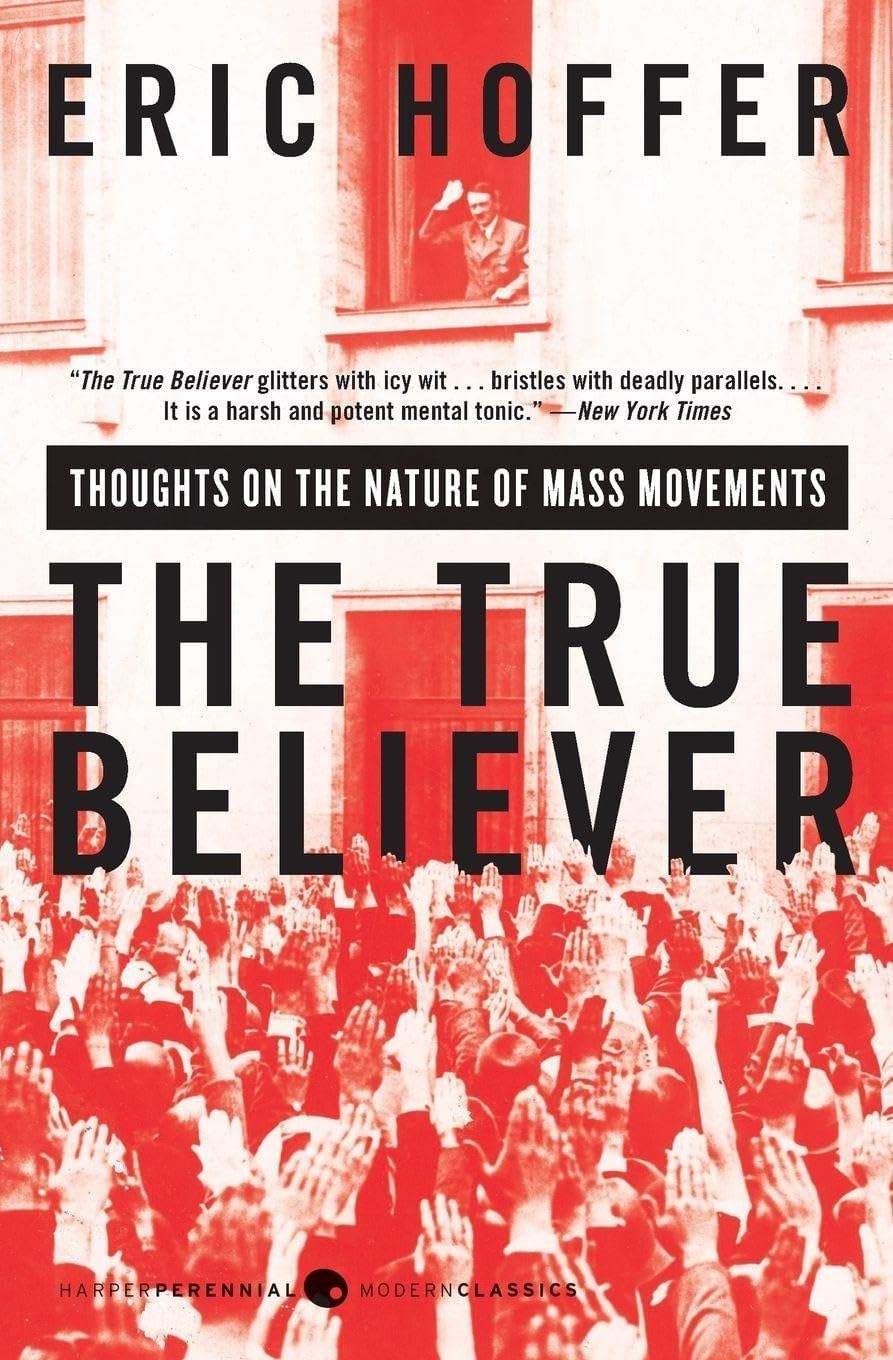
The True Believer: Thoughts on the Nature of Mass Movements (Perennial Classics)
Product ID: 7694918
Buy anything from 5,000+ international stores. One checkout price. No surprise fees. Join 2M+ shoppers on Desertcart.
Desertcart purchases this item on your behalf and handles shipping, customs, and support to Macau.
“Its theme is political fanaticism, with which it deals severely and brilliantly.” — New Yorker The famous bestseller with “concise insight into what drives the mind of the fanatic and the dynamics of a mass movement” ( Wall Street Journal ) by the legendary San Francisco longshoreman. A stevedore on the San Francisco docks in the 1940s, Eric Hoffer wrote philosophical treatises in his spare time while living in the railroad yards. The True Believer —the first and most famous of his books—was made into a bestseller when President Eisenhower cited it during one of the earliest television press conferences. Called a “brilliant and original inquiry” and “a genuine contribution to our social thought” by Arthur Schlesinger, Jr., this landmark in the field of social psychology is completely relevant and essential for understanding the world today as it delivers a visionary, highly provocative look into the mind of the fanatic and a penetrating study of how an individual becomes one. Review: Essential reading for revolutionaries - a masterpiece. - Revolutions and other mass movements all have commonalities, chief among them are the people who start and promulgate them. This short, concise book breaks down and organizes the characteristics of these people: The True Believers - and the movements they promote. This is a book of genius, comparable to ‘The Prince’ or ‘Rules for Radicals,’ in its simplicity and insights into human nature and organized political action. Hoffer wrote this book after the Second World War while the memories and realities of Fascism and Communism were very present. If you’ve ever been part of a mass movement, or ever contemplated participating in one, this book will open your eyes to what you can expect as a mass movement gets underway and develops through its active phase. It’ll provide you with an understanding of the motivations and designs of the movement’s leaders, and insight into your own and your fellow believers’ psychology. If you have the ambition to be the next Christ or Hitler to lead a mass movement, this is your blueprint. In summary: I. THE APPEAL OF MASS MOVEMENTS The desire for change starts and lives in the hearts of frustrated people. Attached to this frustration these individuals possess a sense of power to accomplish great change. Faith in the future and the ability to project hope makes for receptivity to change. High hopes and dark endings incongruently go together. Belonging to a mass movement substitutes for deficiencies in the individual. Mass Movements compete with one another, and often are interchangeable. No movement is whole of a singular nature. II. THE POTENTIAL CONVERTS The best and worst of society often determine the course of history - over the heads of the great middle. A society without the dregs may be peaceful and complacent, but lacking in the seeds for change. Here are the ranks of mass movement fodder: New Poor: Memory of better times puts fire in their bellies. Abject Poor: Too occupied with survival to organize. Discontent is high, however, when misery is still bearable. Free Poor: Freedom creates and alleviates frustration. Fanatics fear freedom more than persecution. Equality and fraternity are preferred over freedom. Creative Poor: The ability to create mitigates frustration; however, those whose creativity is fading, or those who didn’t quite achieve creative satisfaction, may seek escape in mass movements. Unified Poor: Compact or tribal groups are relatively free of frustration. Mass movements often try to break down family units to feed the movement. Compact structures, like families in decline are, however, fertile ground for mass movements. Temporary Misfits: Adolescents, unemployed, veterans, and new immigrants are unreliable supporters of mass movements; their frustrations abate once circumstances improve. Permanent Misfits: The incurably frustrated can never have enough of what they really do not want anyway. They are likely to become the most violent true believers. Inordinately Selfish: Those who have lost faith in themselves, look to attach to a holy cause; In compensation, they become champions of selflessness. Ambitious with Unlimited Opportunity: Current actions are never enough; they possess excessive readiness for self-sacrifice. Minorities Intent On Preserving Their Identity: These persons act as tribal groups and lack frustration. Minorities Bent On Assimilation: These frustrated cannot get in the door of the established order. Bored: These people are required in quantity for a successful mass movement; they’re looking for fulfillment in a meaningless existence. Sinners: For the irredeemable, salvation can be found in losing oneself in a holy cause; they are willing to go to extremes. Mass movements attract and hold followers by offering refuge from anxiety. Mass movements aim to infect people with a malady, then offer a cure. Hope comes in two forms: one immediate and one distant. III. UNITED ACTION AND SELF-SACRIFICE The chief preoccupation of mass movements is to foster united action and self-sacrifice. For the individual to commit to self-sacrifice he must be stripped of his individual identity, and by ritual be associated with the movement. To engage in dying or killing, the individual must suffer under the illusion of being a participant in a grand undertaking, or a solemn performance. Glory is theatrical. The present must be deprecated, pushed off the stage, depicted as mean and miserable and held in utter contempt. In replacement, hope is assured for a better future. The frustrated individual is ready to die for what he wishes to have and wishes to be. Mass movements strive to interpose a fact-proof screen between the movement’s faithful and the realities of the world, in a word: doctrine. The effectiveness of a doctrine is judged not on its validity or profundity, but on how well it insulates the individual from his self and the world. The individual’s estrangement proceeds with intense passion and fanaticism. Mass movements prevent the achievement of internal balance for the fanatic individual, but perpetuate insecurity and incompleteness. Unified individuals in a compact collective of a mass movement body are no longer frustrated. Hatred is the most accessible and comprehensive of all unifying agents. Mass movements can rise without a belief in God, but never without a belief in evil. Unreasonable hatreds emerge as an expression of the frustrated individual’s effort to suppress his own shortcomings and self-contempt. Self hate emanates from feelings of helplessness, inadequacy, and cowardice, rather than justified grievances. The object of hate is often those other than the ones who committed the perceived wrongs. Committing grave injustices upon the object of hate re-enforces and fuels hate. A guilty conscience lies behind such acts, which demands even greater effort to demonize the hated to suppress this guilty conscience. Estrangement of the self is required for selflessness and assimilation into the whole of a compact group. The True Believer sees himself as one of ‘the chosen.’ Self-denial and group membership confers the right on them to be harsh upon others, and by which to be rid of personal responsibility. Violence is not the product of leadership, but of a unification of the whole. Propaganda succeeds not with unwilling minds, but with frustrated individuals. Propaganda operates most effectively in conjunction with coercion. The mass movement requires the ability to make people believe, and by force as a last resort. Leadership cannot create a mass movement out of thin air. There has to be grievances with intense dissatisfactions and an eagerness of the True Believers to follow and obey. Once the stage is set, however, an outstanding leader is indispensable. The leader personifies the certitude of the movement, as well as defiance and power. He must be able to steer the faithful and maintain its cohesion. To a large degree, charlatanism is required for effective leadership. Action is a unifier of mass movements. Marching, for instance, kills thought and hastens the end of individuality. An inability to act breeds frustration with the movement, while successful action drains energy and commitment from the movement. The mass movement must perpetuate the individual’s incompleteness and insecurity. IV. BEGINNING AND END Men of Words: Mass movements usually rise when a prevailing order has been discredited. This is the work of men of words with a grievance. They set the groundwork for the movement by undermining existing institutions, promoting the idea of change, and creating a new faith. Men of words may champion the downtrodden, but the grievance that animates them is personal. Their vanity is greater than their ambitions; recognition and the appearance of power is preferred over power itself. Often it’s the men of words who are the tragic figures of the mass movement, as at a certain point, the movement is hijacked by a power hungry clique which usually cheats the masses of the freedoms they seek. Fanatics: A genuine mass movement is hatched by the fanatic. Men of words shrink before the outbreak of anarchy, they forget the troubled masses they set out to help, and run to the protection of strong ‘men of action.’ For the fanatic, chaos is his element. Fanatics come from the ranks of the non-creative men of words; unfulfilled, they can never be reconciled with their self, and they desire not a finality or a fixed order of things. Hatred becomes a habit, and when the outsiders are vanquished, the fanatics then turn on themselves and threaten to destroy what they have achieved. Man of Action: The movement begins with men of words, materializes by fanatics, and consolidated by men of action. With a balanced faith in humanity, men of action save the movement from the fanatics, marking the end of the dynamic phase of the movement. Men of action fix and perpetuate the movement’s unity and readiness for self-sacrifice. The new order is founded on the ‘necks of the people, rather than in their hearts.’ The man of action is a man of the law. The movement now becomes a means of self-realization for the ambitious. Concern for the frustrated is still there, not to harness their discontent, but to reconcile them with it; to turn them meek and patient with visions of distance hopes and dreams. Good and Bad Mass Movements: No matter what good intentions a mass movement starts off with, or what benefit may result, it is hard not to see the active phase as unpleasant, if not outright evil. On the other hand, mass movements are a miraculous instrument for raising societies and nations from the dead. Recommended complementary reading: ‘The Anatomy of Revolution’ by Crane Brinton; compares the four greatest revolutions, providing much historical background that Hoffer refers to in ‘The True Believer.’ Review: Hoffer's keen observations are timeless. - This a a great book, highly relevant these days, a classic that everyone should read. History reveals man's shocking capacity for mass madness and insane cruelty. What is the good, the purpose of pain, suffering, decay and so much abject brutality? One answer is simply that in a polarity universe the one extreme of purity and goodness cannot exist without the other extreme, meaning contamination and evil. In the temporal hologram, everything rots. It is simple physics, or rather metaphysics. A more western oriented explanation of the purpose for such brutal and destructive energies is offered by the plain speaking, down-to-earth American philosopher Eric Hoffer in his classic astute and insightful book, `The True Believer, Thoughts on the Nature of Mass Movements' [1951]: "The discarded and rejected [of any society] are often the raw material of a nation's future. The stone builders reject becomes the cornerstone of a new world. A nation without dregs and malcontents is orderly, decent, peaceful and pleasant, but perhaps without the seed of things to come. It was not the irony of history that the undesired in the countries of Europe should have crossed an ocean to build a new world on the [North American] continent. Only they could do it." From this pragmatic assessment we may approach the idea that those we consider to be the dregs of society, the losers, and the various forms of eroding contamination, chemical or ideological -- are in fact the seed store of new forms. Bacteria and viruses, which destroy weakened living cells, have been with us forever. In a cyclical universe, there must be energies that decay, dissolve, and destroy. Often these are hidden beyond our sight, decomposing matter under rocks, in putrid slime yucky-goo rubbish, or silently lurking inside our human bodies. Sometimes they are found in the malcontent, the alienated, misfits who in blaming others for their "spoiled lives" [Hoffer's words] overthrow the existing order. Hoffer counts political and religious fanatics such as Hitler and Lenin among these `true believers' who throughout history have murdered thousands in the name of truth. Eric Hoffer worked on the San Francisco docks as a stevedore in the 1940s. He was self-educated and his experiences in the realm of physical labour combined with a lack of ivory tower intellectual conditioning, which so is often removed from any real life, and therefore produced an extraordinary view of the human condition. I first read `The True Believer' back in Texas high school, perhaps 1962, and I admit that I did not and could not have understood it in those days -- but even in my tender green naive teens, I realized that there was something deeply profoundly true in this book. Because of the recent rumours of revolution, I remembered and thus reread this classic, which was reissued in 2010. Hoffer makes it unequivocally clear that what motivates the True Believer into fanaticism is his or her own lack. They are as he says the disaffected, the poor, the unemployed, the misfits, outcasts, minorities, adolescent youth, the ambitious, the obsessed, the impotent in mind or body, the inordinately selfish, the bored and sinners. "...they are wholly without reverence toward the present. They see their lives and the present as spoiled beyond remedy and they are ready to waste and wreck both: hence their recklessness and their will to chaos and anarchy...Thus they are among the early recruits of revolutions, mass migrations, and of religious, racial and chauvinist movements, and they imprint their mark upon these upheavals and movements which shape a nations character and history." Hoffer's keen observations are brilliant, timeless, and yet more relevant than ever.
| Best Sellers Rank | #26,324 in Books ( See Top 100 in Books ) #12 in Violence in Society (Books) #18 in Political Philosophy (Books) #68 in Popular Social Psychology & Interactions |
| Customer Reviews | 4.6 out of 5 stars 2,419 Reviews |
H**J
Essential reading for revolutionaries - a masterpiece.
Revolutions and other mass movements all have commonalities, chief among them are the people who start and promulgate them. This short, concise book breaks down and organizes the characteristics of these people: The True Believers - and the movements they promote. This is a book of genius, comparable to ‘The Prince’ or ‘Rules for Radicals,’ in its simplicity and insights into human nature and organized political action. Hoffer wrote this book after the Second World War while the memories and realities of Fascism and Communism were very present. If you’ve ever been part of a mass movement, or ever contemplated participating in one, this book will open your eyes to what you can expect as a mass movement gets underway and develops through its active phase. It’ll provide you with an understanding of the motivations and designs of the movement’s leaders, and insight into your own and your fellow believers’ psychology. If you have the ambition to be the next Christ or Hitler to lead a mass movement, this is your blueprint. In summary: I. THE APPEAL OF MASS MOVEMENTS The desire for change starts and lives in the hearts of frustrated people. Attached to this frustration these individuals possess a sense of power to accomplish great change. Faith in the future and the ability to project hope makes for receptivity to change. High hopes and dark endings incongruently go together. Belonging to a mass movement substitutes for deficiencies in the individual. Mass Movements compete with one another, and often are interchangeable. No movement is whole of a singular nature. II. THE POTENTIAL CONVERTS The best and worst of society often determine the course of history - over the heads of the great middle. A society without the dregs may be peaceful and complacent, but lacking in the seeds for change. Here are the ranks of mass movement fodder: New Poor: Memory of better times puts fire in their bellies. Abject Poor: Too occupied with survival to organize. Discontent is high, however, when misery is still bearable. Free Poor: Freedom creates and alleviates frustration. Fanatics fear freedom more than persecution. Equality and fraternity are preferred over freedom. Creative Poor: The ability to create mitigates frustration; however, those whose creativity is fading, or those who didn’t quite achieve creative satisfaction, may seek escape in mass movements. Unified Poor: Compact or tribal groups are relatively free of frustration. Mass movements often try to break down family units to feed the movement. Compact structures, like families in decline are, however, fertile ground for mass movements. Temporary Misfits: Adolescents, unemployed, veterans, and new immigrants are unreliable supporters of mass movements; their frustrations abate once circumstances improve. Permanent Misfits: The incurably frustrated can never have enough of what they really do not want anyway. They are likely to become the most violent true believers. Inordinately Selfish: Those who have lost faith in themselves, look to attach to a holy cause; In compensation, they become champions of selflessness. Ambitious with Unlimited Opportunity: Current actions are never enough; they possess excessive readiness for self-sacrifice. Minorities Intent On Preserving Their Identity: These persons act as tribal groups and lack frustration. Minorities Bent On Assimilation: These frustrated cannot get in the door of the established order. Bored: These people are required in quantity for a successful mass movement; they’re looking for fulfillment in a meaningless existence. Sinners: For the irredeemable, salvation can be found in losing oneself in a holy cause; they are willing to go to extremes. Mass movements attract and hold followers by offering refuge from anxiety. Mass movements aim to infect people with a malady, then offer a cure. Hope comes in two forms: one immediate and one distant. III. UNITED ACTION AND SELF-SACRIFICE The chief preoccupation of mass movements is to foster united action and self-sacrifice. For the individual to commit to self-sacrifice he must be stripped of his individual identity, and by ritual be associated with the movement. To engage in dying or killing, the individual must suffer under the illusion of being a participant in a grand undertaking, or a solemn performance. Glory is theatrical. The present must be deprecated, pushed off the stage, depicted as mean and miserable and held in utter contempt. In replacement, hope is assured for a better future. The frustrated individual is ready to die for what he wishes to have and wishes to be. Mass movements strive to interpose a fact-proof screen between the movement’s faithful and the realities of the world, in a word: doctrine. The effectiveness of a doctrine is judged not on its validity or profundity, but on how well it insulates the individual from his self and the world. The individual’s estrangement proceeds with intense passion and fanaticism. Mass movements prevent the achievement of internal balance for the fanatic individual, but perpetuate insecurity and incompleteness. Unified individuals in a compact collective of a mass movement body are no longer frustrated. Hatred is the most accessible and comprehensive of all unifying agents. Mass movements can rise without a belief in God, but never without a belief in evil. Unreasonable hatreds emerge as an expression of the frustrated individual’s effort to suppress his own shortcomings and self-contempt. Self hate emanates from feelings of helplessness, inadequacy, and cowardice, rather than justified grievances. The object of hate is often those other than the ones who committed the perceived wrongs. Committing grave injustices upon the object of hate re-enforces and fuels hate. A guilty conscience lies behind such acts, which demands even greater effort to demonize the hated to suppress this guilty conscience. Estrangement of the self is required for selflessness and assimilation into the whole of a compact group. The True Believer sees himself as one of ‘the chosen.’ Self-denial and group membership confers the right on them to be harsh upon others, and by which to be rid of personal responsibility. Violence is not the product of leadership, but of a unification of the whole. Propaganda succeeds not with unwilling minds, but with frustrated individuals. Propaganda operates most effectively in conjunction with coercion. The mass movement requires the ability to make people believe, and by force as a last resort. Leadership cannot create a mass movement out of thin air. There has to be grievances with intense dissatisfactions and an eagerness of the True Believers to follow and obey. Once the stage is set, however, an outstanding leader is indispensable. The leader personifies the certitude of the movement, as well as defiance and power. He must be able to steer the faithful and maintain its cohesion. To a large degree, charlatanism is required for effective leadership. Action is a unifier of mass movements. Marching, for instance, kills thought and hastens the end of individuality. An inability to act breeds frustration with the movement, while successful action drains energy and commitment from the movement. The mass movement must perpetuate the individual’s incompleteness and insecurity. IV. BEGINNING AND END Men of Words: Mass movements usually rise when a prevailing order has been discredited. This is the work of men of words with a grievance. They set the groundwork for the movement by undermining existing institutions, promoting the idea of change, and creating a new faith. Men of words may champion the downtrodden, but the grievance that animates them is personal. Their vanity is greater than their ambitions; recognition and the appearance of power is preferred over power itself. Often it’s the men of words who are the tragic figures of the mass movement, as at a certain point, the movement is hijacked by a power hungry clique which usually cheats the masses of the freedoms they seek. Fanatics: A genuine mass movement is hatched by the fanatic. Men of words shrink before the outbreak of anarchy, they forget the troubled masses they set out to help, and run to the protection of strong ‘men of action.’ For the fanatic, chaos is his element. Fanatics come from the ranks of the non-creative men of words; unfulfilled, they can never be reconciled with their self, and they desire not a finality or a fixed order of things. Hatred becomes a habit, and when the outsiders are vanquished, the fanatics then turn on themselves and threaten to destroy what they have achieved. Man of Action: The movement begins with men of words, materializes by fanatics, and consolidated by men of action. With a balanced faith in humanity, men of action save the movement from the fanatics, marking the end of the dynamic phase of the movement. Men of action fix and perpetuate the movement’s unity and readiness for self-sacrifice. The new order is founded on the ‘necks of the people, rather than in their hearts.’ The man of action is a man of the law. The movement now becomes a means of self-realization for the ambitious. Concern for the frustrated is still there, not to harness their discontent, but to reconcile them with it; to turn them meek and patient with visions of distance hopes and dreams. Good and Bad Mass Movements: No matter what good intentions a mass movement starts off with, or what benefit may result, it is hard not to see the active phase as unpleasant, if not outright evil. On the other hand, mass movements are a miraculous instrument for raising societies and nations from the dead. Recommended complementary reading: ‘The Anatomy of Revolution’ by Crane Brinton; compares the four greatest revolutions, providing much historical background that Hoffer refers to in ‘The True Believer.’
S**N
Hoffer's keen observations are timeless.
This a a great book, highly relevant these days, a classic that everyone should read. History reveals man's shocking capacity for mass madness and insane cruelty. What is the good, the purpose of pain, suffering, decay and so much abject brutality? One answer is simply that in a polarity universe the one extreme of purity and goodness cannot exist without the other extreme, meaning contamination and evil. In the temporal hologram, everything rots. It is simple physics, or rather metaphysics. A more western oriented explanation of the purpose for such brutal and destructive energies is offered by the plain speaking, down-to-earth American philosopher Eric Hoffer in his classic astute and insightful book, `The True Believer, Thoughts on the Nature of Mass Movements' [1951]: "The discarded and rejected [of any society] are often the raw material of a nation's future. The stone builders reject becomes the cornerstone of a new world. A nation without dregs and malcontents is orderly, decent, peaceful and pleasant, but perhaps without the seed of things to come. It was not the irony of history that the undesired in the countries of Europe should have crossed an ocean to build a new world on the [North American] continent. Only they could do it." From this pragmatic assessment we may approach the idea that those we consider to be the dregs of society, the losers, and the various forms of eroding contamination, chemical or ideological -- are in fact the seed store of new forms. Bacteria and viruses, which destroy weakened living cells, have been with us forever. In a cyclical universe, there must be energies that decay, dissolve, and destroy. Often these are hidden beyond our sight, decomposing matter under rocks, in putrid slime yucky-goo rubbish, or silently lurking inside our human bodies. Sometimes they are found in the malcontent, the alienated, misfits who in blaming others for their "spoiled lives" [Hoffer's words] overthrow the existing order. Hoffer counts political and religious fanatics such as Hitler and Lenin among these `true believers' who throughout history have murdered thousands in the name of truth. Eric Hoffer worked on the San Francisco docks as a stevedore in the 1940s. He was self-educated and his experiences in the realm of physical labour combined with a lack of ivory tower intellectual conditioning, which so is often removed from any real life, and therefore produced an extraordinary view of the human condition. I first read `The True Believer' back in Texas high school, perhaps 1962, and I admit that I did not and could not have understood it in those days -- but even in my tender green naive teens, I realized that there was something deeply profoundly true in this book. Because of the recent rumours of revolution, I remembered and thus reread this classic, which was reissued in 2010. Hoffer makes it unequivocally clear that what motivates the True Believer into fanaticism is his or her own lack. They are as he says the disaffected, the poor, the unemployed, the misfits, outcasts, minorities, adolescent youth, the ambitious, the obsessed, the impotent in mind or body, the inordinately selfish, the bored and sinners. "...they are wholly without reverence toward the present. They see their lives and the present as spoiled beyond remedy and they are ready to waste and wreck both: hence their recklessness and their will to chaos and anarchy...Thus they are among the early recruits of revolutions, mass migrations, and of religious, racial and chauvinist movements, and they imprint their mark upon these upheavals and movements which shape a nations character and history." Hoffer's keen observations are brilliant, timeless, and yet more relevant than ever.
D**R
An Enduring Classic by a Proletarian Philosopher
Although this was Eric Hoffer’s first book, it continues to be recognized as his best and most influential work. Hoffer wrote for the common man because that is what he was. He chose to work on the docks and observe the world about him from that perspective. He got his hands dirty, and he understood sweat. His observations were common—without the pretentious interminable citations from the respected authorities of the day—but his analyses of human nature were perceptive. I would rate the book with five stars for content, but somewhat less than that for its arrangement. The subject matter is unduly fragmented and dispersed throughout the book. It seems that it could have been arranged so as to be less repetitive and easier to follow. Also, an index would have been a great help. (My copy is the first edition. I don’t know if the later editions have added an index). I don’t remember when I first read THE TRUE BELIEVER, but it was about 1960. I found it interesting and informative at the time, and have looked back into it frequently since. It seems that world events periodically bring to mind some pithy aphorism that I first encountered in this book. Some reviewers are apparently disappointed that Hoffer has not formalized and proven some system of theorems that lead inexorably to some specific conclusions that will answer all our questions. The reader that expects such a thing will certainly be disappointed. In fact Hoffer makes it clear that he is not attempting such a thing. He states in the preface, “The book passes no judgments, and expresses no preferences. It merely tries to explain; and the explanations—all of the theories—are in the nature of suggestions and arguments even when they are stated in what seems a categorical tone.” (p.xiii) What Hoffer does do is offer his own observations and thoughts with the aim of stimulating the thinking of the reader: “The reader is expected to quarrel with much that is said … But this is not an authoritative textbook. It is a book of thoughts, and it does not shy away from half-truths so long as they seem to hint at a new approach and help to formulate new questions.” (p.59) As the book, published in 1951, bears the influences of World War II (and the Korean conflict), some critics brand it as ‘dated’, but Hoffer’s observations are easily transferred to movements and events at later times. The thinking reader should be as able to make such application with little difficulty—much as we can transfer the principles of our Bill of Rights to the current age of electronic communications, repeating firearms, et cetera. Hoffer observes three general phases of the typical mass movement, and studies the personalities that emerge as leaders in each phase. The first, or formative phase, is driven by the men of words; the second, or active phase, by the fanatics: and the third, or consolidation phase, by the men of action. He makes broad characterizations of these three types: (1) The men of words are speakers and/or writers, coming from various roots. “They can be priests, scribes, prophets, writers, artists, professors, students and intellectuals in general.” They are ambitious and egotistical: “There is a deep-seated craving common to almost all men of words. It is a craving for recognition, a craving for a clearly marked status above the common run of humanity” (131). The men of words verbalize their disaffection with the current state of affairs and evolve the dogmata that will energize a popular response. ( 2) The fanatical True Believers follow the men of words: “When the moment is ripe, only the fanatic can hatch a genuine mass movement. Without him the disaffection engendered by militant men of words remains undirected and can vent itself only in pointless disorders. …Chaos is his element. When the old order begins to crack, he wades in with all his might and recklessness to blow the whole hated present to high heaven. He glories in the sight of a world coming to a sudden end.” (142) (3) The Practical man of action consolidates the movement as the energy of the active phase becomes sterile. “With the appearance of the man of action the explosive vigor of the movement is embalmed and sealed in sanctified institutions. The institutions freeze a pattern of united action. The members of the institutionalized collective body are expected to act as one man, yet they must represent a loose aggregation rather than a spontaneous coalescence. They must be unified only through their unquestioning loyalty to the institutions. Spontaneity is suspect, and duty is prized above devotion.” (148) The book is about the second of these three personalities; the frustrated, dissatisfied fanatic who is the title character type: the “True Believer.” According to Hoffer, a movement does not create the True Believer—he is a certain type of personality by nature. And he is clamoring to find a radical movement that offers what he is seeking. A challenging read. I recommend it.
C**R
The Fruit of the Disaffected
This book likely reached its zenith of popularity 6 decades ago in the midst of the tumultuous 1960’s. Since then its profile as an essential must read has quietly diminished for a whole host of reasons, not least of which is the bare fact that reading itself has also quietly lost its place in the age of smart phones and computers. Now in the middle of the 3rd decade of the 21st century those still committed to reading important books may want to order this classic work. Why? Because what Hoffer analyzes in this piece is the nature of that individual who finds him or herself irretrievably abandoned to a cause whose pull is so beyond resisting that any personal life goal, personal commitment or personal relationship is tossed aside in rapturous self-surrender to a cause. This individual is the Radical- The True Believer. Radicals are a type and they emerge into and man Mass Movements during what Hoffer describes as the dynamic “Active Phase”. To understand the Radical Hoffer illuminates the psychological fear engendered in the infamous dictum by Jean Paul Sartre in his work Being and Nothingness that states “Man is condemned to be Free”. The weight of responsibility to navigate the manifold options and opportunities of total freedom with the corresponding risk of naked, atomistic failure is the driver to escape the responsibility of Freedom. The Radical, according to Hoffer, is one who has had a full taste of Freedom. His or her experience of such freedom was one of failure. Failure both objectively by the standards of the present societal order and subjectively by his or her own personal standards. With failure comes frustration. The radical is, according to Hoffer, first and foremost a frustrated soul. The Radical is looking for an escape. Where does the Radical escape to? Hoffer systematically argues that the only place of refuge from individual freedom and the corresponding risk of personal failure is within the group or the collective. Mass Movements are made up of a group or some form of a collective. Inside a Mass Movement the Radical garners shared anonymity within and with other members of the group. Hoffer’s thesis states that Mass Movements are revolutionary by nature. Mass Movements seek their own version of the promised land where all will be made right. In the Mass Movement the Radical finds his life tied to and imbued with a transcendent purpose. He or she has located within the Mass Movement self-worth that was otherwise unattainable after failing to become an independent self-directed and successful member of the larger society. In this penetrating work the author delineates an entire complex constellation of factors, various conditions and role players (such as the men of words and the men of action) that are essential elements of the Mass Movement. Hoffer provides plenty of historical examples of each found throughout the centuries. Example in case: Hoffer’s profile of the “frustrated” Radical roughly fits the Puritan who arrived on the shore of North America in and around 1630. Puritans challenged the established Church of England, which according to the Puritans maintained too many elements of the Catholic Church and needed to be purified. Seeking to fully express their faith without interference they risked life and limb to cross an ocean after which they faced the daunting task of creating a colony out of what was then wilderness. This was consistent with one of Hoffer’s identified societal reliefs for safely processing an internal mass movement – the relief is simply migration of the group or collective out of the larger society and into a foreign land. In the end, his book may have personal value if you know someone drawn to or you find yourself drawn to the siren song of some political, religious or other mass movement. This book may be the tool to keep you tied to the mast of your own personal life course while others jettison all restraint and throw themselves headlong into the throes of a Mass Movement where many find their fate cast upon the rocks.
R**Z
As Relevant Today as it Was in 1951
This is a 60+ year-old book that retains its fascination because the varieties of ‘true believers’ persist, along with the results of radical actions. Essentially, Hoffer looks at multiple, seemingly heterogeneous movements, from Christianity to National Socialism and observes their leadership and, more important, their followers. He identifies the traits of those leaders and followers and records them in a succession of discussions—125 numbered divisions in a book of approximately 170 pp. While he has done his homework in examining the movements he does not discuss one or a handful in depth. This is not historiography. It is more a collection of observations that flow from his own readings in history. With the large number of separate discussions the result is something like reading Pascal or Wittgenstein. One is presented with many unified discussions but the most powerful aspect of the book is the manner in which it breaks into single, quotable sentences. These are the rocks polished by the river of thought which preceded them. For example: p. 14: “Faith in a holy cause is to a considerable extent a substitute for the lost faith in ourselves.” p. 24: “. . . the character and destiny of a group are often determined by its inferior elements.” p. 29: “It is not actual suffering but the taste of better things which excites people to revolt.” p. 33: “Those who clamor loudest for freedom . . . often . . . want to eliminate free competition and the ruthless testing to which the individual is continually subjected in a free society.” p. 116: “There can be no mass movement without some deliberate misrepresentation of facts.” p. 133: “However much the protesting man of words sees himself as the champion of the downtrodden and injured, the grievance which animates him is, with very few exceptions, private and personal.” p. 144: “Whence come the fanatics? Mostly from the ranks of the noncreative men of words.” Ultimately, this is a phenomenological study of human behavior in mass movements. Its key, overarching theme is the notion that the true believer suffers from some personal form of alienation or failure which pushes him to seek an alternative society in which he can comfortably fit. This is powerful stuff, endlessly suggestive and continuing in its relevance for our present condition. Highly recommended.
R**T
Understanding Fanatics
Anyone wanting to understand the psychology, motivations and goals of fanatics—and we seem to have so many these days, whether of the religious, political, social, cultural or other stripe—should read or reread Eric Hoffer’s The True Believer: Thoughts on the Nature of Mass Movements. Originally published in 1951 and most recently reissued by Harper Perennial Modern Classics, it remains relevant, eye opening and entertaining. The entertainment value comes from the epigrammatic Hoffer’s pungent language and frequent insights that carry the ring of revealed truth. For me they made this book of political philosophy into a page-turner. For example: “Faith in a holy cause is to a considerable extent a substitute for lost faith in ourselves.” “The vanity of the selfless, even those who practice utmost humility, is boundless.” “All forms of dedication, devotion, loyalty and self-surrender are in essence a desperate clinging to something which might give worth and meaning to our futile, spoiled lives.” “It is the inordinately selfish…who are likely to be the most persuasive champions of selflessness.” “Hatred is the most accessible and comprehensive of all unifying agents.” “Self-righteousness is a loud din raised to drown the voice of guilt within us.” “…[W]here a mass movement can either persuade or coerce, it usually choses the latter.” “The creed whose legitimacy is most easily challenged is likely to develop the strongest proselytizing impulse.” “Self-contempt, however vague, sharpens our eyes for the imperfections of others. We usually strive to reveal in others the blemishes we hide in ourselves.” “The true believer is eternally incomplete, eternally insecure.” And, finally, a cautionary word to fellow writers (and readers): “The true-believing writer, artist or scientist does not create to express himself, or to save his soul or to discover the true and the beautiful. His task, as he sees it, is to warn, to advise, to urge, to glorify and to denounce.” I could on. But such gems are found on most every page, so the only way to really appreciate the San Francisco stevedore philosopher Hoffer is to read the book. In doing so you might find, as I did, that The True Believer stands as a validation and call for individualism, liberty, civil order and prosperity—the very things that by their nature oppose and subvert fanaticism.
C**E
An Oldie but Goody
I decided to 're-read this book, which I originally read as part of a philosophy class in the early 60's. The emergence of Trumpism and the willingness of a large part of the population to follow him and believe his words, make me wonder how his influence became so strong. This book is a very good exposition of how fanatical leaders arise and how movements emerge. But it's an old book, and it is now very demanding of the reader's knowledge of both foreign and domestic politics in the middle of the 20th century.
T**N
Brilliant and concise treatise on mass movements
The True Believer_ by Eric Hoffer is a short though rather intense and pithy book. His basic premise is that there are traits common to all mass movements, whether they are religious, social, or nationalist in nature. He stresses that while not all movements - and followers of such mass movements, the titular true believer - are identical nevertheless (be they Communism, the French Revolution, Islam, or Christianity) all share certain essential characteristics. He also stresses that he is not making value judgments; that while few would dispute that Nazism was evil many mass movements produced positive benefits (for instance the rapid modernization of Japan and Turkey would not have been possible without a revivalist nationalist movement). The true believer in any mass movement shares many key characteristics. One is that he or she is discontented and blames the world for his or her problems. Second is that he possesses some sense of power, whether real or imagined (those who are in awe of the world he wrote do not think of change, no matter how miserable); the true believer is not destitute, as those who are living hand-to-mouth, unsure of food on a daily basis, don't join mass movements. Moreover, this power comes from some powerful doctrine or infallible leader and through these things the believer feels he has power. Third, the true believer has a great deal of faith in the future, that he believes that tremendous change is possible. Fourth, the true believer is inexperienced, that generally he is nearly completely ignorant of the difficulties involved in a movement's massive undertakings. Hoffer identified several of the appealing elements of mass movements to individuals. Though mass movements in their more mature stages attract those who seek self-advancement, they generally at first are appealing to those who seek self-renunciation. They see their lives - and the present in which they live -as irredeemably spoiled. These people seek a rebirth and wish to lose themselves in a mass movement. The true fanatic of a movement is always incomplete and insecure, only finding assurance through whatever he desperately clings to. Hoffers wrote that fanatics sometimes switch movements entirely and the truest fanatics in any movement have more in common with the fanatics in other movements than with moderates, sometimes one becoming the other (Saul becoming Paul, radical Communists becoming radical Nazis, etc.). The fanatic seeks to deal with a pressing sense of self insufficiency with a strong missionary zeal to proselytize and dominate the world. What types of individuals seek the self-renunciation, rebirth, and transformed future offered by a mass movement? The "new poor" are a key group, those that have a memory of better times, of more affluence and often more power but through circumstances have been deprived of them. The "free poor" are another vital group. Hoffer wrote that freedom "aggravates as much as it alleviates frustration." Freedom of choice places the blame of failure in life squarely on the shoulder of the individuals; they are free to fail and they would rather seek freedom from responsibility. The free poor - perhaps recently freed slaves, perhaps those who once lived under a despotic regime and came to dislike the following anarchy - often seek freedom from being free, valuing equality and fraternity much more than they value freedom. They find in a mass movement a refuge "from the anxieties, barrenness, and meaninglessness of an individual existence." Hoffer stressed however that not all poor people join mass movements; as noted the abject poor do not join them, nor do those he called the "unified poor," those who are members of compact, tightly knit groups that provide solidarity and support (such as in the past the Chinese family or the Jewish ghettos in Medieval Europe). Leaders of mass movements he noted were aware of these groups and often sought to disrupt or destroy them. Once within a mass movement the true believer is assimilated. This is facilitated by "make believe" - activities such as parades and by wearing uniforms - that stress the glory of a movement, carrying away viewers by sheer spectacle. Leaders of a mass movement deprecate the present, encouraging a negative attitude to the world as it is and fixing the attention upon the future. Doctrine is key in this, a "fact proof screen" that insulates the individual from the world, a doctrine that is deliberately not wholly intelligible and that requires no small amount of faith to follow. Mass movements themselves have many similarities. First, all mass movements are competitive. Second, all mass movements are ultimately interchangeable, either changing in character or possessing more than one character, as a religious movement may become a nationalist one or vice versa. For instance Zionism can be seen as a nationalist, social, and religious movement. Third, while mass movements do not require a God they do require a devil, something to focus their wrath on (and if an enemy does not exist it must be invented). For a mass movement to come to pass, three types of leaders at different stages are required. More often than not, each of these leaders is a different person. First is the man of words, an articulate and intelligent person who undermines faith in the existing order and sets the stage for a mass movement. When conditions are ripe the second leader, the fanatic, appears, one who is comfortable in a world of chaos and is not interested in reform but rather revolution, moving beyond mere dialogue - however important - and enacting real change. However, while a mass movement is pioneered by the man of words and materialized by the fanatic, it is consolidated by the man of action, a person who has experience and can consolidate and stabilize the gains made by fanatics. Those movements that lack this person can burn out, destroyed in trying to achieve ever more impossible goals. The man of action saves a movement from suicidal dissensions and the recklessness of fanatics. An excellent book, it was well worth reading.
T**S
Extremely thought provoking
Absolutely fascinating and true, Hoffer explains humanity, psychology, and sociology with deft phrases and punchy conclusions. It did nothing short of changing how I view movements and social change
A**N
Fantastic, if no longer entirely relevant
Much like the book by the unmentionable author who figures on the cover of my paperback edition of “The True Believer,” and for all the endnotes and references, this is but a list of largely unsubstantiated assertions and aphorisms. Eric Hoffer admits as much on page 60: “This is not an authoritative textbook. It is a book of thoughts, and it does not shy away from half-truths, so long as they seem to hint at a new approach and help formulate new questions.” With that caveat out of the way, it has to be said that this is a tremendous exploration of the motivations of mass movements and the fanatic in particular. The thoughts described in this book clearly derive from the experiences leading up to the horrors of the first and second world war, as well the wars themselves. They pertain to the conditions that lead to the creation of populist mass movements, the leaders these movements require and the state of mind of the fanatic. I guess that’s why I picked it up in 2017. It’s been in print for a good 60 years, but had not seemed relevant for some time… Fanaticism is built on humiliation. It is himself (most often his humiliated, debased, self, relative to some yardstick set by his own recent or ancient history or the rest of society) that the fanatic is escaping. Indeed, he is renouncing his current self and the present world and is dedicating his existence (including the possibility that it may come to an end) to a cause that will help create a better, utopian, future. Reason and observation do not come into it; the fanatic is a man of faith in the cause to which he has dedicated himself. Faith replaces reason, to the point of overruling empirical observation. The cause becomes the center of the fanatic’s existence. He willingly, gleefully, hands over his free will and (crucially) his responsibility and becomes an instrument of the cause. He experiences relief in doing so and, once inducted in one faith, finds it very difficult to get back his free will. Should his faith disappoint him, he’d sooner join another faith! The hatred that the fanatic sometimes harbors is a hatred of himself. Others having a just grievance against a fanatic therefore fills him with more hate and their elimination actually helps assuage this self-hatred: “The most effective way to silence our guilty conscience is to convince ourselves and others that those we have sinned against are indeed depraved creatures, deserving every punishment, even extermination.” (p. 95) The leader is a more complex person than the fanatic. At the first stage of the movement he needs to be a man of ideas. The Rousseau or the Voltaire or the Karl Marx. In the revolutionary stage he needs to be true believer himself, a fanatic. The lucky fanatic who happens to be in charge of the movement when the moment is ripe. The Robespierre, the Lenin or the Mussolini. Finally, when the movement wins out something funky happens: the mass movement becomes the status quo, the “today” that all misfits and downtrodden will hate from now onward and the leader needs to become a consolidator, a “practical man of action,” who will carry on with ritual “permanent revolution,” whose actual cause will be to maintain the status quo. Stalin and Mao spring to mind here, but not Trotsky, for example. Another important point made in the book is that if the source of fanaticism is humiliation, the raw material for the creation of populist mass movements can be channeled in a number of ways, but it will be channeled: “When we debunk a fanatical faith or prejudice, we do not strike at the root of fanaticism. We merely prevent its leaking out at a certain point, with the likely result that it will leak out at some other point.” (p. 139) That really floored me. Moving on to our current times, when, mid-financial crisis, the dispossessed and foreclosed-on American people voted in a President of African descent called Barack Hussain Obama, a man casting himself as an outsider, with a mandate to bring about change, very little was achieved when he turned out to be a level-headed member of the establishment. In due course, the humiliation of the dispossessed would merely be channeled into somebody else. Erm, worth the price of purchase, then. In some respects, however, the book is starting to show its years. Sixty years is a long time and I, for one, am observing around me a different world from the one in evidence in 1951: The author claims that the people never clamors for its freedom, that the masses never rebel against authority to reclaim their freedom of conscience and free choice: “They sweep away the old order not to create a society of free and independent men, but to establish uniformity. It is not the wickedness of the old regime they rise against, but its weakness; not its oppression, but its failure to hammer them together into one solid, mighty whole. The persuasiveness of the intellectual demagogue consists not so much in convincing the people of the vileness of the established order as in demonstrating its helpless incompetence. The immediate result of mass movement usually corresponds to what people want. They are not cheated in the process.” This, while perhaps accurate in 1951, is exactly half-right in year 2017. When in 1930 a demagogue would be promising a new world order to the dispossessed, today the demagogue’s audience is very much the bourgeoisie. The depression era utopias were not materialistic. They were idealistic and were offered to the dispossessed: communism, nationalism etc. The utopia our politicians peddle today is that we can maintain in permanence the once-in-many centuries post-WWII growth that the West has recently stopped enjoying. The final salary schemes, healthcare benefits and rising stock markets that came together with a demographic phenomenon called the baby boom, which we know for certain cannot be repeated for a good 25 years, even if we start multiplying like bunnies tonight. When three governments in a row have been elected in Greece with a mandate to fight back the “austerity” allegedly imposed by foreigners, when Monti was shoved out of running Italy within months of announcing entirely sensible measures, when Donald Trump promises to bring back jobs that have either gone to robots or to the cloud and gets elected, you know we’re not in 1951 anymore. The fanatic is no longer the villain in our world. The mass movement that all demagogues have in their sights is that of the entitled. Their promised land is not a utopia that lies in the future. It is a circumstantially contrived abundance that occurred in the past and is not coming back. The redemption the entitled seek is not ideological. It is material. I guess that is a vast improvement. But it means the book, while fun to read, is only relevant from a historical perspective.
1**2
Why people kill other people while feeling good about it.
Eric Hoffer was a once-of-a-kind, yet very insightful political thinker only the United States could have made possible. Like the legendary Horatio Alger, Hoffer started as farm laborer. Later he became longshoreman. But, perhaps not untypical for the time, he became an autodidact. He made learning, reading and thinking his life's passion. "The True Believer" describes his analysis of how people decide to throw their individual freedom and ability to think for themselves away to become willing instruments of autocratic, dictatorial systems of values. This applies equally to religions, political systems and nationalism. Hoffer's writing style is easy to understand. In an interview he once described how much care he put into finding the best way toget his ideas across to the readers. That shows. The True Believer is very enjoyable yet disturbing reading. You want to understand why people became willing, yes, enthusiastic Nazi, Soviet, Maoist mass murderers? You can't imagine why a highly intelligent honors graduate in electronic engineering prepared for months so he could fly an airplane into the World Trade Center and kill thousands of innocent men, women and children? You wonder about ISIS? Eric Hoffer has the answers. While he passed away many years ago, his analysis is more timely today than it ever was.
A**R
Does the book meet your expectations
All the books met my expectations in terms of content
V**N
Should be required reading for all.
Excellent book! Should be required reading for all. Quick delivery.
Trustpilot
5 days ago
2 months ago