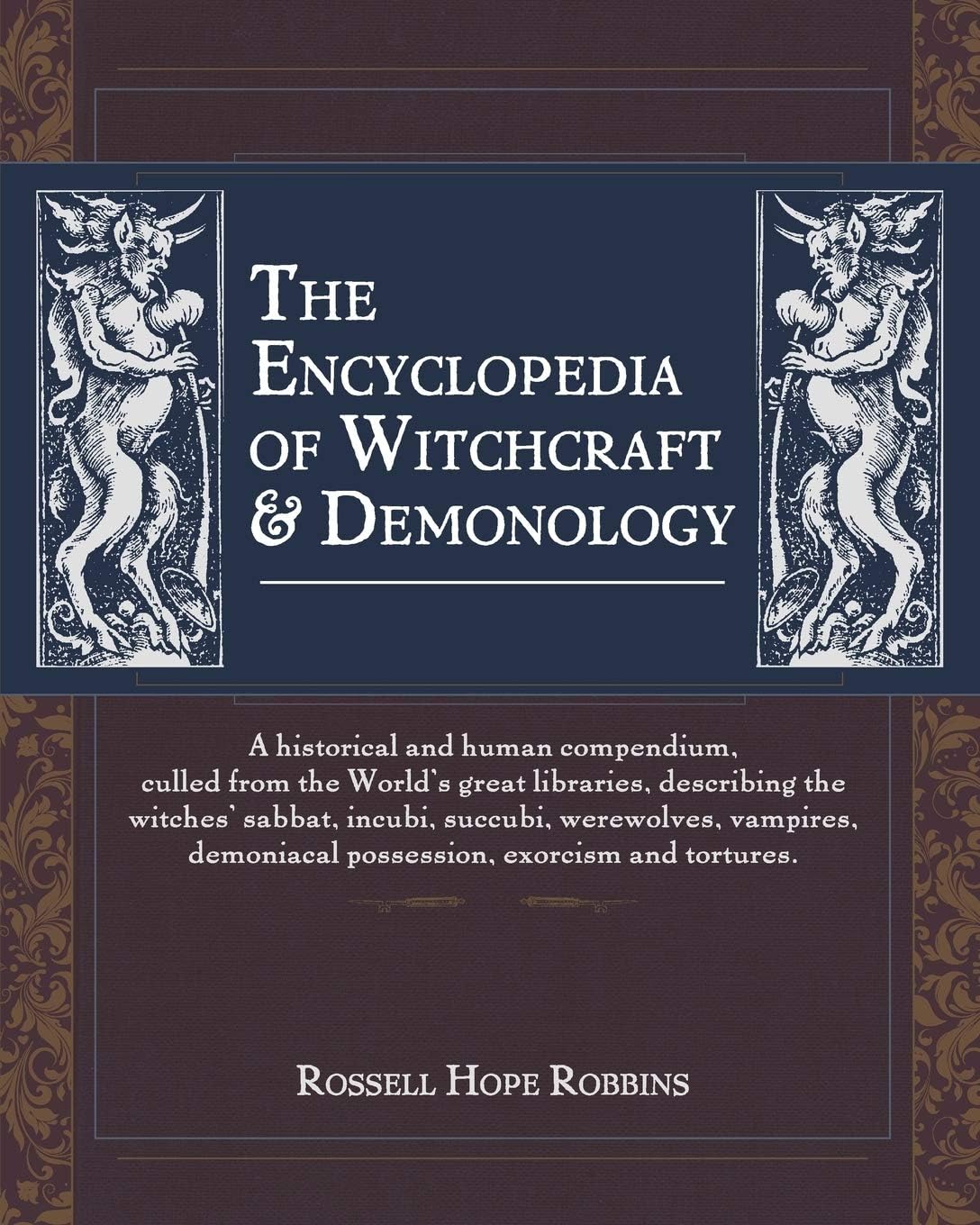
The Encyclopedia Of Witchcraft & Demonology
Product ID: 87080779
Buy anything from 5,000+ international stores. One checkout price. No surprise fees. Join 2M+ shoppers on Desertcart.
Desertcart purchases this item on your behalf and handles shipping, customs, and support to Macau.
With research sourced by the world's greatest libraries, Robbins has compiled a rational, balanced history of 300 years of horror concentrated primarily in Western Europe. Spanning from the 15th century through the 18th century, the witch-hunt frenzy marks a period of suppressed rational thought; never before have so many been so wrong. To better understand this phenomenon, Robbins examines how the meaning of "witch" has evolved and exposes the true nature of witchcraft—a topic widely discussed in popular culture, though remarkably misunderstood. First published in 1959, Robbins' encyclopedia remains the most authoritative and comprehensive body of information about witchcraft and demonology ever compiled in a single volume. Lavishly acclaimed in academic and popular reviews, this full-scale compendium of fact, history, and legend covers about every phase of this fascinating subject from its origins in the medieval times to its last eruptions in the 18th century. Accompanying the text are 250 illustrations from rare books, contemporary prints, and old manuscripts, many of which have been published here for the first time. Rossell Hope Robbins (1912-1990), an acknowledged authority on witchcraft, was one of the half-dozen Americans ever elected Fellow of the Royal Society of Literature. He authored over a dozen books and nearly 200 articles, including the definitive introduction to the catalogue of the Witchcraft Collection at Cornell University Library in 1979. He was a Commonwealth Fellow, Canada Council Professor, and he received grants from the Modern Language Association of America and from the American Council of Learned Societies. He also served as Chairman of the Middle English Division of the MLA, President of the Medieval Club of New York, research associate at Harvard and Columbia Universities. Robbins has lectured extensively on medieval topics and witchcraft at universities throughout the world. Review: Essential - If you have any serious interest in the history of witchcraft, then you will want to own this book. Professor Robbins consulted no less than 1140 sources (and they are listed and numbered in the ‘Select Bibliography’ at the end of his book), and condensed the information into this remarkable single-volume work of reference. I wholeheartedly approve of the way in which Professor Robbins approaches his subject. He recounts the facts about the witchcraft cases as they were originally recorded, often in considerable detail. He examines these original accounts critically, and exposes the fallacies and weaknesses inherent in them – for Professor Robbins does not consider that the evidence for any of the accounts of a society of witches who had entered into a pact with the Devil and who attended sabbats will stand up to scrutiny. I am pleased to say that he also cites the sources which he has used for each article in his encyclopaedia (although this sometimes does not work as well as might be expected, when the authority which he cites is a collection of documents and he does not specify exactly which document was the source of his information). While a substantial part of the book is devoted to articles about outbreaks of witchcraft, there are also articles about individuals who were prominent in the history of witchcraft and demonology (including those who were influential in developing the arguments for and against the existence of a society of Devil-worshipping witches) and articles about subjects such as the Black Mass, exorcism, familiars, the pact with the Devil, the sabbat, storm-raising and transvection. I should stress that Professor Robbins makes a strong distinction between witchcraft and sorcery. He uses the term ‘witchcraft’ to mean the imaginary cult of Devil-worshipping witches which was the object of the witch-hunting craze of the 16th and 17th Centuries. He uses the term ‘sorcery’ to mean “an attempt to control nature, to produce good or evil results, generally by the aid of evil spirits”. Now, the terminology employed in the study of the history of witchcraft is notoriously problematic, and you may not agree with Professor Robbins’s choice of words – but his distinction between the people who were labelled as Devil-worshippers by the witch-hunters and those who really believed that they were practitioners of magic (whether for good or for ill) is a valid one. Finally, there is the question of which edition of this wonderful book you should acquire. I have no personal experience of the Girard & Stewart edition but, having seen a review on the desertcart site which was highly critical of the print quality of that edition, I tracked down a second-hand copy of the 1959 Spring Books edition published by Hamlyn (Fifth impression, 1968). I am happy to say that the print quality of my copy is very good, even after so many years. Review: I love it - I haven’t fully started reading it, but I have seen good reviews and look forward to using it in the near future.
| Best Sellers Rank | 4,840,714 in Books ( See Top 100 in Books ) 490 in Satanism & Demonology 2,622 in Religious Studies Encyclopaedias 7,078 in New Age Occultism |
| Customer Reviews | 4.7 out of 5 stars 498 Reviews |
L**X
Essential
If you have any serious interest in the history of witchcraft, then you will want to own this book. Professor Robbins consulted no less than 1140 sources (and they are listed and numbered in the ‘Select Bibliography’ at the end of his book), and condensed the information into this remarkable single-volume work of reference. I wholeheartedly approve of the way in which Professor Robbins approaches his subject. He recounts the facts about the witchcraft cases as they were originally recorded, often in considerable detail. He examines these original accounts critically, and exposes the fallacies and weaknesses inherent in them – for Professor Robbins does not consider that the evidence for any of the accounts of a society of witches who had entered into a pact with the Devil and who attended sabbats will stand up to scrutiny. I am pleased to say that he also cites the sources which he has used for each article in his encyclopaedia (although this sometimes does not work as well as might be expected, when the authority which he cites is a collection of documents and he does not specify exactly which document was the source of his information). While a substantial part of the book is devoted to articles about outbreaks of witchcraft, there are also articles about individuals who were prominent in the history of witchcraft and demonology (including those who were influential in developing the arguments for and against the existence of a society of Devil-worshipping witches) and articles about subjects such as the Black Mass, exorcism, familiars, the pact with the Devil, the sabbat, storm-raising and transvection. I should stress that Professor Robbins makes a strong distinction between witchcraft and sorcery. He uses the term ‘witchcraft’ to mean the imaginary cult of Devil-worshipping witches which was the object of the witch-hunting craze of the 16th and 17th Centuries. He uses the term ‘sorcery’ to mean “an attempt to control nature, to produce good or evil results, generally by the aid of evil spirits”. Now, the terminology employed in the study of the history of witchcraft is notoriously problematic, and you may not agree with Professor Robbins’s choice of words – but his distinction between the people who were labelled as Devil-worshippers by the witch-hunters and those who really believed that they were practitioners of magic (whether for good or for ill) is a valid one. Finally, there is the question of which edition of this wonderful book you should acquire. I have no personal experience of the Girard & Stewart edition but, having seen a review on the Amazon site which was highly critical of the print quality of that edition, I tracked down a second-hand copy of the 1959 Spring Books edition published by Hamlyn (Fifth impression, 1968). I am happy to say that the print quality of my copy is very good, even after so many years.
D**D
I love it
I haven’t fully started reading it, but I have seen good reviews and look forward to using it in the near future.
A**R
Excellent resource. The information in it is purely historical
Excellent resource. The information in it is purely historical. It has plenty of illustrations. Somehow it doesn't read like an encyclopaedia. I read it from start to finish just as I would a book of short stories.
N**R
Fast delivery
Excellent book. Very pleased with it.
M**Y
Happy
A very old book and only a little related to my dissertation, so cant say I love the book :) not sure where the book came from, but took a long time to get here. If overseas good, if in England very long time to wait. As described.
M**N
Five Stars
Good
R**S
Five Stars
Brilliant
C**T
One of my favourite books on the witch hunt mania
Full of historical information and illustrations. A very detailed book. I have read this many times throughout my life. A good resource
A**D
Super
Wer sich dafür interessiert, dem kann ich das Buch ans Herz legen
?**.
Thumbs up
Great book. Print is a little small.
A**S
edition grossly overpriced
This is a review of the Girard & Stewart edition NOT the title itself which is an acknowledged classic of its type. This edition (I bought the hardback version) looks as if it was made by having another copy badly photocopied and then scanned. The print is a little blurred and faded; the illustrations are VERY blurred and faded. This is a great pity as Hope Robbins' work needs a real quality edition with crystal clear images. So overall definitely NOT worth the vastly overinflated asking price (currently going on for 50 euro new for the hardback!). I got it substantially discounted and even then the price was a little too high bearing in mind the print quality. A great pity.
D**O
A Most Bewitching Book
Dr. Rossell Hope Robbins, who died in 1990, was a Cambridge-educated academic and the leading authority on the subject of witchcraft as a historical and cultutal concept. This volume, first published in 1959 and reprinted several times over the past 60 years, is the most comprehensive collection of information on the subject, drawing upon facts and illustrations Dr. Robbins had gathered and culled from thousands of ancient manuscripts, grimoires, trial records for people accused of witchcraft and sorcery, biographical accounts, descriptions of various demons, and murders attributed to werewolves and vampires. He is interested, moreover, in the evil of using accusations of witchcraft-- an umbrella term encompassing a number of pagan spiritual systems he collectively calls "delusions"-- as a justification for torturing and killing many innocent people, raising, I think, an intriguing point. For anyone interested in the topic of evil-- not the moral kind that generally interests me and other researchers and authors on the subject, but the preternatural, metaphysical kind-- this is an essential volume. Five stars for superb scholarship and nerdy over-inclusiveness.
C**N
Lujo de detalles
Un libro grande y extenso con todo lujo de detalles. Diferentes puntos de vista religiosos. Además incluye archivos y documentos con fechas de datación desconocidas, donde se incluyen escritos de acusadores y acusados. Pequeños dibujos y grabados en las páginas, que mezclan diferentes épocas y que aunque no tienen muy buena calidad, este último detalle, no le resta importancia alguna a este genial libro en inglés, que hoy guardo como joya en mi biblioteca.
Trustpilot
3 weeks ago
2 weeks ago